Showing posts with label architecture. Show all posts
Friday, December 13, 2013
Sihanoukville Railway Station
The Sihanoukville Railway Station was designed and built by Georges Kondracki and a German engineer in the late 1960s. It was the last of three major train stations built as part the construction of the Phnom Penh - Sihanoukville rail link constructed between 1960 and 1969. The Sihanoukville Railway Station was scheduled to be completed in 1967 but was not completed and inaugurated until 1969.
Saturday, May 11, 2013
Bridge Tower Building
Bridge Tower Building, 2008
Bridge Tower Building and Treasury Bridge (Naga Bridge), circa 1900
Originally constructed in the early 1890s, Phnom Penh's old Bridge Tower Building stood distinctively at the corner of Norodom Blvd and Street 108 until last year when it was razed to the ground by the property owner (1). It would have been nice to see this unique piece of Phnom Penh's architectural heritage preserved and restored, but it was in extremely poor condition and would have cost a small fortune to save, if possible at all. According to the Cambodia Daily (2), at the time it was razed the owner pledged to replace it with some sort of replica, but that has yet to come to pass. Yesterday the Cambodia Daily (2) reported a new building had been constructed on the site - a garishly colored piece of architectural lint slated to be an office supply store (see last photo). Regarding the promise of a replica the owner of the property plead lack of funds in yesterday's article, saying she simply couldn't afford to build a replica at this time, hinting it may happen at some time in the future. I won't be holding my breath.
As distinctive as the Bridge Tower was, there seems to be very little published on its history and fewer historic photos than other buildings and bridges of the time. It was a remnant of the Belle Époque and a particularly productive decade in the early colonial development of Phnom Penh.
In the early 1890s Résident-supérieur Huyn de Verneville initiated several public works projects in Phnom Penh including draining wetlands by the construction of an enclosing canal around the European District centered on Wat Phnom. One leg of the canal ran about 1km from the Tonle Sap River along what is now Street 106/108. Three bridges were built over the canal including the Treasury Bridge (aka the 'Naga Bridge', so named for the naga ballustrades), which linked the European district with the Chinese/Khmer districts and formed the beginning of what is now Norodom Blvd. The canal and Treasury Bridge were completed in1893 (3). The Bridge Tower Building sat at the south end of the Treasury Bridge and was probably constructed at about the same time. Other surviving buildings of the same period include the Treasury Building on Street 106 (namesake of the Treasury Bridge,) the Post Office and the Central Police Station next to the Post Office.
The canals were filled and the bridges dismantled in the early 1930s. The canal with the Treasury Bridge became the boulevard park separating Streets 106 and 108. In 2006, naga balustrades were erected along the short stretch of Norodom Blvd between Streets 106 and 108, creating a faux Naga Bridge where the original sat.
As distinctive as the Bridge Tower was, there seems to be very little published on its history and fewer historic photos than other buildings and bridges of the time. It was a remnant of the Belle Époque and a particularly productive decade in the early colonial development of Phnom Penh.
In the early 1890s Résident-supérieur Huyn de Verneville initiated several public works projects in Phnom Penh including draining wetlands by the construction of an enclosing canal around the European District centered on Wat Phnom. One leg of the canal ran about 1km from the Tonle Sap River along what is now Street 106/108. Three bridges were built over the canal including the Treasury Bridge (aka the 'Naga Bridge', so named for the naga ballustrades), which linked the European district with the Chinese/Khmer districts and formed the beginning of what is now Norodom Blvd. The canal and Treasury Bridge were completed in1893 (3). The Bridge Tower Building sat at the south end of the Treasury Bridge and was probably constructed at about the same time. Other surviving buildings of the same period include the Treasury Building on Street 106 (namesake of the Treasury Bridge,) the Post Office and the Central Police Station next to the Post Office.
The canals were filled and the bridges dismantled in the early 1930s. The canal with the Treasury Bridge became the boulevard park separating Streets 106 and 108. In 2006, naga balustrades were erected along the short stretch of Norodom Blvd between Streets 106 and 108, creating a faux Naga Bridge where the original sat.
The tower
2006
Collapsed roof
Window
Replacement building on the site of the former Bridge Tower Building. Today.
(1) 'After Demolition, Colonial Building Site to Lie Dormant', The Cambodia Daily, June 20, 2012
(2) 'Store Built in Place of Colonial Building Decried', The Cambodia Daily, May 9, 2013
(3) Phnom Penh Then and Now by Michael Igout, White Lotus Co, 1993
K440: Another Old Building Disappears
Phnom Penh Places Blog: Le Pont Des Najas or The Naga Bridge
1920 Map of Phnom Penh showing the canals around the European District
Tuesday, December 25, 2012
Wednesday, August 15, 2012
Saturday, December 11, 2010
Floor Tiles
Antique floor tiles of a French colonial-era building on Post Office Square in Phnom Penh, at the Golden Mermaid restaurant. Note the deep colors and fleur-de-lis not found in most modern tiles used in Cambodian buildings. Such tiles are often ripped up and discarded when an old building is refurbished, destroying a bit of history in the process. The proprietor of the Golden Mermaid was thoughtful enough to preserve the original tiles in place and even incorporate some of the broken tiles into the design of the bar counter.
Thursday, November 4, 2010
Pa Cha
Crematorium at Wat Ounalom, next to Phsar Kandal off of Street 154, now gone.
Cambodian Buddhist tradition is to cremate the dead. Major Buddhist pagodas in Cambodia often have a traditional crematorium (pa cha) on the grounds. Over the last year most of Phnom Penh's crematoria were shuttered and demolished. After many years of planning, the city implemented the closure of the crematoria within the city, citing air quality and traffic control reasons. (See 'Municipality prepares to move cremations outside the capital.') As the city has developed and filled in, many of these crematoria were within a few tens of meters of restaurants, schools, businesses and the like where wisps of smoke drifting by were less than welcome. The crematorium pictured above sat at the back of the Wat Ounalom pagoda grounds and was something of a minor landmark, overlooking the market intersection of Street 13 and Street 154. It was demolished earlier this year, now an empty lot within the pagoda grounds. For most of its existence it sat opposite the site of the old French prison T3, which was demolished several years ago.
Thursday, September 23, 2010
Towering Phnom Penh
Skyscrapers rise along Monivong Blvd., two of several under construction and more planned, threatening to transform Phnom Penh from a quaint, low-rise, distinctively Cambodian city into a generic, skyless, gray and glass metropolis that could be anywhere in the world.
Wednesday, September 15, 2010
St Michael Church, Sihanoukville
By comparison to most Cambodian provincial capitals, many with histories counted in the centuries, Sihanoukville is a very new city. Nothing but jungle and a few fishing camps prior to the 1950s, the town was first established in 1960 as an adjunct to the newly constructed deep water port. Few of Sihanoukville’s historically or architecturally significant buildings from the period between 1955 and 1970 still exist. In fact, as Sihanoukville only saw about 10-15 years of development before the country descended into war, there weren’t that many in the first place. Most of the original public and port buildings, the ritzy beach villas, and even the King’s residence have all succumbed to the years. Amongst few others, significant early structures that still remain include The Independence Hotel, the train station, Wat Leu, staff housing on Victory Beach and one building that is probably the least likely of all the structures in Sihanoukville to have survived the last 35 years, St Michael Catholic Church.
St Michael Church of Sihanoukville is almost completely unique amongst Catholic churches in Cambodia. Under Khmer Rouge rule from 1975-1979, religion was outlawed and churches in particular were targeted for destruction, both as religious structures and as symbols of the bourgeois West. Most churches, including the grand Cathedral in Phnom Penh, were leveled. Only two of Cambodia's 73 churches survived the Khmer Rouge period and St. Michael of Sihanoukville was one of those two, the other being Carmelite Chapel in Phnom Penh.
I drove up to St Michael Church day before yesterday to check the state of things and take some photos. It is an old and intriguing looking place, at least by Sihanoukville standards. The church occupies a prominent piece of land located near the entrance to the town, originally donated to the Church back in the late 50s by King Norodom Sihanouk. Set back from the road a bit and elevated at the base of Sihanoukville Mountain, the church faces the sea and commands a sweeping view of the area. The church building bears a unique architectural form, like a terracotta A-frame, tepee-shaped at first glance, seemingly neither wholly Cambodian nor western in artistic origin. According to official records* St Michael Church was inaugurated in 1962, though actually constructed in 1960. The church building was designed by French Catholic priest Father Ahadobery with the assistance of famed Cambodian architect Vann Molyvann.
I first visited St Michael Church back in 1995, trying to gather some information on the place, just as a matter of curiosity. There I met an accommodating old priest who tried to answer my questions, though it took some significant linguistic gymnastics to do it.
On that first visit, when I arrived the gates were open but the church closed and the grounds seemingly deserted. Uninvited, I wandered about taking photos until a couple of nicely dressed kids walked up and with very limited English asked if I wanted to meet "Ta." 'Ta' is a Khmer honorific for a respected elder person, and though I couldn't be certain who they were talking about, it sounded like a step in the right direction. I first apologized for my poor Khmer and then asked if I might please meet ‘Ta.’
The kids disappeared and a few minutes later an old white man emerged from a nearby house, an ancient man really, perhaps an octogenarian. The children followed beside him and presented him to me as “father.” The old man smiled and greeted me in French. A difficult start. I speak a little French, but not much, really only enough to rehearse the niceties and then ask if he could speak English. "Non," he said apologetically. After another abortive attempt at speaking French, I switched to Khmer on the chance he might understand. His eyes brightened and he responded in clean fluent Cambodian, much better than mine. My Khmer at the time was limited, but sufficient. Now we had a common ground. As we spoke together the kids giggled at the two barang forced to speak Khmer in order to communicate with each other. They really couldn’t get enough of us, snickering on the sidelines for the next hour.
The old man told me his name, but I was simply unable to understand his pronunciation, and never did get it clear, which I deeply regret. In hindsight I suspect I know who he was though I am hesitant to say without further confirmation.
He said that he had been the priest there at St. Michael Church since the late 1950s, and had been in Cambodia for at least a decade or two before that. Kindly and accommodating gentleman that he was, he proceeded to give me a tour of the grounds and the church and told me the story of St Michael Church as he knew it.
As we walked around the building he emphasized that the church reflected a seafaring theme appropriate to a port town, noting that it was named for St. Michael the patron saint of sailors, and more importantly that the nautical motif was embodied in the design and even spirit of the church. He led me to the back and pointed out the ‘ship’s sail’ brick latticework that made up the entire rear wall. He then backed us up away from the building so as to allow a wider view. Sweeping his hands in the air he traced out the boat shaped brickwork along the sides. “Bateau! K’pal Tuk!...Voila!” he declared. I honestly hadn’t notice before, unobservant as I apparently am, but once he laid it out for me it became quite obvious. Viewed from the side the church is a boat and the walls its sails.
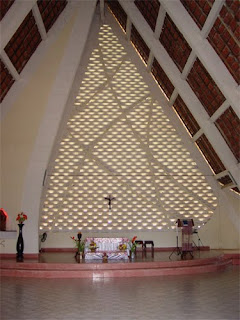
Hot in the open sun, we went inside, into the church. The interior was and is strikingly spartan, but to impressive effect. It was not unlike the interior of a Cambodian Buddhist pagoda devoid of the Buddha image and its accouterments. The church is single room, a largely unfettered space, without pews, chairs or ornate alter, only a small lectern, the crucifix and some flowers, yet with a open ceiling, soaring roof and towering sail shaped brick latticework at both ends, allowing light and a gentle breeze to enter. For the high ceiling and constant breeze it was surprising cool inside, even on a hot day. Like a boat, the space was open but contained. Come Sundays the Catholic community of Sihanoukville, all in a boat together in this church. The space was simple but captivatingly complete, as if the design and the presence of the essentials said "enough." No further adornment required. The air was one of unembellished serenity, born not of austerity but a sort of aesthetic minimalism, an ideal place in which to meditate on God.
According to the priest the church has seen it share of fair and very troubled times.
On his history of St Michael Church, from its birth back when the French were still building the port until the beginning of the Khmer Rouge period a decade and a half later, St. Michael served the local Catholic community, primarily French (in the early days) and other foreigners, particularly ethnic Vietnamese which has always made up the bulk of the congregation. There are in fact very few Khmer Catholics in Cambodia. Even after centuries of missionary work, the Catholic Church has had precious little luck converting Khmers to the faith, capturing well less than 1% of the population for their efforts. On the other hand, more than 7% of the comparative large population of Vietnam is Catholic, most of them in the south, from which many of the ethnic Vietnamese in Cambodia originate.
According to the priest during the Khmer Rouge regime from 1975-79, St Michael Church was used as a jail and an animal shed, but unlike almost every church in Cambodia, it escaped destruction. He speculated that perhaps the church’s very unchurch-like appearance saved it. Devoid of its function as a church, it did not look like religious structure and, unlike other more traditionally designed Catholic churches around the country, St Michael did not seem an obvious symbol of the bourgeoisie that the Khmer Rouge were trying to destroy.
The priest claimed that after the fall of the Khmer Rouge in 1979 the church saw very little ascent in its station, and was used as a storage building of some sort through the 1980s into the 90s. He said that St. Michael was not reopened as a church until 1993 during the UN administration of Cambodia and has been operating continuously as a Catholic church ever since. As of today… well… as of day before yesterday when I was there, it appeared very little different than it did when I was first visited in 1995. In fact I have visited the church more than a dozen times in the last decade and a half and it has remained essentially the same save a few details. Now there are more out buildings, a new terrace and gazebo in front of the church, a bigger crucifix inside and small pictures on the walls marking the Stations of the Cross, but that is all that can be counted changed in the last 15 years.
That said, I did notice something on this visit I had never noticed before. Perhaps it was always there and I just missed it, or perhaps it is a recent addition. It is something I don’t fully understand.
Behind the church, on a lush garden path leading up the mountain, is a shrine of some sort to the Virgin Mary, but a shrine unlike I have seen before. At a distance I first guessed it a traditional Cambodian spirit house. But on closer inspection I could see an image of the Virgin atop and the shrine appeared more a representation of a cave than a spirit house. Perhaps a model of the cave tomb of Jesus? Or a Cambodian inspired house for the spirit of Mary? Or something else. I am not sure and there was no-one around to ask. A question for my next visit to St Michael.
*For more on the architecture of St Michael see Building Cambodia: 'New Khmer Architecture' 1953 - 1970 by Helen Grant-Ross and Darryl Collins.
St Michael Church is located in Sihanoukville city at the base of Sihanoukville Mountain, just off the corner of Boray Kamakor and Kampuchea-Soviet Mittapheap Streets.
St Michael Church of Sihanoukville is almost completely unique amongst Catholic churches in Cambodia. Under Khmer Rouge rule from 1975-1979, religion was outlawed and churches in particular were targeted for destruction, both as religious structures and as symbols of the bourgeois West. Most churches, including the grand Cathedral in Phnom Penh, were leveled. Only two of Cambodia's 73 churches survived the Khmer Rouge period and St. Michael of Sihanoukville was one of those two, the other being Carmelite Chapel in Phnom Penh.
I drove up to St Michael Church day before yesterday to check the state of things and take some photos. It is an old and intriguing looking place, at least by Sihanoukville standards. The church occupies a prominent piece of land located near the entrance to the town, originally donated to the Church back in the late 50s by King Norodom Sihanouk. Set back from the road a bit and elevated at the base of Sihanoukville Mountain, the church faces the sea and commands a sweeping view of the area. The church building bears a unique architectural form, like a terracotta A-frame, tepee-shaped at first glance, seemingly neither wholly Cambodian nor western in artistic origin. According to official records* St Michael Church was inaugurated in 1962, though actually constructed in 1960. The church building was designed by French Catholic priest Father Ahadobery with the assistance of famed Cambodian architect Vann Molyvann.
I first visited St Michael Church back in 1995, trying to gather some information on the place, just as a matter of curiosity. There I met an accommodating old priest who tried to answer my questions, though it took some significant linguistic gymnastics to do it.
On that first visit, when I arrived the gates were open but the church closed and the grounds seemingly deserted. Uninvited, I wandered about taking photos until a couple of nicely dressed kids walked up and with very limited English asked if I wanted to meet "Ta." 'Ta' is a Khmer honorific for a respected elder person, and though I couldn't be certain who they were talking about, it sounded like a step in the right direction. I first apologized for my poor Khmer and then asked if I might please meet ‘Ta.’
The kids disappeared and a few minutes later an old white man emerged from a nearby house, an ancient man really, perhaps an octogenarian. The children followed beside him and presented him to me as “father.” The old man smiled and greeted me in French. A difficult start. I speak a little French, but not much, really only enough to rehearse the niceties and then ask if he could speak English. "Non," he said apologetically. After another abortive attempt at speaking French, I switched to Khmer on the chance he might understand. His eyes brightened and he responded in clean fluent Cambodian, much better than mine. My Khmer at the time was limited, but sufficient. Now we had a common ground. As we spoke together the kids giggled at the two barang forced to speak Khmer in order to communicate with each other. They really couldn’t get enough of us, snickering on the sidelines for the next hour.
The old man told me his name, but I was simply unable to understand his pronunciation, and never did get it clear, which I deeply regret. In hindsight I suspect I know who he was though I am hesitant to say without further confirmation.
He said that he had been the priest there at St. Michael Church since the late 1950s, and had been in Cambodia for at least a decade or two before that. Kindly and accommodating gentleman that he was, he proceeded to give me a tour of the grounds and the church and told me the story of St Michael Church as he knew it.
As we walked around the building he emphasized that the church reflected a seafaring theme appropriate to a port town, noting that it was named for St. Michael the patron saint of sailors, and more importantly that the nautical motif was embodied in the design and even spirit of the church. He led me to the back and pointed out the ‘ship’s sail’ brick latticework that made up the entire rear wall. He then backed us up away from the building so as to allow a wider view. Sweeping his hands in the air he traced out the boat shaped brickwork along the sides. “Bateau! K’pal Tuk!...Voila!” he declared. I honestly hadn’t notice before, unobservant as I apparently am, but once he laid it out for me it became quite obvious. Viewed from the side the church is a boat and the walls its sails.
Hot in the open sun, we went inside, into the church. The interior was and is strikingly spartan, but to impressive effect. It was not unlike the interior of a Cambodian Buddhist pagoda devoid of the Buddha image and its accouterments. The church is single room, a largely unfettered space, without pews, chairs or ornate alter, only a small lectern, the crucifix and some flowers, yet with a open ceiling, soaring roof and towering sail shaped brick latticework at both ends, allowing light and a gentle breeze to enter. For the high ceiling and constant breeze it was surprising cool inside, even on a hot day. Like a boat, the space was open but contained. Come Sundays the Catholic community of Sihanoukville, all in a boat together in this church. The space was simple but captivatingly complete, as if the design and the presence of the essentials said "enough." No further adornment required. The air was one of unembellished serenity, born not of austerity but a sort of aesthetic minimalism, an ideal place in which to meditate on God.
According to the priest the church has seen it share of fair and very troubled times.
On his history of St Michael Church, from its birth back when the French were still building the port until the beginning of the Khmer Rouge period a decade and a half later, St. Michael served the local Catholic community, primarily French (in the early days) and other foreigners, particularly ethnic Vietnamese which has always made up the bulk of the congregation. There are in fact very few Khmer Catholics in Cambodia. Even after centuries of missionary work, the Catholic Church has had precious little luck converting Khmers to the faith, capturing well less than 1% of the population for their efforts. On the other hand, more than 7% of the comparative large population of Vietnam is Catholic, most of them in the south, from which many of the ethnic Vietnamese in Cambodia originate.
According to the priest during the Khmer Rouge regime from 1975-79, St Michael Church was used as a jail and an animal shed, but unlike almost every church in Cambodia, it escaped destruction. He speculated that perhaps the church’s very unchurch-like appearance saved it. Devoid of its function as a church, it did not look like religious structure and, unlike other more traditionally designed Catholic churches around the country, St Michael did not seem an obvious symbol of the bourgeoisie that the Khmer Rouge were trying to destroy.
The priest claimed that after the fall of the Khmer Rouge in 1979 the church saw very little ascent in its station, and was used as a storage building of some sort through the 1980s into the 90s. He said that St. Michael was not reopened as a church until 1993 during the UN administration of Cambodia and has been operating continuously as a Catholic church ever since. As of today… well… as of day before yesterday when I was there, it appeared very little different than it did when I was first visited in 1995. In fact I have visited the church more than a dozen times in the last decade and a half and it has remained essentially the same save a few details. Now there are more out buildings, a new terrace and gazebo in front of the church, a bigger crucifix inside and small pictures on the walls marking the Stations of the Cross, but that is all that can be counted changed in the last 15 years.
That said, I did notice something on this visit I had never noticed before. Perhaps it was always there and I just missed it, or perhaps it is a recent addition. It is something I don’t fully understand.
Behind the church, on a lush garden path leading up the mountain, is a shrine of some sort to the Virgin Mary, but a shrine unlike I have seen before. At a distance I first guessed it a traditional Cambodian spirit house. But on closer inspection I could see an image of the Virgin atop and the shrine appeared more a representation of a cave than a spirit house. Perhaps a model of the cave tomb of Jesus? Or a Cambodian inspired house for the spirit of Mary? Or something else. I am not sure and there was no-one around to ask. A question for my next visit to St Michael.
*For more on the architecture of St Michael see Building Cambodia: 'New Khmer Architecture' 1953 - 1970 by Helen Grant-Ross and Darryl Collins.
St Michael Church is located in Sihanoukville city at the base of Sihanoukville Mountain, just off the corner of Boray Kamakor and Kampuchea-Soviet Mittapheap Streets.
Subscribe to:
Comments (Atom)


