Friday, April 29, 2011

Juxtaposition

From the front page of yesterday's The Nation (one of Thailand's main English language newspapers.)


Interesting choice and placement of photos. To the left, armed and uniformed Cambodian soldiers aiming their rifles to the right as if ready to shoot. Immediately to the right, a separate photo of unarmed Thai civilians ducking for cover. From the juxtaposition of photos it almost seems that Cambodian soldiers are ready to fire on Thai civilians. Though both the comparative sizes of the subjects and the caption beneath the photos make it clear this is not what is actually happening, this particular juxtaposition would seem...well...suggestive. I guess it comes as no surprise that a Thai newspaper would have a Thai lean. But I found this particular manipulation heavy-handed enough to roll my eyes a bit.

Saturday, April 23, 2011

Snub?

In an article titled, "'Sorry, I'm busy!' King of Cambodia snubs Royal Wedding for 'something more important'" the online version of the British newspaper the Daily Mail yesterday bemoaned Cambodian King Sihamoni's "snub" to the British Prince, supposedly committed by turning down an invitation to the wedding of Prince William and Kate Middleton. The also article notes that "His father Sihanouk refused to attend Princess Alexandra's wedding in 1963 after being told he would not get a guard of honour and could not stay at Windsor Castle," perhaps suggesting that the then King Sihanouk felt he was not afforded the respect and regard that he was due as a king.

Accompanying the article was a photo labeled "No thank you: King Sihamoni of Cambodia has turned down…etc." Except the photo was not of King Sihamoni but of retired King Sihanouk.


Ooops?

The Mail has since corrected the apparent error, maintaining the same caption but replacing the photo of retired King Sihanouk with one of King Sihamoni.

Saturday, April 16, 2011

Elephants Suffering

Prey Veng Zoo - 2003
Back in 2003 I visited a small, little known zoo in central Prey Veng province. Most of the cages were empty and the few remaining animals were in terrible shape. At the time I was told that the zoo was slowly shutting down and that most of the animals had been transferred to a new zoo from the same owner, located outside of Kampot town near the Teuk Chhou rapids - a popular destination for local tourists. So a couple of months later I went to check out the new zoo in Kampot – the Toek Chhou Zoo.

At the time the Toek Chhou Zoo didn't look all that bad, at least as Southeast Asian zoos go. By western standards the animals were kept in abysmal little enclosures and treated more as amusements than living creatures, but that is something of the norm at zoos in Southeast Asia. That aside, the animals appeared to be healthy and properly fed, especially as compared to some other zoos in the region. But since then, things have changed considerably. Like the old Prey Veng zoo, the Toek Chhou Zoo has fallen into disrepair and many of the animals are horribly neglected.

The dismal state of the zoo has been well-reported of late. I first read of it on Khmer440 back in early March 2011. Shortly thereafter the Phnom Penh Post picked up the story, doing an in-depth report on the miserable state of the zoo and its charges:

The zoo of horrors
27 March 2011, The Phnom Penh Post
Kampot province’s Teuk Chhou zoo is a place where no one seems to care about how animals are treated, a place where animals are kept in cramped, roofless shelters and rely largely on food from tourists to survive…

It has no roofed-in shelters as the wet season approaches or even any semblance of a natural habitat for the animals as witnessed during a visit over the weekend.

Orangutans and baboons swing restlessly back and forth between the steel bars of their three-metre square enclosures, while eagles and other birds of prey scarcely have enough space to spread their wings, let alone fly – that is if they are one of the lucky few whose wings aren’t badly damaged.

The state of the zoo’s two elephants is heartbreaking, as their emaciated necks stretch through the thick bars of their enclosure in an attempt to eat blades of grass, seemingly one of their few sources of nourishment.

The skeletal bodies of the two animals are hard to ignore and the two have become aggressive, lashing out at visitors who step near their enclosure…

Moved by the report in the Post, particularly by the sad state of the large mammals, many have stepped forward with offers of possible assistance, both financial and expert, as reported in a follow-up by the Post on April 5:

Zoo owner open to NGO help
05 April 2011, The Phnom Penh Post

Last month, The Post gave an in-depth view into the deplorable conditions at the zoo, which is unable, due to an apparent shortage of funding, to provide adequate food and water for the animals.

Offers of help from NGOs, private companies and individuals have since been made.

Nick Marx, wildlife rescue director at the NGO Wildlife Alliance, said yesterday: “I will do whatever I can to ensure the safety of the animals, and to work with Nhim Vanda and any other supporters that want to help financially better the lives of animals at Teuk Chhou zoo.

“Wildlife Alliance has wanted to help for a long time and I’m really happy [to] do whatever is required.”

The zoo has also caught the attention of a member of the Royal Family, Princess Norodom Sita, who was shocked at the treatment of the animals but hopes to raise support for a solution in the near future...

In light of these reports, and with the memory of the sorry conditions of the old Prey Veng zoo still in mind, I decided to go see for myself what was up in Kampot. I visited to the Toek Chhou Zoo a couple of days ago, spending several hours there. It was Khmer New Year and they were doing a moderately brisk business. It wasn’t crowded but there were dozens of people touring the zoo at the same time I was there – all Cambodians, no foreigners that I saw.

I walked the entire place and found it to be a pretty mixed bag. The grounds were quite run down. The kid's rides were in a state of complete disrepair, but most of the statues that adorn the park were bright and freshly painted. Some zoo animals were fairing better than others. Some looked fed, others much less so. The birds appeared fairly well miserable in their tiny cages, as did the great apes and monkeys. The big cats appeared gaunt but still active. The elephants in particular were a truly pitiful sight.


Female and male Asian elephants at Toek Chhou Zoo, Kampot

Water pit
There is a pair of them there - Asian elephants, a male and female. Both are in very rough shape, withered for lack of food and seemingly unhealthy. Bones protruded under their loose skin, especially along their shoulders, neck and back. They seemed lethargic and sad wandering about their barren pen. There was no food or anything to graze in the enclosure, only dirt, dead leaves and feces. A slime covered pool seemed to be the only water source and a small roofed area just big enough to fit the two was their only possible escape from the sun. It was a harsh, empty, desert-like environment for animals meant to live in a green and shaded tropical jungle. To be honest I’ve seen elephants treated worse in Thailand, but that did nothing to reduce the shock of seeing these magnificent animals reduced to such a deplorable state. I am not a zoologist or vet and am not qualified to assess the health of zoo animals, but it seemed fairly well obvious to my untrained eye that these animals weren’t just unhappy and deprived but were and are suffering.

Elephant pen
Apparently I was not alone in my inexpert assessment. As I stood there, a Khmer family wander up to the other side of the pen. They did not look happy with what they saw. The father shook his head in disapproval and I distinctly heard him say “ooooh, skoam, skoam” ('thin, thin.') He quickly led his wife and frowning children away from the sad sight of these anguished animals.

Female elephant stretching for grass to eat
The female elephant continually picked at the well picked over greenery outside the pen, but to no avail. All of the grass was gone, already eaten, leaving only inedible plants and thistle. Disturbed, I went to a nearby drink vendor and asked if there was anywhere I might buy some food for the elephants. First she said "no" but then offered to sell me some of the stock of sugarcane she uses to make drinks for the tourists. I bought about half of it, a full armload of cane which I lugged back to the elephant pen. Apparently I wasn’t the first to do this. When the elephants saw me coming with food they rushed to meet me. I passed them a stalk at a time, trying to distribute it evenly between the two, but the larger, stronger male aggressively stole the female's food. So I gave him a few stalks to keep him busy then lured the other to a different part of the pen to feed her separately. They both ate eagerly.

I hope that was the right thing to do - that it was the right kind of food, etc.


As mentioned above, since the first Post article about the zoo, there has been an outpouring of concern and offers of help from individuals, companies and NGOs, and according to the April 5 Post article (see above,) the zoo owner seems willing to accept assistance. As this is a privately owned zoo in an out-of-the-way place and the help would have to be very long term, I can't imagine how exactly that is going to work. But whatever is to be done, these animals are suffering right now, as I write, and help cannot come too soon for the elephants and the other animals at the zoo.

Female elephant scrounging for grass to eat

Wednesday, April 13, 2011

Signs of Sihanoukville

What's wrong with this picture?...
See the big signs above, directing traffic straight ahead to Otress (sic) Beach and Poymachoav? Did you also see the tiny little 'Do not enter/One-way' sign in the background on the right side of the road. Almost needless to say, the police often work this corner, stopping and 'fining' drivers who make the mistake of following the big sign above. (23 Tola Street, one street back from Ochheuteal Beach) instead of the little sign.


I don't know who they think this 'we' is, or where they got that photo of a clean beach, but they can't be talking about Sihanoukville or the local inhabitants. Or if they are, my first reaction would be, "No you don't, the beaches and town are strewn with trash." Might as well put up a sign saying, 'We always drive safely in Cambodia' or 'Tuk-tuks: "Courtesy" is in our middle name.' But, to trying to give the sign maker the benefit of the doubt, perhaps it is a statement of an unrealized ideal to which they hope people will aspire rather than a statement of fact...maybe. Which leads me to the next sign... 


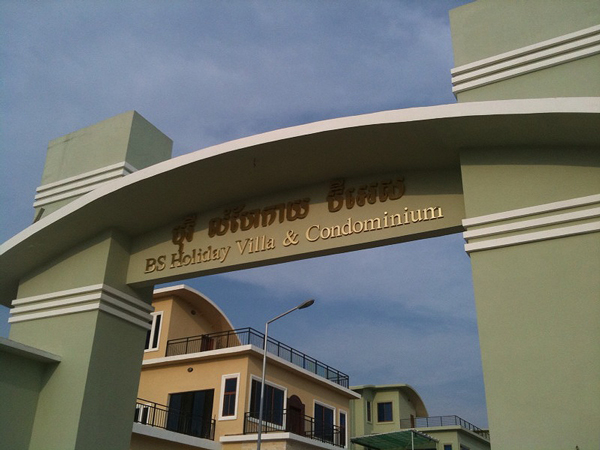
Truth in advertising? 
Sign at the entrance of a new condo development on O-pram road near the Otres turnoff. They are currently advertising for buyers and investors, though I find the name of the place less than confidence inspiring.

Sunday, April 10, 2011

A body on the beach

(Sitting on Ochheuteal Beach in Sihanoukville in one of what must be a thousand beach chairs, I am reminded of an old Ochheuteal story from more than a decade ago. Back in the early/mid 90s Sihanoukville was quite different than now, at least in terms of tourist development. Sokha was the most popular beach in town, Victory second and Ochheuteal usually a distant third, known for its sand fleas and lack of cover from the sun. Serendipity Beach had yet to be invented. There weren't any restaurants or bars, nor even a single grass umbrella on Ochheuteal, just 3km of empty sand and scrub grass, an MP base and the remains of the UNTAC offices. The only hotels on Ochheuteal were the new Seaside and the Eagle's Nest on the beach road, with Cobra Karaoke next door, Claude's restaurant a couple of doors down and Les Feuilles one road back.)

Early January 1995. 9:00am.

Per my usual weekend morning routine, I was sitting in the Eagle's Nest on Ochheuteal Beach road, eating a 'Big Aussie Breakfast' and watching Collin, the proprietor, clean and groom the beach sand in front of the guesthouse. Suddenly he came running up through the scrub grass and burst into the restaurant yelling "there's a body in the water!" I was the only one in the place so we ran back out to the beach together where I saw what looked to be a garbage bag bobbing in the surf. "Are you sure?" I asked. "Yes, yes" he said and waded into the water without hesitation.

He tried to get hold of it to drag it onto the beach, but it was heavy and pieces of flesh dislodged in his hands. He tried again bellowing a disgusted "Eewwooaarrgg" and "fuuuuck me!," but to the same result. Just as he was about to give up, a series of strong waves tossed the body forward where it belly flopped like a limp sack of wet cement onto the damp sand.

So there it was, a body on the beach, dressed in loose-fitting gray fisherman's clothes, not too bloated, but lacking lower legs, hands and a head. Collin was wide-eyed and pacing in place. "You stand here and watch," he ordered, prodding my arm, "I'm going to call the police." He bounded away, hurtling clumps of beach grass as he headed for the guesthouse.

'Did he think somebody would steal it?' I wondered. I wasn't sure what I was supposed to be watching for, but what the hell, it was Saturday and I didn't have anything better to do. So I plopped down in the sand next to the body and stared at it.

The clothes indicated he was a fisherman. There was no stench of death, no blood, no obvious signs of violence save the missing extremities. I speculated that fish might have nibbled away his arms and legs, but could the fish have also eaten his head?

The skin was gray and wrinkled, making it difficult to tell where the clothes ended and the flesh began. As I sat there, sand fleas started to cover the body. Thousands of them crawled around on his chest, lending an iridescent shimmering effect in the low morning sun.

Sand fleas were a common annoyance on Ochheuteal, but these fleas seemed to have a particular taste for dead flesh. At first they clustered at the exposed bits protruding from the neck and arm holes in the shirt, but then began jumping from the body to me and then back, which was revolting, so I backed off about 5 meters to the edge of the scrub, well out of flea range, pulled up a log and sat down again.

A short time later, Collin trotted up, huffing from his jaunt. He coughed out the news that the phones weren't working (a regular occurrence) and that he had sent somebody for the police. "They'll be here shortly," he sputtered as he sat down on my log, pulling out a cigarette as he parked his rear.

The beach was completely deserted. Not a soul in sight. After a while Collin fetched us a snack from the guesthouse. We sat there alone for about an hour, drinking Coke, eating baguettes with wedges of Laughing Cow (La Vache Qui Rit) cheese and watching little beach crabs pick at the dead guy's stumps.

Midday a small group of beachcombing Japanese tourists from the Seaside Hotel wandered up. Seeing the body, they chattered excitedly amongst themselves, pulled out several cameras and proceeded to take dozens of photos, even posing with the corpse. I figured that this was the 'war-torn Cambodia' that they had come to see, and here it was, a body on the beach, right in front of their hotel. What a story it would make back home. But they soon realized that the sand fleas were attacking their legs and other exposed skin. They began jumping around slapping at their ankles and screeching like a pack of tortured Chihuahuas. They left in a hurried fluster, a couple craning back to take some last snaps as they went.

We sat there for another 30 minutes or so, finally got bored and headed back to the guesthouse to watch a movie. Three hours later the police showed up at the door asking where the body was. Collin pointed at the beach, but upon glancing that direction, we saw it was gone. No body at all. We both looked surprised. The police seemed annoyed, maybe even suspicious. Collin charged out the door and marched down to the beach with the police in tow and me trailing behind.

Where the body had been lay a single vertebra in the sand. 'Curious,' I thought. "It's disappeared!" Collin exclaimed. I was just forming a mental picture of the sand fleas eating it to the ground like a swarm of tiny piranhas when Collin blurted out, "No, there it is!" pointing down the beach. And sure enough, it was bobbing at the edge of the surf about 100 meters away. Apparently the waves had scooped it up and moved it along. The police immediately took charge, shooing us away and clustering around the body.

A bit disappointed not to be included, we trudged back up to the guesthouse to watch the end of the movie. Thirty minutes later, after the movie had concluded, I looked back at the beach to find that the police had departed, but the body remained. We speculated that they were arranging to have it removed, but as the day grew older it became apparent that they weren't coming back. I figured they determined it wasn't anybody important, that there was no profit in it and that the sand fleas were fierce, so they blew it off, leaving nature to sort it out.

Frustrated with the continued presence of a dead body in front of his guesthouse, late that day Collin grabbed a shovel and went out to bury it, but on walking out to the beach the body had disappeared again and was nowhere to be seen. Not even a vertebra remained.

The following morning the body was back on the beach right in front of the guesthouse, a little bit smaller...or perhaps 'shorter' is a better word. The legs and arms were reduced several inches from the previous day. Collin once again tried to bury it, but any attempt to move it resulted in chunks breaking off. Completely disgusted, he gave up. That afternoon the body left again, riding the waves I imagine, this time leaving an arm bone on the sand as a souvenir of his visit. Collin moved the bone away from the water and buried it there deep in the beach sand. Predictably, the body turned up on the beach again the following day, a couple of hundred meters in the opposite direction. As before, a bit smaller.

This went on for almost a week. The body coming and going with the waves, depositing bones up and down the beach - a long bone here, a coccyx there - slowly getting smaller and smaller, like an ice cube in a cold drink on a hot day. Over the week Collin followed the trail of bones up and down Ochheuteal, burying them as and where he found them, until one day the body just didn't come back.

As I sit relaxing in a beach chair on Ochheuteal today in 2011, 16+ years later, I wonder if some remnant of that long forgotten fisherman might still rest under my feet, covered in sand just meter or so below.

Friday, April 8, 2011

The way things are done

Riverfront pavement cleared of restaurant tables and chairs
Today the police made the rounds on the Phnom Penh riverfront, once again ordering restaurants and bars to pull their sidewalk seating back inside. This has been an on-going battle between the police and the riverfront cafés for several years. It's never made much sense to me. The riverfront is perhaps the most popular tourist area in the city. Many tourists and other diners prefer the sidewalk seating to being trapped indoors - to enjoy the view of the riverfront scene, the sights, the sun, the air, Sambo the elephant walking by. Presumably this clearing is done to keep the path open for pedestrians, though for years the restaurants have been particularly careful to leave at least half the sidewalk clear for passers-by. I walk the riverfront everyday and though there are plenty of obstacles I have never had my path encumbered by sidewalk seating. 

That aside, the police have cleared the riverfront sidewalk of all restaurant tables and chairs. Where yesterday there were happy tourists swigging mugs of cold Angkor beer, there is now enough space for a two-lane tuk-tuk highway. And what was left after they cleared the riverfront of this offending tourist draw?

 Motorcycle parking...

Luxury vehicles and tuk-tuks blocking the crosswalks...

Child beggars/vendors and more tuk-tuks blocking the crosswalks...

Luxury car parking...

Vans loading coffins...

More motorcycles and scaffolding...

Racks of clothes...

...and plenty of room to park your car.

But to be sure, there was no sidewalk seating on the pavement. Nor were there any tourists sitting in that non-existent seating spending their tourist dollars. If nothing else, the police accomplished that much. As for the luxury vehicles on the sidewalk, the motorcycles and cars, the exploited children, the tuk-tuks blocking the crosswalks and so on, well, the authorities have their priorities.

Wednesday, April 6, 2011

Phnom Penh Abloom

For the last month or so Phnom Penh has been abloom with flowers (phka.) The flower trees that line some of the major boulevards and many of the side streets have come to life with color. Same thing happens every year around this time - the early hot season. The monsoon rains are still a couple of months away, but the mango showers have begun and seem to feeding the blooming. It's a comparatively pretty time of year in Phnom Penh.

I took the following photos over the last month as I've done my exercise walks around the city. Most were taken with an iPhone so are of relatively low quality but still give an idea of the look of the city right now.

Phka Reach, Street 240

Phka Reach 

Phka Reach, Street 242

Phka Champey (Frangipani), Russian Blvd. 

Phka Champey (Frangipani)

Phka Champey (Frangipani)

Phka Trabek Prei, Norodom Blvd

Phka Trabek Prei

Phka Trabek Prei

Phka Ka Nhoak ('Peacock Flower')

Phka Ka Nhoak ('Peacock Flower')

Sothearos Blvd.

Street 228

Phka Rum Yaul, Norodom Blvd.

Mango Tree, Street 242

Thursday, March 31, 2011

Be careful out there

Tuk-tuk outfitted with anti-bag snatching netting
Two weeks left.

Every year at this time, in the weeks before Khmer New Year, there is a spate of petty crime against foreigners in Cambodia as some less than honest locals try to collect some coin to finance their planned New Year festivities. There will be shakedowns, moto-thefts and muggings, bag snatchings, bar raids and a few break-ins. Not that these sorts of things don't happen throughout the year but such crimes spike in these weeks leading up to Khmer New Year. Like the shopping season before Christmas, this is crime season in Cambodia.

To be up front, I don't have any statistics to back this up, not that there are any reliable crime statistics available anyway, but the anecdotal evidence is overwhelming and accords quite well with my casual observation over the years. And if you mention a tale of a recent robbery or some such crime to a long-term expat, he will likely just shrug his shoulders and mutter "Khmer New Year."

'Tis the season to be careful.

On that note, a few quick tips…

- Bag snatching is not uncommon. When in a tuk-tuk place your bag in the middle of the seat or floor. Do not put it to the outside at the end of the seat where it is easily grabbed. When on a motodup, place your bag either between you and the driver or have the driver set it in front of him between his legs. Whatever you do, do not wear it on your back. More than one foreigner has been pulled off of a moving moto by a thief trying to pull the bag off their back. When on foot, carry your bag/camera on your inside shoulder away from the street. And lastly, do not wear expensive jewelry around your neck if you plan on walking around, especially near the traditional markets.

- Street robberies in Phnom Penh, though not common, are reported with some regularity. Most occur at night, near popular tourist destinations and expat areas, and almost always happen to people on a motorcycle/motodup, in a tuk-tuk or on foot. The robbers are sometimes armed with a handgun and usually only want money. Though there have been some unprovoked assaults, they generally avoid applying violence, but will if challenged. Give up your money and they will likely leave post haste.

- Consider traveling about town in a car, especially at night, whether that be a taxi or your own vehicle. You are far less visible, exposed and vulnerable in a car than in a tuk-tuk or on a moto.

- Muggers work areas frequented by foreigners - the riverfront area, Boeung Keng Kang 1, the Street 51 area, near markets and clubs and other tourist haunts. They lay in wait at the periphery of these areas looking for passing or lone foreigners. You are much more likely to be robbed in these areas than in some dark, lonely all-Khmer neighborhood deep in Phnom Penh. Whereas foreigners tend to let down their guard in tourist areas, it is in fact a place to be extra cautious.

- Sadly, muggers seem to target women more than men. Women need be especially careful.

- Do not dawdle at the gate. Over and over again people have been robbed at the point they arrive home and stop to open their door or gate. The robbers descend while you fumble with your keys or wait on an exposed moto or tuk-tuk for the door to open. Best strategy is to have somebody inside the house (maid, guard, family) open the gate as you arrive. Call home as you leave the bar, tell them you'll be there soon so that they can open the gate as arrive and allow you walk or drive in without ever stopping.

- Pick-pocketing is generally limited to the traditional markets and occasionally discos and clubs. They target both locals and foreigners. It's done in usual fashion, taking advantage of close situations, crowding and such. Tourists often fall victim to seemingly friendly beggar children, allowing them too close, only to have their purse or pocket relieved of its contents while distracted. I have heard several such reports from Phsar Tuol Thom Poung (the Russian Market.) And at the clubs, as the t-shirt reads, "Beware of pickpockets and loose women." 'Nuff said there. Keep your radar up when in close situations. Do not allow people, especially 'innocent' beggar children, to touch you.

- Home owners and renters remember, the thieves rarely come through the front door. They come from above. People usually take great care to make sure the ground floor of their house is well locked and secure. But the thieves often come from the roof or upper windows, climbing walls and traversing roofs to access some weakly locked upper door or window, or cut through unsecured fenced openings. Don't neglect to lock the upstairs doors and windows. Another common trick is for them to use a long stick with a hook to fish your belongings through an open window. When possible, keep windows closed and locked. And do not leave you’re your wallet, phone or purse on a table or draped over a chair near a window.

Two weeks left. Khmer New Year will fall April 14-16. That week, many businesses will close and Phnom Penh will become a ghost town as revelers take to the countryside, traffic accidents on the national routes will skyrocket and Crime Month in Cambodia will come to an end.

Sunday, March 27, 2011

Notes on the death of a friend

Notes on the death of a friend, a bit more than a month ago…

4:00PM - Terrible news. Our friend and colleague, Mrs. Dam Bopha, has died.*

She committed suicide, poisoning herself today around 10AM. Her husband discovered her at 11 when he came home for lunch. She was about 50 years old, the mother of 4, well-known and respected in the community here in southern Cambodia. We know the whole family. Apparently there was some sort of public confrontation with another woman at the market this morning. Comparatively minor stuff, problems between their teenage children - teenagers in love, girl's family doesn't want boy around their daughter, complains to boy's family, etc. A not uncommon tale. But apparently there was a loss of face. Mrs. Bopha, mother f the boy,  went home, locked herself in her room and did herself in with rat poison. A rough way to go.

A friend came to our place around 2PM to inform us. We all immediately went to her house. Things were already in progress. Chairs and tables set out. An awning and tent with trimming ribbon in Buddhist colors had been erected in front of the house. Women were cooking food at a furious pace. Mrs. Bopha was laid out on a daybed in her living room, covered with a white sheet. Her best friend, Mrs. Lim (a health care worker) was performing a medical procedure, perhaps some sort of minor embalming. She worked quietly, with stoic expression and red eyes. Mrs. Bopha's youngest children, maybe 9 and 11, were burning ghost money in an urn at her feet. They worked with purpose. An incense pot and photo sat between her and the urn.

We spent maybe an hour at the house. After paying our respects we moved outside to one of the tables where we were served several dishes. Not feeling the least hungry I picked at the plate. Mrs. Lim came out and urged people to eat. I did, out of obligation.

9:05 PM - Back at our place. The amplified chanting of the monks from Mrs. Bopha's house wafts across the town. Here, a half mile away, the sound of the monks and funeral music rises and falls on the wind, from nearly inaudible to jarringly loud.

Foreigners, including myself, often complain of the seemingly over-amplified music that accompanies Khmer funerals and weddings. I think this time, for the first time, I got a little hit of the cultural logic behind it. The whole town is, in some sense, part of the funeral. We, her friends and those who knew her, though not at her funeral at this moment, are still participating. We know what's happening at her house right now. The sad and nagging question, "I wonder how the family is doing?" has at least some answer so long we hear the monks and music. They're receiving guests, burning ghost money, praying, talking about her, serving food... No matter how far away her friends in this town, we all derive the benefit, the comfort of continued inclusion.

The amplified music would seem a tradition of a smaller community, a village tradition in which every funeral and every wedding was an event that affected the entire community. In larger, more disconnected communities where the death or wedding of some stranger has no direct impact on us, it seems an intrusion rather than inclusion. I have felt so in the past. But tonight, it's consoling.

11:00PM - Just back from a smoke on the roof. Orion is already past the meridian at 8:30. At 11 he's low and there's a waxing moon further obscuring the view. Perhaps a month of Orion left. The funeral music continues, though much more softly.

My first reaction to this whole thing has been, 'How could she be so selfish?' She has money, a good job and dependent children... But there is probably more to it. Possibly depression. She survived the Khmer Rouge, she survived the war in the 80s including a rocket attack on a van she was in. It killed several and permanently maimed her best friend Mrs. Lim. She told me the story several times. She always seemed a very delicate, fragile person. Nevertheless, it is bullshit to leave those children without a mother. I can't get past that.

Two days later…

They buried Mrs. Bopha today. We went to their house in the morning around 10AM. Pallbearers lifted her in her coffin onto the back of the hearse - a flat bed truck with dragons painted on the sides. Her photo and a megaphone hung from the front grill. The funeral music started with the engine, blasting from the megaphone, a mournful droning bagpipe like sound at 120dB.

As the hearse pulled onto the road a local beggar who's a couple of bubbles off plumb unexpectedly jumped on the bed of the truck, pulled out a toy cap gun and rode shotgun, brandishing his weapon as if to protect the hearse. Nobody bothered him. The procession moved slowly through town, littering the street with ghost money dribbled by attendants from the back of the hearse. The money swirled in the wake of the passing motos and cars. Children ran along side, playing and collecting the ghost bills. We left downtown and proceeded up the mountain to the Chinese graveyard at Wat Leu overlooking city.

It was one of the the longest, largest funeral processions I have seen in this town. She knew a lot of people.

When we arrived at the pagoda her friends took the coffin from the truck and placed it on braces above the grave. The whole family was dressed in white, the boys shaved bald. Her teenage son held an incense pot and led the family as they walked in a line around the grave 2 or 3 times. The sun was high and hot. Monks prayed and most people squatted on their heels. Finally the mourners went to the soft, freshly dug earth around the grave and planted incense and flower bundles in the loose dirt. The family stood close to the grave and her husband received mourners as they passed. When I approached I saw her teenage son standing there, dressed in his white garb, holding the incense pot, his shaved head. He looked so miserable, so sad. This whole thing has been so unfair to him. We met eyes and I nodded gently. He responded similarly.

We offered our condolences, said our goodbyes, and left.

Rest in Peace dear lady.

(* Names and some other details have been changed for sake of privacy.)

Sunday, March 20, 2011

The 5 Gates of Angkor Thom

North Gate, Angkor Thom (2006)

Victory Gate, Angkor Thom (2010) 

West Gate, Angkor Thom (2002)

 East Gate, Angkor Thom (2002)

South Gate, Angkor Thom (2008)


 Angkor Thom

Angkor Thom (Big Angkor) is a 3km x 3km walled and moated royal city and was the last capital of the Angkorian empire. After King Jayavarman VII recaptured the Angkorian capital from the Cham in 1181, he began a massive building campaign across the empire and built Angkor Thom as his new capital city. He began the new city with existing structures such as Baphuon and Phimeanakas, building a grand enclosed city around them, adding the outer wall/moat and raising other important temples including the Bayon set at the center of the city and probably serving as his state temple. Five grand entrances allowed access to the capital city - five towering face gates - one for each cardinal point, and the Victory Gate leading to the Royal Palace area. Each gate is crowned with 4 giant faces and framed by elephants wading amongst lotus flowers. Most modern visitors and tourists first enter Angkor Thom by the South Gate, coming from Siem Reap town 9km south.  

Thursday, February 17, 2011

Hot Season Triangle


It was 35ºC in Phnom Penh today. After 3 months of blessedly cool, dry weather, the season is changing. Temperatures are beginning to rise. Standing on the roof for a smoke last night I noticed the ‘Hot-Season Triangle’ almost straight up - a landmark of the hot season nighttime sky. The Hot Season Triangle (also known as the 'Winter Triangle' and the 'Summer Triangle' in other parts of the world) is a group of three bright stars (Betelgeuse in the shoulder of Orion, Sirius and Procyon) forming a equilateral triangle. In February and March the Triangle can be seen high in the sky in the early evening, almost straight up about 2-3 hours after sunset here in Cambodia. It is particularly apparent when the moon is full as the moonlight washes out the dimmer stars, leaving the bright stars of the Triangle standing alone. When the Hot Season Triangle sits high in the sky in the early evening it bodes the coming of the heat and the imminent beginning of the ‘mango showers’ - light afternoon rains in the months before the monsoons, so known as they help ripen the mangoes, making the hot season the mango season as well.

Thursday, February 3, 2011

It's New Year again

Chinese New Year revelers at Wat Phnom, Phnom Penh, Cambodia
Urn Jostling at Wat Phnom
It's lunar New Year today, commonly known as 'Chinese New Year' here in Cambodia - 'Tet' in Vietnam. It's Cambodia's second new year of 2011 - international New Year (January 1) being the first, Chinese New Year (today) the second and Khmer New Year in April will be the last and most important. This particular New Year is not an official holiday in Cambodia, though one might guess otherwise from the appearance of the city.

Many businesses were closed today and will be tomorrow as well - gates shut, bulbous Chinese lanterns hanging from the eves. In my walk around the city this afternoon, the streets were comparatively quiet - traffic very light as many stayed home with their families today. The smell of incense hung and still hangs in the air. Noisy troupes of Lion Dancers were making the rounds, visiting homes and businesses. Many houses in the city are decorated with New Year ornaments, almost all in red and gold - paper lanterns and coins, Fu Lu Shou, New Year children, stylized flowers and animals and other traditional Chinese images. Offerings of a red pig, food and fruit, incense, tobacco and drink sat on blankets and tables in front of houses. Some displays at the richer houses were quite elaborate. People burned ghost money at the streetside throughout the day, leaving little piles of ash and fake US$100 and Chinese bills blowing down some roads.

It's 1AM and I've just returned home from Wat Phnom here in Phnom Penh. My clothes reek of incense smoke and my eyes are burning and tearing from the same. Wat Phnom is the most popular pagoda in town for the local Chinese, Vietnamese and Khmer-Chinese to usher in the New Year. After 11PM hundreds of people crowd the pagoda grounds to await the new year. Like international New Year and unlike Khmer New Year, the Chinese New Year enters at midnight.

Dozens of vendors set up at the entrance and along the paths, selling joss sticks, flowers and ghost money. In previous years beggars lined the steps to the top of the hill. People would bring piles of small bills (100 Riel notes) just for the beggars. This year there were no beggars. None at all. I don't know why.

Revelers pay homage at the various shrines around the pagoda, offering incense, food and prayer to the spirit houses at the outer corners of the vihear, at the Ya Penh shrine and of course to Buddha inside the vihear. But the real action is on the north side of the hill at the 'Chinese shrine' - uncomfortably crowded and the air thick with the smoke of a thousand joss sticks, sometimes suffocatingly so. The mood is energetic as people vie for space and move from shrine to shrine. Crowds of men jockey and jostle for position around the preferred urns, jamming in giant joss sticks and holding on as if for dear life, sometimes for several minutes, so the stick can be retrieved and taken home still alight. Standing on the level above the urns for the best view, spectators (including myself) choked on the dense clouds of rising smoke, only able to watch for a couple of minutes at a time before having to flee for fresh air.

The midnight crowd at Wat Phnom was significantly lighter this year than previous years. Still several hundred people there, but probably half of last year's number. The pagoda area was not as well or festively lit as in the past, there seemed to be fewer vendors, and as I mentioned no beggars at all. I'm not sure if people have found someplace else to go or if perhaps they just aren't feeling as flush this year.     

Still, it's all a pretty photogenic and exciting scene, and I've been going for years, but I almost never see foreigners there on New Year Eve. Tonight I think I was the only one. I find that a bit surprising. 

A few photos and videos from around Phnom Penh yesterday and at Wat Phnom this last evening…

Chinese New Year, lion dance helper, Phnom Penh, Cambodia
Lion dance trouper

Chinese New Year Lion Dance, Phnom Penh, Cambodia
Feeding the lion

Red pig for sale on the street, Phnom Penh, Cambodia
Red pig for sale on the street today.

Wat Phnom, Phnom Penh, Cambodia
Vihear and stupa at Wat Phnom

'Chinese Shrine' at Wat Phnom

Wat Phnom, Phnom Penh, Cambodia
At the urn, Wat Phnom

At the urn, Wat Phnom, almost midnight...


The 'Chinese shrine' at Wat Phnom, just after midnight...


(Videos were taken with my iPhone.)