Years back, on a bus from Phnom Penh to Sihanoukville – with the long defunct DH Cambodia – I saw flying cow.
On National Route 4, we were somewhere south of Pich Nil but hadn't yet reached the Koh Kong turnoff. I was sitting toward the back, half dozing, when the bus suddenly lurched, braking hard, very hard, tossing me forward. The bus began fishtailing this way and that, tires squealing, metal straining, the driver was losing control. He released the brake. I fell back into my seat. The path straightened and everything went silent, if only briefly. There was a huge explosive crashing noise, but the bus glided on, barely impeded. I turned to my window just in time to see a cow flying gently past, a dirty white Brahma, only inches away, about 2 meters off the ground, front legs and head pointed forward, superman style, gently rolling left as if executing a banking turn. She looked rather majestic in what appeared to be, for that moment, controlled flight. The bus braked hard again, finally coming to a stop.
I looked forward. The windshield was smashed. The driver opened the door and jumped out, running to collect bits of the bus that had broken off in the impact. A cow lay motionless in the field next to the bus. Two hundred meters away, a saronged old woman was running across the field toward the bus, screaming something and waving her arms. The driver yelled for his partner in the bus to help him gather the bus parts quickly. They hurriedly tossed pieces of panels, bumper and headlamp in through the door. The old woman got closer. The driver scrambled back on the bus and fired it up. He fought to close the door but it wouldn't shut for the damage. He threw it into gear and pulled away, the old woman trailing near the still open door screaming, the bus making equally unpleasant grinding and screeching noises from the front.
He drove another 5km or so, the passengers in muttering semi-silence, then stopped, now safe from the cow owner. The driver and assistant got out to inspect the damage. They tried reassembling the front end, without success. The driver decided to run away at that point, but the assistant caught him and brought him back. On arrival in Sihanoukville, I saw the driver explaining to the company manager at the station, pleading really. I hopped on a motodup to my hotel, and as I looked back I could see the manager beating the driver over the head with a plastic chair at the side of the street, him now on the ground cowering, motodups and small children pointing, giggling and laughing at the sight.

Showing posts with label Sihanoukville. Show all posts
Showing posts with label Sihanoukville. Show all posts
Monday, November 3, 2014

Friday, December 13, 2013
Sihanoukville Railway Station

The Sihanoukville Railway Station was designed and built by Georges Kondracki and a German engineer in the late 1960s. It was the last of three major train stations built as part the construction of the Phnom Penh - Sihanoukville rail link constructed between 1960 and 1969. The Sihanoukville Railway Station was scheduled to be completed in 1967 but was not completed and inaugurated until 1969.


Saturday, August 3, 2013
Dreamt of a dead friend

Career soldier (Brit) and mercenary, retired. Veteran of the Malayan emergency. Did some work in Africa too. Lived in Singapore for years. A fat, alky, chain-smoking whoremonger and a teller of good stories. We lived in Sihanoukville for a few years back in the mid-90s when the wars were still on and there were but a few barang in the province.
We'd sit streetside at the town's number 1 brothel (Victoria), drink beer and talk shit. The taxigirls would tease me over hanging with the old man, calling him 'your father Chris.' (Actually, that began in 96. I had been working in the countryside for a couple of weeks and was in town for the weekend. Apparently it was a slow night at the brothel and a couple of the girls called me to come hang out and drink. I told them I couldn't because I was watching movies with Chris at his house that night. They said, "oh, you do whatever he tells you to. He your father?" Forever after that he was 'your father Chris.')
Anyway, he loved bird watching (real birds) and history books and old guns. He had a French MAT-49 he bought in Vietnam mounted on the wall of his bar in Sihanoukville that I don't think anybody knew was fully functional. I taught him how to use computer and helped him write letters to his aging mum back in England. He'd tell me how great Lee Kwan Yew was and I'd argue Singapore lacked civil rights. Drove him mad, those human rights arguments. He'd call me every few nights (when the phones were working) and say "Come drink with me you Commie bastard." And I usually would.
He introduced me to the Hash House Harriers and the quaint colonial tradition of mixing exercise with chugging beer. He got into petty wars with just about every other barang in town. But not me. Me he treated like a son.
A codger when he died suddenly back in July 2003, somebody sent me the news by email in Prey Veng where I was working the election. It threw me. I didn't see him those last few years before he died. He had moved to Chiang Mai. He never met my daughter. I wish he had. Meant to take her up there to show him, but somehow never got around to it.
The other night I dreamed I was in front of Monument Books in Phnom Penh, looked over and there he was on the ground doing sit-ups as part of a drinking game, cigarette hanging out of his mouth per usual. He saw me, jumped up, ran to me calling my name, smiling as he rarely would, and threw his arms around me. We hugged. (We never hugged in real life.) Arms still around each other I looked up at his face, overwhelmed with emotion and said, "But you’re dead." He looked confused. I said "in 94." He looked up as if he was trying to remember. I started to cry and said, "or in 97 or 98." I couldn't remember. I recalled talking to him on the phone from Phnom Penh during the fighting of July 97, unable to hear him for the noise of machine guns and tank fire down the street. 'It couldn't be 97' I thought, looking up at him again, tears streaming down both of our faces, him smiling but looking confused.
And then I woke up, face wet, alone here in my hotel room in Prey Veng.
RIP my friend.
Saturday, October 13, 2012

Friday, July 27, 2012
The Sacred Cows of Bet Trang

Another story of Cambodians flocking to yet another ‘magic’ object has been making the news for the last 24 hours or so – this time it is a ‘magic log.’ An article appeared in today’s Cambodia Daily, and the story has since hit the wire, different versions of an AFP story popping up in papers around the world. These stories of Cambodians worshiping turtles, anchors, snakes, meteorites and so on have been showing up in the international press at least a couple of times a year for more than a decade. And often they seem to have something of a condescending tone, usually nothing too overt, but still as if we are to snicker a bit and feel a twinge of superiority over these superstitious people who do such silly things. There often seems little context to it all besides the occasional hollow nod to tradition as the source of their superstitions.
Almost 15 years ago I did such a story for a local paper here in Cambodia – ‘The Sacred Cows of Bet Trang.’ In fact I like to imagine that it was the first of its kind in Cambodia. I hadn’t seen any similar stories in the English press prior to that, and at the time thought it was something new and fresh. Perhaps there were other such newspaper articles prior to mine and I just hadn’t noticed them. I can't be sure.
One thing I tried hard to do in writing that article was avoid the all too easy mocking angle, instead aiming at contextualizing and perhaps offering some grasp of the meaning the participants felt in it all, or at least as much as I could do within the limitations of a daily newspaper. I’m not sure I fully accomplished that, but I think I did better job of it than some others as the story was picked up in the international press in the following days and weeks.
This story was originally published mid-October 1997. The UN sponsored elections had taken place in 1993, followed by steadily rising political tensions that boiled over and found an edgy resolution in the violent factional fighting in Phnom Penh in July 1997, just 4 month earlier. Low level war with the Khmer Rouge continued but the end seemed in sight. The mood of the country was tense but hopeful as Cambodia fitfully but persistently pulled itself up from the muck of 30 years of war and isolation. It was then that the sacred cows appeared in Bet Trang.
-------------
The Sacred Cows of Bet Trang

Tales of miraculous healings and the extraordinary powers of two very special oxen have consumed the southern coastal region.
“Preah Ko and Preah Keo (have) come back to Cambodia” said one Sihanoukville restaurateur. “They can do anything...heal people, bring peace, fly, anything!”
It all began shortly before Phra-Chum Ben last month when rumours started to emerge of two oxen that were curing people’s illnesses in the village of Bet Trang, about 10 kilometres north of Sihanoukville.
According to Sok Vanny who tends their shrine, the oxen’s powers were discovered after a farmer from Bet Trang unknowingly sold them to a butcher. That night, he had a dream that the animals were actually Preah Ko and Preah Keo (Sacred Cow and Sacred Gem), the sacred oxen of Cambodian legend.
He bought them back and, upon returning to the village, the ox known as Preah Ko reputedly performed two healings, first restoring the leg of a lame man by licking it and then curing a chronically thin woman by drinking from the family cistern.
 |
| Photo sold by vendors in Bet Trang |
At the end of the path, in the middle of the village, their manger has been turned into shrine, adorned with candles and incense and continuously packed with people.
Once in their presence, many of the faithful attempt to feed Preah Ko (considered the more ‘powerful’), grass, bananas, water and anything else he might eat, in the hopes of retaining the scraps from which to make medicine.
Ur Sovath, a pilgrim suffering from a skin condition, said that he was sceptical but that he had visited them three times. “The first (two) times I washed with the urine of Preah Ko but it did not help. If they help I will believe.” This visit he was hoping to be licked but there were too many people to get close enough.
To the naked eye the oxen appear normal save the swirl of people that constantly surround them. The ox called Preah Keo is white and slightly larger than Preah Ko who is dark brown with a “5” branded into his rump from his stay with the butcher.
Despite their average appearance, many of the faithful argue that these oxen somehow embody the legendary Preah Ko and Preah Keo, though many of the pilgrims I spoke to could not agree on the precise telling of the legend or its connection to these oxen.
“Young people (like me) didn’t study this, only the old people know the story clearly,” said Mr. Sovath, a 30 year-old pilgrim at Bet Trang.
Scholar and author, David Chandler, noted that “there are no approved versions of (the legend), only stories that people tell and listen to” and that this particular legend is “deeply embedded in Cambodian culture.”
In his History of Cambodia, Dr. Chandler relates a standard telling of the traditional legend. Preah Ko and Preah Keo were statues, one of a cow and the other a Buddha image, which contained Cambodian sacred books and treasures. In an ancient war, the king of Siam sought to capture the sacred statues from the citadel in the city of Lovek, but the city was fortified by a bamboo forest. So the Siamese fired coins from their cannons into the forest, leading the Khmer soldiers to cut down the bamboo in search of the money. When they did, they also exposed the city to attack, allowing the statues to be captured and taken to Ayudhya, the capital of Siam, never to return. Lost with the sacred statues, so the legend goes, was Cambodian power and eminence in the region.
Shrine tender, Sok Vanny, offered a similar but more flowery version of the legend which included flying cows and magic formulas but ending with the same great loss to Cambodia. She went on to explain that it is the “spirits” of Preah Ko and Preah Keo that have returned to Cambodia in the oxen in Bet Trang.

To skeptics, their appearance is obvious charlatanism. “Who’s making the money on these ‘magic cows’?” seemed to be the most common sentiment expressed at an expatriate pub in Sihanoukville. One British expat could not resist but make note of the primary by-product of feeding a male cow. But to many this event remains enigmatic even in the face of skeptical doubt. After long discussion, the Cambodian barkeep concluded “I (will) believe it when I see it work...even if I don’t see it, many people do. For this I must have respect.”
Wednesday, April 13, 2011
Signs of Sihanoukville

What's wrong with this picture?...
See the big signs above, directing traffic straight ahead to Otress (sic) Beach and Poymachoav? Did you also see the tiny little 'Do not enter/One-way' sign in the background on the right side of the road. Almost needless to say, the police often work this corner, stopping and 'fining' drivers who make the mistake of following the big sign above. (23 Tola Street, one street back from Ochheuteal Beach) instead of the little sign.

I don't know who they think this 'we' is, or where they got that photo of a clean beach, but they can't be talking about Sihanoukville or the local inhabitants. Or if they are, my first reaction would be, "No you don't, the beaches and town are strewn with trash." Might as well put up a sign saying, 'We always drive safely in Cambodia' or 'Tuk-tuks: "Courtesy" is in our middle name.' But, to trying to give the sign maker the benefit of the doubt, perhaps it is a statement of an unrealized ideal to which they hope people will aspire rather than a statement of fact...maybe. Which leads me to the next sign...
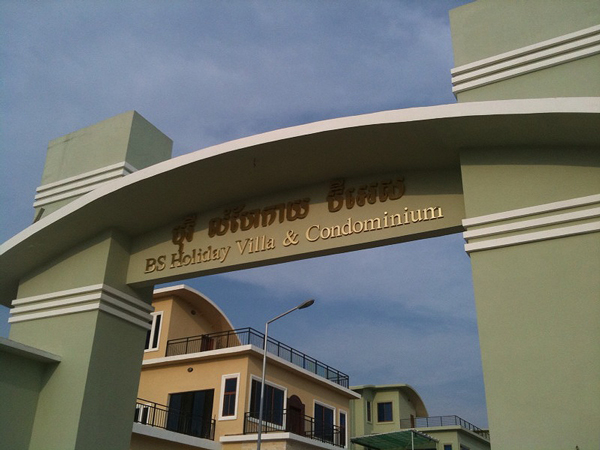
Truth in advertising?
Sign at the entrance of a new condo development on O-pram road near the Otres turnoff. They are currently advertising for buyers and investors, though I find the name of the place less than confidence inspiring.
Sunday, April 10, 2011
A body on the beach
(Sitting on Ochheuteal Beach in Sihanoukville in one of what must be a thousand beach chairs, I am reminded of an old Ochheuteal story from more than a decade ago. Back in the early/mid 90s Sihanoukville was quite different than now, at least in terms of tourist development. Sokha was the most popular beach in town, Victory second and Ochheuteal usually a distant third, known for its sand fleas and lack of cover from the sun. Serendipity Beach had yet to be invented. There weren't any restaurants or bars, nor even a single grass umbrella on Ochheuteal, just 3km of empty sand and scrub grass, an MP base and the remains of the UNTAC offices. The only hotels on Ochheuteal were the new Seaside and the Eagle's Nest on the beach road, with Cobra Karaoke next door, Claude's restaurant a couple of doors down and Les Feuilles one road back.)
Early January 1995. 9:00am.
Per my usual weekend morning routine, I was sitting in the Eagle's Nest on Ochheuteal Beach road, eating a 'Big Aussie Breakfast' and watching Collin, the proprietor, clean and groom the beach sand in front of the guesthouse. Suddenly he came running up through the scrub grass and burst into the restaurant yelling "there's a body in the water!" I was the only one in the place so we ran back out to the beach together where I saw what looked to be a garbage bag bobbing in the surf. "Are you sure?" I asked. "Yes, yes" he said and waded into the water without hesitation.
He tried to get hold of it to drag it onto the beach, but it was heavy and pieces of flesh dislodged in his hands. He tried again bellowing a disgusted "Eewwooaarrgg" and "fuuuuck me!," but to the same result. Just as he was about to give up, a series of strong waves tossed the body forward where it belly flopped like a limp sack of wet cement onto the damp sand.
So there it was, a body on the beach, dressed in loose-fitting gray fisherman's clothes, not too bloated, but lacking lower legs, hands and a head. Collin was wide-eyed and pacing in place. "You stand here and watch," he ordered, prodding my arm, "I'm going to call the police." He bounded away, hurtling clumps of beach grass as he headed for the guesthouse.
'Did he think somebody would steal it?' I wondered. I wasn't sure what I was supposed to be watching for, but what the hell, it was Saturday and I didn't have anything better to do. So I plopped down in the sand next to the body and stared at it.
The clothes indicated he was a fisherman. There was no stench of death, no blood, no obvious signs of violence save the missing extremities. I speculated that fish might have nibbled away his arms and legs, but could the fish have also eaten his head?
The skin was gray and wrinkled, making it difficult to tell where the clothes ended and the flesh began. As I sat there, sand fleas started to cover the body. Thousands of them crawled around on his chest, lending an iridescent shimmering effect in the low morning sun.
Sand fleas were a common annoyance on Ochheuteal, but these fleas seemed to have a particular taste for dead flesh. At first they clustered at the exposed bits protruding from the neck and arm holes in the shirt, but then began jumping from the body to me and then back, which was revolting, so I backed off about 5 meters to the edge of the scrub, well out of flea range, pulled up a log and sat down again.
A short time later, Collin trotted up, huffing from his jaunt. He coughed out the news that the phones weren't working (a regular occurrence) and that he had sent somebody for the police. "They'll be here shortly," he sputtered as he sat down on my log, pulling out a cigarette as he parked his rear.
The beach was completely deserted. Not a soul in sight. After a while Collin fetched us a snack from the guesthouse. We sat there alone for about an hour, drinking Coke, eating baguettes with wedges of Laughing Cow (La Vache Qui Rit) cheese and watching little beach crabs pick at the dead guy's stumps.
Midday a small group of beachcombing Japanese tourists from the Seaside Hotel wandered up. Seeing the body, they chattered excitedly amongst themselves, pulled out several cameras and proceeded to take dozens of photos, even posing with the corpse. I figured that this was the 'war-torn Cambodia' that they had come to see, and here it was, a body on the beach, right in front of their hotel. What a story it would make back home. But they soon realized that the sand fleas were attacking their legs and other exposed skin. They began jumping around slapping at their ankles and screeching like a pack of tortured Chihuahuas. They left in a hurried fluster, a couple craning back to take some last snaps as they went.
We sat there for another 30 minutes or so, finally got bored and headed back to the guesthouse to watch a movie. Three hours later the police showed up at the door asking where the body was. Collin pointed at the beach, but upon glancing that direction, we saw it was gone. No body at all. We both looked surprised. The police seemed annoyed, maybe even suspicious. Collin charged out the door and marched down to the beach with the police in tow and me trailing behind.
Where the body had been lay a single vertebra in the sand. 'Curious,' I thought. "It's disappeared!" Collin exclaimed. I was just forming a mental picture of the sand fleas eating it to the ground like a swarm of tiny piranhas when Collin blurted out, "No, there it is!" pointing down the beach. And sure enough, it was bobbing at the edge of the surf about 100 meters away. Apparently the waves had scooped it up and moved it along. The police immediately took charge, shooing us away and clustering around the body.
A bit disappointed not to be included, we trudged back up to the guesthouse to watch the end of the movie. Thirty minutes later, after the movie had concluded, I looked back at the beach to find that the police had departed, but the body remained. We speculated that they were arranging to have it removed, but as the day grew older it became apparent that they weren't coming back. I figured they determined it wasn't anybody important, that there was no profit in it and that the sand fleas were fierce, so they blew it off, leaving nature to sort it out.
Frustrated with the continued presence of a dead body in front of his guesthouse, late that day Collin grabbed a shovel and went out to bury it, but on walking out to the beach the body had disappeared again and was nowhere to be seen. Not even a vertebra remained.
The following morning the body was back on the beach right in front of the guesthouse, a little bit smaller...or perhaps 'shorter' is a better word. The legs and arms were reduced several inches from the previous day. Collin once again tried to bury it, but any attempt to move it resulted in chunks breaking off. Completely disgusted, he gave up. That afternoon the body left again, riding the waves I imagine, this time leaving an arm bone on the sand as a souvenir of his visit. Collin moved the bone away from the water and buried it there deep in the beach sand. Predictably, the body turned up on the beach again the following day, a couple of hundred meters in the opposite direction. As before, a bit smaller.
This went on for almost a week. The body coming and going with the waves, depositing bones up and down the beach - a long bone here, a coccyx there - slowly getting smaller and smaller, like an ice cube in a cold drink on a hot day. Over the week Collin followed the trail of bones up and down Ochheuteal, burying them as and where he found them, until one day the body just didn't come back.
As I sit relaxing in a beach chair on Ochheuteal today in 2011, 16+ years later, I wonder if some remnant of that long forgotten fisherman might still rest under my feet, covered in sand just meter or so below.
Early January 1995. 9:00am.
Per my usual weekend morning routine, I was sitting in the Eagle's Nest on Ochheuteal Beach road, eating a 'Big Aussie Breakfast' and watching Collin, the proprietor, clean and groom the beach sand in front of the guesthouse. Suddenly he came running up through the scrub grass and burst into the restaurant yelling "there's a body in the water!" I was the only one in the place so we ran back out to the beach together where I saw what looked to be a garbage bag bobbing in the surf. "Are you sure?" I asked. "Yes, yes" he said and waded into the water without hesitation.
He tried to get hold of it to drag it onto the beach, but it was heavy and pieces of flesh dislodged in his hands. He tried again bellowing a disgusted "Eewwooaarrgg" and "fuuuuck me!," but to the same result. Just as he was about to give up, a series of strong waves tossed the body forward where it belly flopped like a limp sack of wet cement onto the damp sand.
So there it was, a body on the beach, dressed in loose-fitting gray fisherman's clothes, not too bloated, but lacking lower legs, hands and a head. Collin was wide-eyed and pacing in place. "You stand here and watch," he ordered, prodding my arm, "I'm going to call the police." He bounded away, hurtling clumps of beach grass as he headed for the guesthouse.
'Did he think somebody would steal it?' I wondered. I wasn't sure what I was supposed to be watching for, but what the hell, it was Saturday and I didn't have anything better to do. So I plopped down in the sand next to the body and stared at it.
The clothes indicated he was a fisherman. There was no stench of death, no blood, no obvious signs of violence save the missing extremities. I speculated that fish might have nibbled away his arms and legs, but could the fish have also eaten his head?
The skin was gray and wrinkled, making it difficult to tell where the clothes ended and the flesh began. As I sat there, sand fleas started to cover the body. Thousands of them crawled around on his chest, lending an iridescent shimmering effect in the low morning sun.
Sand fleas were a common annoyance on Ochheuteal, but these fleas seemed to have a particular taste for dead flesh. At first they clustered at the exposed bits protruding from the neck and arm holes in the shirt, but then began jumping from the body to me and then back, which was revolting, so I backed off about 5 meters to the edge of the scrub, well out of flea range, pulled up a log and sat down again.
A short time later, Collin trotted up, huffing from his jaunt. He coughed out the news that the phones weren't working (a regular occurrence) and that he had sent somebody for the police. "They'll be here shortly," he sputtered as he sat down on my log, pulling out a cigarette as he parked his rear.
The beach was completely deserted. Not a soul in sight. After a while Collin fetched us a snack from the guesthouse. We sat there alone for about an hour, drinking Coke, eating baguettes with wedges of Laughing Cow (La Vache Qui Rit) cheese and watching little beach crabs pick at the dead guy's stumps.
Midday a small group of beachcombing Japanese tourists from the Seaside Hotel wandered up. Seeing the body, they chattered excitedly amongst themselves, pulled out several cameras and proceeded to take dozens of photos, even posing with the corpse. I figured that this was the 'war-torn Cambodia' that they had come to see, and here it was, a body on the beach, right in front of their hotel. What a story it would make back home. But they soon realized that the sand fleas were attacking their legs and other exposed skin. They began jumping around slapping at their ankles and screeching like a pack of tortured Chihuahuas. They left in a hurried fluster, a couple craning back to take some last snaps as they went.
We sat there for another 30 minutes or so, finally got bored and headed back to the guesthouse to watch a movie. Three hours later the police showed up at the door asking where the body was. Collin pointed at the beach, but upon glancing that direction, we saw it was gone. No body at all. We both looked surprised. The police seemed annoyed, maybe even suspicious. Collin charged out the door and marched down to the beach with the police in tow and me trailing behind.
Where the body had been lay a single vertebra in the sand. 'Curious,' I thought. "It's disappeared!" Collin exclaimed. I was just forming a mental picture of the sand fleas eating it to the ground like a swarm of tiny piranhas when Collin blurted out, "No, there it is!" pointing down the beach. And sure enough, it was bobbing at the edge of the surf about 100 meters away. Apparently the waves had scooped it up and moved it along. The police immediately took charge, shooing us away and clustering around the body.
A bit disappointed not to be included, we trudged back up to the guesthouse to watch the end of the movie. Thirty minutes later, after the movie had concluded, I looked back at the beach to find that the police had departed, but the body remained. We speculated that they were arranging to have it removed, but as the day grew older it became apparent that they weren't coming back. I figured they determined it wasn't anybody important, that there was no profit in it and that the sand fleas were fierce, so they blew it off, leaving nature to sort it out.
Frustrated with the continued presence of a dead body in front of his guesthouse, late that day Collin grabbed a shovel and went out to bury it, but on walking out to the beach the body had disappeared again and was nowhere to be seen. Not even a vertebra remained.
The following morning the body was back on the beach right in front of the guesthouse, a little bit smaller...or perhaps 'shorter' is a better word. The legs and arms were reduced several inches from the previous day. Collin once again tried to bury it, but any attempt to move it resulted in chunks breaking off. Completely disgusted, he gave up. That afternoon the body left again, riding the waves I imagine, this time leaving an arm bone on the sand as a souvenir of his visit. Collin moved the bone away from the water and buried it there deep in the beach sand. Predictably, the body turned up on the beach again the following day, a couple of hundred meters in the opposite direction. As before, a bit smaller.
This went on for almost a week. The body coming and going with the waves, depositing bones up and down the beach - a long bone here, a coccyx there - slowly getting smaller and smaller, like an ice cube in a cold drink on a hot day. Over the week Collin followed the trail of bones up and down Ochheuteal, burying them as and where he found them, until one day the body just didn't come back.
As I sit relaxing in a beach chair on Ochheuteal today in 2011, 16+ years later, I wonder if some remnant of that long forgotten fisherman might still rest under my feet, covered in sand just meter or so below.
Thursday, March 31, 2011
Be careful out there
 |
| Tuk-tuk outfitted with anti-bag snatching netting |
Every year at this time, in the weeks before Khmer New Year, there is a spate of petty crime against foreigners in Cambodia as some less than honest locals try to collect some coin to finance their planned New Year festivities. There will be shakedowns, moto-thefts and muggings, bag snatchings, bar raids and a few break-ins. Not that these sorts of things don't happen throughout the year but such crimes spike in these weeks leading up to Khmer New Year. Like the shopping season before Christmas, this is crime season in Cambodia.
To be up front, I don't have any statistics to back this up, not that there are any reliable crime statistics available anyway, but the anecdotal evidence is overwhelming and accords quite well with my casual observation over the years. And if you mention a tale of a recent robbery or some such crime to a long-term expat, he will likely just shrug his shoulders and mutter "Khmer New Year."
'Tis the season to be careful.
On that note, a few quick tips…
- Bag snatching is not uncommon. When in a tuk-tuk place your bag in the middle of the seat or floor. Do not put it to the outside at the end of the seat where it is easily grabbed. When on a motodup, place your bag either between you and the driver or have the driver set it in front of him between his legs. Whatever you do, do not wear it on your back. More than one foreigner has been pulled off of a moving moto by a thief trying to pull the bag off their back. When on foot, carry your bag/camera on your inside shoulder away from the street. And lastly, do not wear expensive jewelry around your neck if you plan on walking around, especially near the traditional markets.
- Street robberies in Phnom Penh, though not common, are reported with some regularity. Most occur at night, near popular tourist destinations and expat areas, and almost always happen to people on a motorcycle/motodup, in a tuk-tuk or on foot. The robbers are sometimes armed with a handgun and usually only want money. Though there have been some unprovoked assaults, they generally avoid applying violence, but will if challenged. Give up your money and they will likely leave post haste.
- Consider traveling about town in a car, especially at night, whether that be a taxi or your own vehicle. You are far less visible, exposed and vulnerable in a car than in a tuk-tuk or on a moto.
- Muggers work areas frequented by foreigners - the riverfront area, Boeung Keng Kang 1, the Street 51 area, near markets and clubs and other tourist haunts. They lay in wait at the periphery of these areas looking for passing or lone foreigners. You are much more likely to be robbed in these areas than in some dark, lonely all-Khmer neighborhood deep in Phnom Penh. Whereas foreigners tend to let down their guard in tourist areas, it is in fact a place to be extra cautious.
- Sadly, muggers seem to target women more than men. Women need be especially careful.
- Do not dawdle at the gate. Over and over again people have been robbed at the point they arrive home and stop to open their door or gate. The robbers descend while you fumble with your keys or wait on an exposed moto or tuk-tuk for the door to open. Best strategy is to have somebody inside the house (maid, guard, family) open the gate as you arrive. Call home as you leave the bar, tell them you'll be there soon so that they can open the gate as arrive and allow you walk or drive in without ever stopping.
- Pick-pocketing is generally limited to the traditional markets and occasionally discos and clubs. They target both locals and foreigners. It's done in usual fashion, taking advantage of close situations, crowding and such. Tourists often fall victim to seemingly friendly beggar children, allowing them too close, only to have their purse or pocket relieved of its contents while distracted. I have heard several such reports from Phsar Tuol Thom Poung (the Russian Market.) And at the clubs, as the t-shirt reads, "Beware of pickpockets and loose women." 'Nuff said there. Keep your radar up when in close situations. Do not allow people, especially 'innocent' beggar children, to touch you.
- Home owners and renters remember, the thieves rarely come through the front door. They come from above. People usually take great care to make sure the ground floor of their house is well locked and secure. But the thieves often come from the roof or upper windows, climbing walls and traversing roofs to access some weakly locked upper door or window, or cut through unsecured fenced openings. Don't neglect to lock the upstairs doors and windows. Another common trick is for them to use a long stick with a hook to fish your belongings through an open window. When possible, keep windows closed and locked. And do not leave you’re your wallet, phone or purse on a table or draped over a chair near a window.
Two weeks left. Khmer New Year will fall April 14-16. That week, many businesses will close and Phnom Penh will become a ghost town as revelers take to the countryside, traffic accidents on the national routes will skyrocket and Crime Month in Cambodia will come to an end.
Sunday, January 23, 2011

Monday, January 17, 2011

Saturday, January 15, 2011
The state of Otres Beach
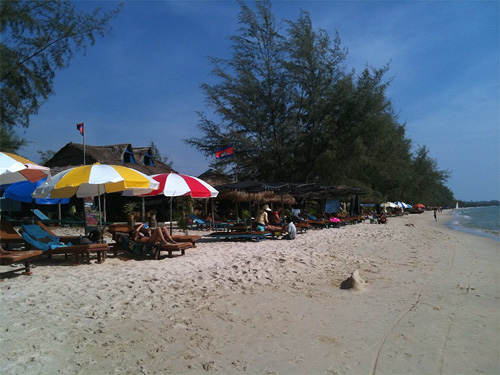 |
| The near end of Otres Beach, last week |
The beach itself is wonderfully primitive and laid back. There are no hotels, spas or shops, not even any running water or, until just last year, regular electricity. Until mid-2010, thatch covered beach bars dotted the full length of Otres, but much more sparsely than Ochheuteal. There were a few basic bungalows on the sand and a couple of places offering kayaks and Hobies. Even the roaming beach vendors (massage and trinkets) were much fewer and far less aggressive than their Ochheuteal counterparts. Otres was (and still is) a place that you can fall asleep in your beach chair unperturbed by crowds, beggar kids and hawkers. The only real drawback to Otres was that it is difficult (and even dangerous) to get back to the main town area come evening. The road is long, lonely and dark, and robberies of those trying to make their way back in the evening are not unknown. Better to come back either before sundown or stay the night at Otres.
 |
| Map of Otres showing the project area |
Early last year, it seemed the end was nigh. The on and off talk of development began to concretize. The government delivered notice that all businesses were to clear the beach in a month to make way for a planned development. After negotiations, the government seemed to relent, demanding only that people stop laying permanent foundations on the beach. And offering even greater hope at the time, the city connected the Otres area to the regular electrical grid and allowed the beach businesses to hook in, bringing Otres its first 24/7 power.
 |
| The development project |
 |
| Inside the development area, last week |
At the near end, the atmosphere has changed very little from the old Otres. If you don't walk up the beach too far you won't even know the development project is there. Relaxed little beach bars and BBQ shacks still ply their trade. Many of the beach bungalows are now gone, but not all, and little guesthouses have begun to pop up on the other side of the road, off the sand but still only 20 meters from the
 |
| Evicted villager's huts |
How long will it last? God and the government only know. There are still rumors of an expanded development project that will take out the remaining businesses at the near end, but no sign or official word of it yet. There is still the very grim reminder of Otres development on the entry road - the sad remnants of the Otres community, local people violently evicted from their village by a land deal back in 2007, now living in a string of squatter huts along the roadside. But for beach goers, for now, Otres is not gone. In fact, save the middle section, it is much the same as before.
 |
| Otres Beach, 2006 |
Eviction of Otres village
DAS: Otres evictions, update, February 12, 2008
PPP: Band bids Otres beach bars farewell, February 12, 2010
PPP: Otres eviction talks set for today, July 5, 2010
July 2010, Otres Beach 2010: What does the future hold???
Monday, January 10, 2011
Road Widening
 |
| Bulldozer works on Serendipity Beach Road |
I happened to be in Sihanoukville at the time and heard of some sort of trouble up on Serendipity, so headed over to check it out. I arrived a couple of hours after the bulldozer, its destructive work already well begun. The machine was moving up the edge of the road, crushing signage and curbside decks. A dozen and a half sour looking policeman lingered in the shade of a tree in front of Utopia and business owners both foreign and Khmer milled about with crossed arms and furrowed brows.
 |
| 21 meter mark |
Much complaining, cajoling and reasoning with the authorities ensued. It all seemed first to fall on deaf ears but then, at the last day, in a seeming act of partial concession, the city reduced the clear area from 40 meters to only 21 meters, bringing the edge of the road back to the front of the main structures of the businesses. Though a couple small places near the road's edge and at the peak of the hill such as Corruption Bar were completely removed, in most cases including all of the larger places, the area lost was limited to the street side seating, garden, signage and walkway, many not even that. Business continues pretty much as usual.
None of the business owners I asked knew for sure if the reduction to 21 meters was permanent or whether there might be further widening in the future. Time will no doubt tell.
Back in the mid 90s when I first came to Sihanoukville, coconut palm trees lined the 2-lane main road (Ekareach Street) from the police station at the top of the hill, through the downtown and most of the way to the Golden Lions. The trees were a varied bunch, some picture perfect, some less so, but still, they gave the Sihanoukville character, arching over the roads, providing little islands of shade for vendors, a playground for the monkeys, and affording the town a 'sea of palms' look - ideal for a tourist beach town.
 |
| Ekareach St., from the top of the hill, opposite the VN Embassy, Sihanoukville 1998 |
 |
| Ekareach St., from the same place at the top of the hill, last week |
One weekend in 1999 I came down for a couple of days and the first night turned into a late one. I stumbled out of the Moonshine Bar 4:30ish and then up the street to my downtown hotel, The Kampong Som.
At about 6am the 'next morning,' (an hour and a half later,) I was woken by the fitful drone of a distant chainsaw. My head was pounding. I took a swig of water, consoled myself with the idea that whatever they were cutting wouldn't take long, put the pillow over my head and tried to sleep. What seemed about an hour later the chainsaw was still whining, now even louder and closer. I cursed the hotel for its thin walls and cheap windows. 'This is what I get for $10 a night,' I thought. My head still hurt. I drank some more water, stuffed toilet paper in my ears, sandwiched my head between pillows and tried to sleep. But there was no let up in the noise...well...in fact, it would stop intermittently for a minute or two, offering hope, but would flare again as sure as a bad tooth. About 10am I admitted defeat. Between the headache, the noise and my general annoyance, I was up and out. I decided to get something to eat to try to quell the hangover. As I stepped into the hall I ran into a Vietnamese taxi girl from the bar the night before, Mai, a friend. She had just finished her shift so to speak and was on her way to breakfast. We joined up and headed out for a street side noodle stand that sat a few doors away from the hotel.
Stepping out the front door I was assaulted by an uncharacteristically bright hot sun. As my eyes adjusted I was struck near dumb by the scene. The palm trees, and all the shade and shield they provided, were gone...all of them! Well, not gone, but no longer standing. Dozens and dozens lay on the ground along the main street. Sawdust filled the air. The whir of the chainsaw was still audible a couple of blocks away. Every single palm along the road had been felled, exposing a painfully intense sky and rows of monotonous blocky white buildings.
Aghast, I bounded toward the destruction sputtering "What the fuck?!? What the fuck is this??? What have they done???" The place had gone from a picturesque little beach town to a communist-era cinder block city in a matter of hours. Mai walked up behind me, put her hands on her hips and surveyed the street, slowly turning her head back and forth to take in the whole scene. She nodded approvingly. "Very good, very neat, very clean, very good control." Shocked again, I looked at her and blurted "What?!? But the beautiful trees...It took years for those trees to grow...And now look, it's just dust and concrete," to which she calmly responded, "This city, not jungle. This very clean, very good control. See all the buildings. Good order." I was speechless. "Yes, very good. Clean! But..." she continued while shading her eyes from the intense tropical sun, "very hot here. Sun very strong. Come back, go inside, eat breakfast." I looked down the street. The noodle stand was gone. I went back inside.
Later that day I heard that the tree removal was the first stage of a road widening development plan. It took a long time after the trees were removed before the new road actually went in. Years, in fact. At first I was skeptical that it would ever happen. But the two lanes were eventually repaired. A couple of years on, it was improved to four lanes, then a couple years after that, widened to six lanes.
Monday, January 3, 2011
2010

It’s the first New Year of the year. Two more to come.
And it’s harvest time in Cambodia.
The monsoons ended a month or so ago. It’s cool and mostly rainless, bringing an end to the primary growing season. Most of the rice has recently been cut and the paddies are dry and turning fallow brown.
Driving through rural Kampong Trach (Kampot province) yesterday I saw several groups threshing rice by hand - the ‘flailing method’ - beating the long stalks against rows of threshing boards and funneling the seed into baskets beneath. Piles of drying rice straw sat stacked in front of houses and bamboo and plastic mats lined the side of the road, covered with new rice seed airing in the sun and breeze. Toward the end of the day, as the sun was setting, women collected the dry seed from the mats into large sacks for storage.
Rural Cambodia is a busy place right now, bustling with harvest work. Not really an ideal time for a New Year holiday. Nevertheless, there will be many celebrations today (Dec 31,) and a certain amount of partying come Chinese New Year in February as well. Cambodians are never ones to pass up on a good holiday, even non-Cambodian ones. But the real New Year here - Khmer New Year (Jol Chhnam Khmei) - is still months away, in April, well after the harvest period has ended and just before the seasonal rains begin, at a time more in sync with the Southeast Asian rhythms of the monsoons and the rice.
Nevertheless, for a westerner like me, today is New Year Eve, my New Year Eve. So, naturally, with three hours to kill driving from Phnom Penh to Kep, I took to reflecting on the year for Cambodia - the news, the big stories, the not so big stories, changes, non-changes, lingering impressions and the state of things. I made a list of whatever came to mind, noting it into my iPhone as I drove. This is that list, with some references added.
* The Preah Vihear border dispute with Thailand was news all year in one form or another – a largely imposed crisis, its current incarnation born of Thailand’s recent internal upheaval. To date, Cambodia has held her own quite well throughout, the Cambodian PM deserving much of the credit for navigating difficult political waters, just bringing the Preah Vihear dispute to a seemingly settled calm... Through there has just been yet another incident spurring yet another crisis. It continues.
* China is HERE in the most present tense, inking huge deals in aid, investment and development, throwing money at Cambodia like it grows on trees in China. The US (and the west) lost significant ground in Cambodia as China soared in the zero-sum game of aid/investment-bought influence and favor. ‘No-strings’ money from China won hands down over American-style hard bargaining aid-for-improvements approach. Uncle Sam isn't the only deep-pockets sugar daddy on the block anymore.
* Boeung Kak Lake is almost gone.
* The Japanese drainage system project in Phnom Penh that tied up traffic and parks for two years was completed this year, seemingly with no visible effect whatsoever on the drainage. In my non-expert observation, it floods now same as before, maybe worse. I’m no engineer but I can’t help but wonder if the demise of Boeung Kak Lake might have something to do with it.
* A mid-term year, the next national elections still 2 years away, internal politics were a bit slow. The government is stable and functioning, probably more so than any government since UNTAC. The CPP is in firm and sole control, holding the majority necessary to control Parliament. SRP is still percolating along, being provocative, getting accused, threatened with jail and touring the world. FUNCINPEC and friends burped and gurgled a couple of times.
* Mu Sochua of SRP distinguished herself, winning a big-stakes game of chicken with the government, standing her ground when others may have gone to France. Who has the cajones in that party, eh? Keep an eye on this lady. She’s going places.
* Land grabbing and evictions continue unabated.
* A Khmer Rouge guy was convicted. 'Enough is enough' was declared. And send more money.
* Boeung Keng Kang 1 is now the city's preferred hunting ground of midnight muggers.
* Yet another beach in Sihanoukville - Otres Beach - has been partially closed for development. Now, something like two thirds of the main beaches on the peninsula are either closed or suffer limited access. (Don't fret, beach-goers. There's still plenty of beach in Sihanoukville for you - Ochheuteal, part of Victory, part of Otres and Sokha if you can afford it.)
* Most of the islands near Sihanoukville remain completely undeveloped - beautiful, pristine beaches and untouched tropical jungle. But it’s not going to last. Plans are afoot. Experience it while you can.
* An exclusive gym for the employees of 7NG Land Development Group has been erected on the site of the Dey Krahorm village eviction. All 7NG Group staff will be free to play different kinds of sports: football, tennis, volleyball, etc.
* Siem Reap managed to get even more touristy with Pub Street at ground zero.
* There are now several KFCs in Cambodia (Phnom Penh and Siem Reap) and Pizza Hut and Burger King are on the way.
* Koh Pich.
* Cambodia, long given one-dimensional coverage in the international press, got a little more comic book this year – a land of Villains, Victims and now Heroes.
* The rural countryside remains about the same - picturesque, poor, ignorant and traditional.
* The guy throwing bricks at foreigners on the riverfront seems to have stopped, and it turns out none of it ever happened anyway.
* Cambodia's first viral video, oh my.
* Pity tourism is still en vogue - 'volunteering,' orphanage visits, be-Angelina-for-a-day packages - providing potentially lucrative outlets for those who would exploit children and the disadvantaged. Study up before you do it.
* There seemed to be an abundance of sex industry focused Johnny-come-lately journalists, Christian saviors and new NGOs turning up this year – over-funded, under-informed and 10 years too late.
* On that same note, evangelical Christian groups seem to be arriving at an ever increasing rate, most involved in charitable work of some sort, all of them with an ulterior motive - hunting and collecting souls. However they have chosen to help - education, rescue, shelters, etc - it always come back to exposing people to the Word of the Lord Jesus.
* The real estate bubble that burst a couple of years ago remains burst. The Monument to Pointless Development at the corner of Monivong and Sihanouk has been completed.
* The tallest building in the Asia was constructed on the riverfront, but sank in the mud and disappeared. (Just kidding, sort of.)
* Kingdom Beer is making a go of it.
* Overland border crossings evolved a little. Poipet immigration seems to have cleaned up it's act. If you can fight your way through the army of visa and money exchange scammers on the Thai side and get to Cambodian immigration, you can get a Cambodian tourist visa for about the right price - $20. The crossing at Koh Kong remains the same, steeped in its overcharging ways. And Prek Chak on the VN border seems to have picked up some of the same habits.
* Police are actually enforcing the helmet laws for motorcyclists and occasionally a smattering of other traffic laws as well. Most people even obey the traffic signals these days, at least during the day. Times change.
* Tourist arrivals are up, though the demographics have changed some. Roads continue to improve. Seems to be lots of small infrastructure projects underway or imminent around the country. Investment, especially Chinese investment, is way up. GDP is up. The country is, in many ways, moving forward.
* The Cambodian riel lost a bit against the dollar but gained it back by years end - settling in around the old standard of 4000R to the dollar. Petrol isn't cheap (US$1-$1.20/liter) but cigarettes and beer still are. A buck for a pack of Marlboros, less for local cigarettes. Can even buy them one at a time. There's still no closing time at the bars...
Friday, October 8, 2010
Notes on the legend of Ya-Mao
 Ya-Mao is the central personage of a legend local to Sihanoukville and much of the Cambodian coast. She is a neak-ta, a powerful ancestor spirit that lords over a part of the country. Known as Ya-Mao, literally the Black Lady, her domain encompasses much of southwestern coastal Cambodia and she is the protector of sailors and other travelers of the area, both on and off shore. Locals from fisherman to taxi drivers are careful to make appropriate prayers and offerings (phallic objects and/or bananas) to Ya-Mao for their safe passage.
 Fishing boats that work the area waters hang a hand of bananas on the bridge as an offering to Ya-Mao, and phallic-stick offerings can still sometimes be found on the beaches near fishing camps. There is also a major shrine to Ya-Mao at Wat Krom in Sihanoukville. But perhaps the best known and most apparent manifestation of the veneration of Ya-Mao is the collection of spirit houses at the crest of the Pich Nil mountain pass on National Route #4, at the northern edge of Ya-Mao's domain half way between Phnom Penh and Sihanoukville. Many if not most drivers on Route #4 stop at the shine to make offerings, and like the fishing boats, some drivers, especially taxi and truck drivers display a hand of bananas on the dashboard for Ya-Mao. Other significant roadside shrines for Ya-Mao can be found at the beginning of Route #4 in Sihanoukville and just outside Koh Kong City on Road #48.
 |
| Route #4, Pich Nil, Ya-Mao Shrine |
I first heard tell from my Khmer teacher. He related the legend quickly and rather casually. I asked if he would retell it when we had more time so that I could take notes. He agreed. Next time I saw him he told me that his wife had been injured in an accident on Route #4 and he feared it was because of his indiscretion telling me the legend. He eventually told me the legend a second time but only after praying to Ya-Mao about it and waiting for a dream to give him a sign of what he should do. Apparently I got a thumbs up. A couple of weeks after he discovered that the legend had recently been in the Khmer newspaper Rasmei Kampuchea and this lightened his burden considerably.
The following is his telling of the legend of Ya Mao, largely in his words. It has been altered slightly for sake of grammar, privacy and relevance.
"Her history begins perhaps more than 100 years ago. This area was called Kampong Som. It was a small village. Her husband was leader of the village. The people respected what he and his wife said. One time he had to go to Koh Kong for business. He had to stay there nearly one year. Ya-Mao missed her husband very much.
These people live by the ocean so they eat a lot of sea fish so they have a lot of protein so the men have a lot of semen. The people want to make love.
At the rainy season it is cold. So people like to make love. So she missed her husband. But she met a strong storm and the boat was flooded and sank. She drown. She died. Since then she has become a god. Most people say that Ya-Mao hates men. But I’m not sure. They say that she hates them because most of then people at sea are men. The women stay at home. So especially men die at sea. So they say that Ya-Mao hates men because they are the ones that die at the sea.
But Ya- Mao became a god. After she died her spirit entered through a man and said through him that she is Ya-Mao and that she died in the middle of the sea. And that she hates men that travel by the sea because her husband was the cause of her death. Because if she didn’t have to go to meet her husband she would not have died. So people pray to Ya-Mao ‘Oh Ya-Mao, please don’t make me anything bad. Please help me. Please help me. What do you want?’ And she wants a phallic symbol. And she wants this because her death was caused by this. Because she went to meet her husband (for) this. She wanted to go and sleep with her husband.
The sea shore men have a lot of semen and a lot of passion and living is difficult so the husband has a lot of passion. And so the people offer a phallic symbol to Ya-Mao.
After that there were a lot of strong winds, storms, ship sinkings and deaths of men. And the people didn’t know why. But when the spirit of Ya-Mao enters a person and that person speaks as Ya-Mao, they know! And they pray before they go fishing, before they go anywhere, they offer a phallic symbol.
People place phallic symbols on the beach, near trees, rocks and launching places of boats. They are small sticks place up in the sand. Before they go they pray.
In 1979 (the government said that Ya-Mao is old and she does not want the phallic symbol. Communist regimes do not allow this (sort of thing). She doesn’t need it because she is old. (Before this) you could see many sticks on the seashore. They now now she need only bananas.

Anybody can pray to Ya-Mao. Men or women. Sometimes women go fishing with their husband at night so they pray. But mostly men, sometimes women.
They say that the crocodile is the body guard of Ya-Mao.
And now I want to emphasize that Ya-Mao is a true story. The people still believe. I think perhaps you don’t believe me. But I have my experience. I have been here since 1979. Route #4 is a dangerous route.
She is responsible for the sea, along the seashore and the sea area and Route #4.
You should put one incense holder in your house. You can take an empty milk can and put dry rice in it and use it for an incense holder. You should put it against the wall. This is the place of Ya-Mao. If you want to go to Phnom Penh, you put banana and incense and sahtoo (praying hands) and say, ‘Oh Ya-Mao, I hope that I have no problem.'"
 |
| Stored under the shrine - the overflow of phallic offerings |

Stories of Ya-Mao in action:
From the teller of the above story:
"Before we begin I want to say something for her because she has become a god. The Khmer people, especial those who live along the sea shore believe in Ya-Mao. Ya-Mao is a true story. It happened perhaps more than 100 years ago. You can see at the mountain at the middle of Route #4. They have built a lot of Ya-Mao houses and they are for passengers (and drivers). They go there, they stop the car and they take bananas and incense to pray to Ya-Mao to help them along the road. I have had an experience myself. I was the … in Kampong Som…I had been here since after 1979 after Pol Pot fell. So the USSR carried thing to Cambodia to help the Cambodian people. And the ships would berth at Kampong Som. I must go to Phnom Penh 3 or 4 time per month. But no problem. 1983-1984 the road was quiet. Pol Pot had not yet collected his troops….
Route #4 became dangerous. Sometimes they shoot behind me, sometimes they shoot before me. But they never shoot me. Mr. Dara had a bad accident. His Vietnamese consultant, his driver and bodyguard were killed. That day I went also. I went before him. But I became very hungry and I stopped to eat noodle soup in Kampong Speu. So Mr. Dara went before me. I later heard that a car had been attacked. Everybody died. It was Mr. Dara’s car. Only he survived but with serious injuries.
When troops secured the area and I went and looked and, ‘My God!’, Ya-Mao helped me. If I had gone before him I would have been shot. So I believe in Ya-Mao. When I got to Phnom Penh I brought a hand of bananas and three incense and to her prayed to Ya-Mao. "Oh Ya-Mao please help me tomorrow. I will go to Phnom Penh. If I dream no good I will not go to Phnom Penh. I will wait." If there is any danger on the road Ya-Mao will tell me in my dream. I think that. If I don’t dream that I’ll go. So I believe. So many people were killed along Route #4. But not me, because I believe in Ya-Mao.”

'The Story of the Whirlpool'
I have heard the 'Story of the Whirlpool' from several people in Sihanoukville, often attached to a telling of the general legend. The story usually runs pretty much the same and seems to be told rather matter-of-factly. One significant difference in tellings is the dating of the story, ranging from 'last year' to 25 years ago.This version was told to me by an office assistant at a school. He said that his mother told him the story.

One day a woman and her children were on a boat going to a nearby island where her husband was working. One of the children cried throughout the voyage and could not be made to stop. After coaxing and reasoning the woman final resorted to threatening the child saying that she would throw him into the ocean if he did not stop. But the frightened child persisted.
At that moment the boat was swept up in a whirlpool. The boatmen fought to free the vessel but to no avail. One of the passengers speculated that it was the work of Ya-Mao, angered by the ill words and the unfulfilled threat to throw the child into the sea. Some passengers said ‘toss the child overboard’ but the woman refuse to give up her child. In its stead, the crew threw a pig into the ocean. Ya-Mao apparently appeased, the boat was almost immediately released from the whirlpool and proceeded to the island without further incident.
From my taxi driver to Sihanoukville:
One time he was driving a fare to Kampong Som from Phnom Penh. As he was leaving the city on Route #4 it occurred to him that he hadn’t made an offering to Ya-Mao. As he neared the crest of Pich Nil a truck in front of him kicked up a rock which smashed his windshield. He realized he was being punished or perhaps warned by Ya-Mao.
He immediately turned back and went to the nearby fruit stands, purchased some bananas and then returned to the spirit houses on Pich Nil to make offerings and pray for safe passage. The rest of the trip was uneventful.
 |
| Spirit houses line the road at Pich Nil |

Subscribe to:
Posts (Atom)