Showing posts with label development. Show all posts

Saturday, December 8, 2012

To Build a Road*

(* or: 'An Irishman walks into a bar...')
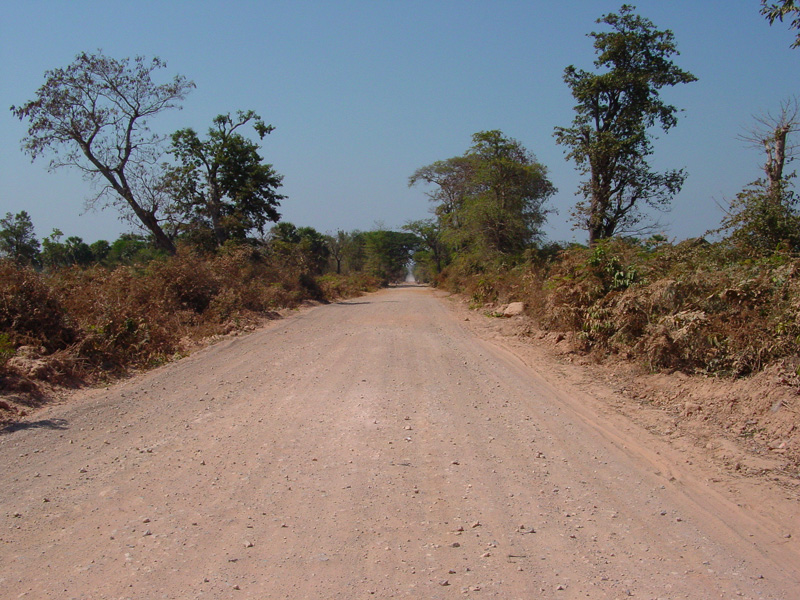

A Japanese company comes to Cambodia to build a road. They do a professional job, get it done almost on schedule, pick up most of the tab, employ local workers at decent wages, donate maintenance equipment and send an expert back periodically to follow up. While in town, the execs spend freely on karaoke, Johnny Walker Blue and young girls. The road is still in excellent condition more than a decade later.

-----

A Chinese company comes to Cambodia to build a road from the highway to some natural resource. They do a thin but serviceable job, get it done relatively quickly, clear cut miles of jungle on either side for the hardwoods, pay off officials, treat local workers like expendable slaves and dump broken equipment and old fuel oil in the river. While in town, the execs spend lots on karaoke, Johnny Walker Black and young girls. When the project is complete, they abandon dozens of Chinese workers in the country. High level government officials praise their fine work and strings-free generosity. The road disintegrates in 2 or 3 years.

-----

An American government-funded contractor comes to Cambodia to rebuild some road they blew up back in the 70s. First they build a massive walled compound for the American workers to live. They fly all new state of the art construction equipment in from America. They begin a series of regular airlifts to bring in all food, water and Budweiser from America. They set up a church group. The US embassy in conjunction with MTV Exit produces a list of approved bars, restaurants and sights that the American workers are allowed to visit. They send in an advance team of security and engineering experts to survey and secure the area.

They announce start up of the project will depend on improvement in Cambodia’s human rights, anti-trafficking efforts and election reform. Cambodia promises. They begin work on the road using a combination of well paid American and local workers. They threaten to stop work and demand improvement in Cambodia’s human rights, anti-trafficking efforts and election reform. Cambodia promises. They continue working.

They stop work while a congressional committee headed by Dana Rohrabacher debates whether Cambodia is living up to its human rights, anti-trafficking efforts and election reform promises. Nobody cares. They resume work. Somebody gets mugged in Phnom Penh. They stop work and evacuate all American workers to Guam. Six months later a security team is sent in. The team deems it safe enough. The American workers return to Cambodia to find all the supplies, machinery and even the newly laid road have disappeared.

They fly in more supplies and equipment from America. They start work again. They finish the road – truly a first rate job, probably the best road in Cambodia. They adorn it with US flag emblazoned plaques and monuments.

They hold a dedication ceremony attended by the US ambassador and the second assistant secretary of the local sangkat. The American contractors leave. A US government official announces that further aid will depend on Cambodia’s record on human rights, anti-trafficking efforts and election reform. Two months later the Cambodians set up toll booths, paint oknha names over the flags and the road is used to haul illegal timber and traffic sex slaves.
-----

A French company comes to Cambodia and doesn’t build a road.

---

A Vietnamese company comes to Cambodia to build a road from the Vietnam border to some nearby Cambodian village. They use mostly Vietnamese labor, do a thin but serviceable job, and get it done on time. While in town, the execs spend a modest amount on karaoke, Johnny Walker Red and young girls. The project complete, all the Vietnamese workers stay in Cambodia and eventually send for their families to join them.

-----

A Russian company comes to Cambodia to build a road to a Russian financed pleasure palace development. On paper it costs 20 times more than any other road in Cambodia. They begin work. Work stops when the entire executive crew dies of alcohol poisoning. A year later a new group of executives arrives and work resumes. Work stops when two are arrested, one is shot, several disappear and the rest die of alcohol poisoning again. Two years later a new group of executives arrives and work resumes. Ultimately they build a good, serviceable road, using local labor at local wages. The pleasure palace is never completed, but (on paper) remains fully booked, year-round, at rack rates.

-----

A Thai company owned by a consortium of Thai generals comes to Cambodia to build a road. And in fact they build dozens of roads from the border deep into the jungle, and don’t tell anybody about it.

-----

A Malaysian furniture company comes to Cambodia to build a US$1,000,000 road if they can also build an entertainment complex. They build half an entertainment complex and put out the word that they are looking for investors.

One year later construction on the road has not yet begun and the Cambodian government asks what’s going on. The Malaysians announce they are holding an Investors Gala Celebration with free flow of Angkor Beer. Tickets $35/pax. At the Gala they announce their intentions to build a US$10,000,000 road. They build half a hotel attached to the half-built entertainment complex.

Two years later construction on the road has not yet begun and the Cambodian government asks what’s going on. The Malaysians announce they are holding a 5-star Grand Investors Gala Celebration with live Filipino band and free flow of Angkor Beer. Tickets $65/pax. At the Gala they announce their intentions to build a US$100,000,000 road. A Chinese restaurant is added to the half-hotel.

Four years later construction on the road has not yet begun and the Cambodian government asks what’s going on. The Malaysians announce they are holding a Supreme 6-Star Investors Super Gala Celebration with live Filipino band, a grand drawing and free flow of Tiger Beer. Tickets $85/pax++. At the Gala they announce their intentions to build a US$1,000,000,000 road.

Two years later construction on the road has not yet begun and the Cambodian government asks what’s going on. The Malaysians say “Road?”

-----

A Cambodian import-export company sets up to build a road using aid money donated by the EU. They retrieve the old Chinese equipment from the river, refurbish it using solder and bailing wire and filter the fuel oil from the water. They use the aid money to buy luxury cars and karaoke, Johnny Walker Blue and young girls. They gas up the old Chinese equipment with the recovered fuel oil and use it to flatten the ground into a basic but serviceable hardpack road. They call it “done.” The hardpack disintegrates the following rainy season. The Cambodians ask the EU for more aid to help rebuild the road. The EU sends money. A Cambodian import-export company sets to rebuild the road using the aid money. They retrieve the old Chinese equipment…

-----

(All companies and projects appearing in this work are fictitious. Any resemblance to real companies or projects, living or dead, is purely coincidental.)

Originally published on Khmer440.com

Saturday, January 15, 2011

The state of Otres Beach

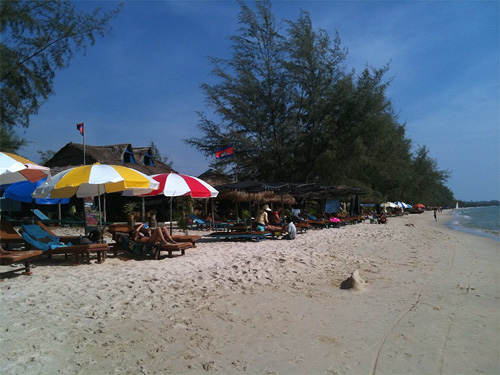
Umbrellas on Otres Beach Sihanoukville
The near end of Otres Beach, last week
Otres has long been my favorite Sihanoukville beach. Twin sister of Ochheuteal Beach (the next beach south, a 3 kilometer crescent of white sand facing southwest) but much more relaxed and far less touristed than Ochheuteal, largely because it is completely undeveloped and a bit difficult to get to. Comparatively close as the crow flies, it still something of a small project to get there. It was only recently (a few years ago) that the road over the headland from Ochheuteal was opened, and that only to motorcycles. And the back way using the city roads requires traversing 2.5 kilometers of broken pavement. The roads have limited the tourists to only those who really want to be there.

The beach itself is wonderfully primitive and laid back. There are no hotels, spas or shops, not even any running water or, until just last year, regular electricity. Until mid-2010, thatch covered beach bars dotted the full length of Otres, but much more sparsely than Ochheuteal. There were a few basic bungalows on the sand and a couple of places offering kayaks and Hobies. Even the roaming beach vendors (massage and trinkets) were much fewer and far less aggressive than their Ochheuteal counterparts. Otres was (and still is) a place that you can fall asleep in your beach chair unperturbed by crowds, beggar kids and hawkers. The only real drawback to Otres was that it is difficult (and even dangerous) to get back to the main town area come evening. The road is long, lonely and dark, and robberies of those trying to make their way back in the evening are not unknown. Better to come back either before sundown or stay the night at Otres.

Sign with map of Otres Beach Sihanoukville
Map of Otres showing the project area
But such idyllic simplicity in 'Cambodia's premier beach town' could not last. Otres is prime beachfront real estate begging by its very nature to be developed into some sort of 5-star moneymaker. Since the first couple of beach bars showed up on Otres a half a decade back it has been known to most that the government would eventually take it all back for development - that the oceanside beach bars and bungalows were temporary, allowed to exist only in the interim until that development began.

Early last year, it seemed the end was nigh. The on and off talk of development began to concretize. The government delivered notice that all businesses were to clear the beach in a month to make way for a planned development. After negotiations, the government seemed to relent, demanding only that people stop laying permanent foundations on the beach. And offering even greater hope at the time, the city connected the Otres area to the regular electrical grid and allowed the beach businesses to hook in, bringing Otres its first 24/7 power. 

Sign with redition of future Otres Beach Sihanoukville
The development project
But the good feelings were short lived. Within a couple of months, government officials were back delivering marching orders to the beach businesses - 'out and out now.' There were more negotiations and a few small payouts to some of the places to get them move. And then that was it. In July 2010 the bulldozers showed up and started leveling some of the beach bars. The talk turned very dark. The end of Otres had come, it was said. I saw internet postings on forums like Lonely Planet Thorn Tree that "Otres is gone." In fact, just last week a tourist on Ochheuteal told me that Otres was no more. But rumors of her death are greatly exaggerated.

Inside the development area, last week
The Otres development project sits behind long green tin fences, marking its boundaries and blocking the beachfront road. A single sign stands near the entrance, displaying the envisioned future. The beach within the project area has been cleared of all but a thin row of trees, revealing a vast expanse of fine white sand. Not even beach grass remains. For the businesses that were destroyed, the loss was total. But, it turned out that this stage of the project took up only the middle section of the Otres - about 1.2km - to be developed into a park (and renamed "Long Beach"?) All of the businesses in the first kilometer at the near end of Otres were left unscathed, as was another kilometer and its smattering of places at the far end. And a few of the lost businesses from the middle section picked up and moved to either end of the beach. After a nasty punch in the gut, Otres collected itself and began to carry on something like usual.

At the near end, the atmosphere has changed very little from the old Otres. If you don't walk up the beach too far you won't even know the development project is there. Relaxed little beach bars and BBQ shacks still ply their trade. Many of the beach bungalows are now gone, but not all, and little guesthouses have begun to pop up on the other side of the road, off the sand but still only 20 meters from the
Squatter shack on Otres Beach Road Sihanoukville
Evicted villager's huts
water's edge, and presumably safer from city demands to stop laying foundations on the beach. And the far end of the beach became even more secluded as the development cut it off from the main beachfront road. The far end is an island of sorts now, perhaps even enhancing that forgotten tropical beach feel that Otres has long enjoyed.

How long will it last? God and the government only know. There are still rumors of an expanded development project that will take out the remaining businesses at the near end, but no sign or official word of it yet. There is still the very grim reminder of Otres development on the entry road - the sad remnants of the Otres community, local people violently evicted from their village by a land deal back in 2007, now living in a string of squatter huts along the roadside. But for beach goers, for now, Otres is not gone. In fact, save the middle section, it is much the same as before.

Otres Beach Sihanoukville
Otres Beach, 2006

Eviction of Otres village

DAS: Otres evictions, update, February 12, 2008

PPP: Band bids Otres beach bars farewell, February 12, 2010

PPP: Otres eviction talks set for today, July 5, 2010

July 2010, Otres Beach 2010: What does the future hold???

Monday, January 10, 2011

Road Widening

Bulldozer works on Serendipity Beach Road
Development has once again reared its intrusive head in Sihanoukville, this time on Serendipity Beach Road. As it has been for several years now, Serendipity Road from the Golden Lion Traffic Circle to the top of the hill is paved and two lanes, lined with businesses on both sides, most catering to tourists - hotels, restaurant, bars and guesthouses including such well known names as the Monkey Republic, Reef Resort, Beach Road and Utopia. It has long been said that the government would widen the road like it has many Sihanoukville streets over recent years. The talk became a reality last week when government officials, followed shortly thereafter by a bulldozer, rolled along Serendipity Beach Road implementing the development plan.

I happened to be in Sihanoukville at the time and heard of some sort of trouble up on Serendipity, so headed over to check it out. I arrived a couple of hours after the bulldozer, its destructive work already well begun. The machine was moving up the edge of the road, crushing signage and curbside decks. A dozen and a half sour looking policeman lingered in the shade of a tree in front of Utopia and business owners both foreign and Khmer milled about with crossed arms and furrowed brows.

21 meter mark
I spoke to a couple of the owners, none of whom were happy, but interestingly seemed somewhat relieved that it wasn't worse. As I understand the story, the city had delivered notice a week earlier that the road was to be widened to a 40 meter wide thoroughfare, similar to the main street through town. The 40 meters would be comprised of six lanes of traffic and frontage. Three days ago, city surveyors came through the area painting a red line to mark the planned edge of the new road. For many businesses, that red line fell near the midpoint of the restaurant. It was under the pool table at Monkey Republic and mid-bar at Reef Resort.

Much complaining, cajoling and reasoning with the authorities ensued. It all seemed first to fall on deaf ears but then, at the last day, in a seeming act of partial concession, the city reduced the clear area from 40 meters to only 21 meters, bringing the edge of the road back to the front of the main structures of the businesses. Though a couple small places near the road's edge and at the peak of the hill such as Corruption Bar were completely removed, in most cases including all of the larger places, the area lost was limited to the street side seating, garden, signage and walkway, many not even that. Business continues pretty much as usual.

None of the business owners I asked knew for sure if the reduction to 21 meters was permanent or whether there might be further widening in the future. Time will no doubt tell.

Back in the mid 90s when I first came to Sihanoukville, coconut palm trees lined the 2-lane main road (Ekareach Street) from the police station at the top of the hill, through the downtown and most of the way to the Golden Lions. The trees were a varied bunch, some picture perfect, some less so, but still, they gave the Sihanoukville character, arching over the roads, providing little islands of shade for vendors, a playground for the monkeys, and affording the town a 'sea of palms' look - ideal for a tourist beach town.

Ekareach St., from the top of the hill, opposite the VN Embassy, Sihanoukville 1998

Ekareach St., from the same place at the top of the hill, last week

One weekend in 1999 I came down for a couple of days and the first night turned into a late one. I stumbled out of the Moonshine Bar 4:30ish and then up the street to my downtown hotel, The Kampong Som.

At about 6am the 'next morning,' (an hour and a half later,) I was woken by the fitful drone of a distant chainsaw. My head was pounding. I took a swig of water, consoled myself with the idea that whatever they were cutting wouldn't take long, put the pillow over my head and tried to sleep. What seemed about an hour later the chainsaw was still whining, now even louder and closer. I cursed the hotel for its thin walls and cheap windows. 'This is what I get for $10 a night,' I thought. My head still hurt. I drank some more water, stuffed toilet paper in my ears, sandwiched my head between pillows and tried to sleep. But there was no let up in the noise...well...in fact, it would stop intermittently for a minute or two, offering hope, but would flare again as sure as a bad tooth. About 10am I admitted defeat. Between the headache, the noise and my general annoyance, I was up and out. I decided to get something to eat to try to quell the hangover. As I stepped into the hall I ran into a Vietnamese taxi girl from the bar the night before, Mai, a friend. She had just finished her shift so to speak and was on her way to breakfast. We joined up and headed out for a street side noodle stand that sat a few doors away from the hotel.

Stepping out the front door I was assaulted by an uncharacteristically bright hot sun. As my eyes adjusted I was struck near dumb by the scene. The palm trees, and all the shade and shield they provided, were gone...all of them! Well, not gone, but no longer standing. Dozens and dozens lay on the ground along the main street. Sawdust filled the air. The whir of the chainsaw was still audible a couple of blocks away. Every single palm along the road had been felled, exposing a painfully intense sky and rows of monotonous blocky white buildings.

Aghast, I bounded toward the destruction sputtering "What the fuck?!? What the fuck is this??? What have they done???" The place had gone from a picturesque little beach town to a communist-era cinder block city in a matter of hours. Mai walked up behind me, put her hands on her hips and surveyed the street, slowly turning her head back and forth to take in the whole scene. She nodded approvingly. "Very good, very neat, very clean, very good control." Shocked again, I looked at her and blurted "What?!? But the beautiful trees...It took years for those trees to grow...And now look, it's just dust and concrete," to which she calmly responded, "This city, not jungle. This very clean, very good control. See all the buildings. Good order." I was speechless. "Yes, very good. Clean! But..." she continued while shading her eyes from the intense tropical sun, "very hot here. Sun very strong. Come back, go inside, eat breakfast." I looked down the street. The noodle stand was gone. I went back inside.

Later that day I heard that the tree removal was the first stage of a road widening development plan. It took a long time after the trees were removed before the new road actually went in. Years, in fact. At first I was skeptical that it would ever happen. But the two lanes were eventually repaired. A couple of years on, it was improved to four lanes, then a couple years after that, widened to six lanes.