Years back, on a bus from Phnom Penh to Sihanoukville – with the long defunct DH Cambodia – I saw flying cow.
On National Route 4, we were somewhere south of Pich Nil but hadn't yet reached the Koh Kong turnoff. I was sitting toward the back, half dozing, when the bus suddenly lurched, braking hard, very hard, tossing me forward. The bus began fishtailing this way and that, tires squealing, metal straining, the driver was losing control. He released the brake. I fell back into my seat. The path straightened and everything went silent, if only briefly. There was a huge explosive crashing noise, but the bus glided on, barely impeded. I turned to my window just in time to see a cow flying gently past, a dirty white Brahma, only inches away, about 2 meters off the ground, front legs and head pointed forward, superman style, gently rolling left as if executing a banking turn. She looked rather majestic in what appeared to be, for that moment, controlled flight. The bus braked hard again, finally coming to a stop.
I looked forward. The windshield was smashed. The driver opened the door and jumped out, running to collect bits of the bus that had broken off in the impact. A cow lay motionless in the field next to the bus. Two hundred meters away, a saronged old woman was running across the field toward the bus, screaming something and waving her arms. The driver yelled for his partner in the bus to help him gather the bus parts quickly. They hurriedly tossed pieces of panels, bumper and headlamp in through the door. The old woman got closer. The driver scrambled back on the bus and fired it up. He fought to close the door but it wouldn't shut for the damage. He threw it into gear and pulled away, the old woman trailing near the still open door screaming, the bus making equally unpleasant grinding and screeching noises from the front.
He drove another 5km or so, the passengers in muttering semi-silence, then stopped, now safe from the cow owner. The driver and assistant got out to inspect the damage. They tried reassembling the front end, without success. The driver decided to run away at that point, but the assistant caught him and brought him back. On arrival in Sihanoukville, I saw the driver explaining to the company manager at the station, pleading really. I hopped on a motodup to my hotel, and as I looked back I could see the manager beating the driver over the head with a plastic chair at the side of the street, him now on the ground cowering, motodups and small children pointing, giggling and laughing at the sight.

Showing posts with label travel. Show all posts
Showing posts with label travel. Show all posts
Monday, November 3, 2014

Tuesday, April 2, 2013
Siem Reap 1995/2013
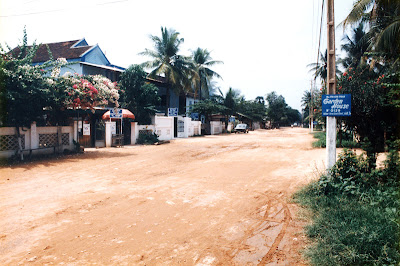
Filtering through old photos I took of at Angkor in the 90s I found a few of Siem Reap Town I took in 1995. Unfortunately the photos are not in great shape, but good enough for a couple of comparison shots. The April 2013 photos were taken today, standing in the approximately the same spots I did 18 years ago.


----------

Wat Bo Road, April 1995. At the time Wat Bo Road had several wooden guesthouses, catering primarily to budget travelers, but there were no hotels or restaurants along Wat Bo.

Wat Bo Road, April 2013.
-----------

Corner of National Route #6 and Wat Bo Road, looking east down Route #6, April 1995. Route #6 at the time was in very poor shape. There were no buses or regularly schedule road transportation from Phnom Penh. It was possible to hire a taxi, but due to road conditions the trip could take 9-14 hours, there were dubious military checkpoints along the way and the KR was still about. Most travelers from Phnom Penh to Siem Reap took the river ferry or the plane. Even the trip from Siem Reap to the Roluos Group (only 13km) was a chore, that stretch of dirt road particularly trenched and pot-holed.

Corner of National Route #6 and Wat Bo Road, April 2013. It's a smooth, paved 5-6 hour drive to Phnom Penh. Buses rule. The river ferry only runs part year now. Roluos is an easy 15 minute drive.
-------------------------

Garden House Guesthouse on Wat Bo Road. Fan, bed, net, shared bathroom, $4/night. April 1995.

Garden House Guesthouse on Wat Bo Road. April 2013.
------------------------------------

The Ya Tep Statue in the center of town, in the middle of National Route #6, near the Hotel Grand d'Angkor Park. April 1995. Ya Tep is a neak-ta (powerful spirit) local to Siem Reap and is said to help bring protection (and winning lottery numbers) to the faithful. At the time people told me that she likes "ugly things" and she always used to be surrounded by stinking chicken skins left by worshipers. I haven't checked thoroughly, but these days the offerings seem to consist mainly of incense, flowers and fruit.

The Ya Tep Statue in the center of town, April 2013.
Monday, February 11, 2013
Veal Preah Man open to public

Now that Royal funeral is over and done, the grounds of Veal Preah Man (a.k.a. Veal Preah Meru), the funerary complex of the late King Father Sihanouk, is open to the public for the first time since it was constructed. The entire complex except the interior of the central crematorium was open today. I don't know how long it will remain open or the hours, but today the guard there told me that it would be open for at least the immediate future.
This entire complex was constructed specifically and exclusively for the funeral of the late King Father Sihanouk. Similar crematoriums were built for previous Kings of Cambodia (including Sihanouk's father King Suramarith in 1960) on this same spot, and then dismantled sometime after the funeral, leaving an open park. I don't know when or if this complex will be similarly dismantled, but assume it will. There was some talk before the funeral that it would be left in place, but it does not appear to be built to last. Much of the construction is just painted plasterboard and in my inexpert opinion wouldn't last long in the rain. If you want to see Veal Preah Man close up and in all its splendor, I think you should visit fairly soon.
If you happen to be touring Cambodia right now, or have any interest in Cambodian culture or history, this is a absolutely unique opportunity to see a fleeting bit of living Cambodia history.
It is located in on Sothearos Blvd between streets 178 and 184 in Veal Preah Man Park, next to the Royal Palace and in front of the National Museum

The Cambodia Daily: In Pictures, Cambodia Prepares for King Father’s Cremation
LTO: Funeral of Sihanouk: Final Touches
LTO: Funeral of Sihanouk: Day 4, cremation
Wednesday, September 12, 2012
Where do your keep your pangolin?
Saw this (serious) story (The Curious Case of the Monkey in the Underpants) about some guy traveling with a monkey in his underwear and it reminded me of a post I made on the Lonely Planet Cambodia travel forum several years ago. I got several serious replies and a few admonishments. Only a couple got the joke. Someday somebody needs to invent a functioning [sarcasm][/sarcasm] mark-up.
Where do your keep your pangolin?
Like many travelers, I always travel with a pangolin. Last week at a $3 guesthouse in Siem Reap Cambodia, I had to go out just briefly and left my stuff there on the bed in the room, including my pangolin. When I returned, the pangolin and my $3500 camera were gone. The room was locked when I left and when I came back. There are no windows so only the guesthouse staff could have had access to the room through the locked door. When I confronted the manager, he insisted that it was "impossible" that any of his staff would steal my pangolin, and suggested that my pangolin had in fact stolen my camera, even implying that pangolins are prone to this sort of behavior. Well, there's no way. That pangolin has always traveled with me and has had plenty of earlier opportunities to steal my camera and lots more. Besides, how could it open the door to get out? With that prehensile tongue? I don't think so. The manager pled with me not to call the police and offered to give me the whole week in his guesthouse, plus dinners, for free, if I just wouldn't report it. Rattled by the loss of my pangolin, I accepted the offer. Here's my question: I know that Cambodians smile a lot. The country is known for its smiles. But every time they serve me my hamburger in the guesthouse restaurant, they don't just smile, but actually snicker, sometimes even laugh. Sometimes I even get the feeling that they are laughing at me. Am I just being paranoid?
Sunday, August 19, 2012
Anniversary
 |
| 500 riel note, stuck in my journal that first week in Cambodia |
This place is dark. Cambodia. Steeped in history still in the making. Khmer Rouge, American bombing, Pol Pot, genocide, war, UN, more war…and here we are, in Phnom Penh. We took a van in from Ho Chi Minh City today. I never thought I'd really come here.
We were originally planning to go back to Bangkok after Vietnam, perhaps find some teaching jobs there, but we met a couple of women at a café in Saigon who had just come back from Cambodia last week. They told us the UN is leaving the country and that there are lots of jobs available and a shortage of people. But safety is a big concern. There is a war going on here and tourists have been killed... On the other hand, several travelers fresh back from Cambodia all agreed that Phnom Penh and the road there from Saigon has long been firmly in government hands and that the military problems are confined to the other side of the country. So we decided to at least check out Phnom Penh.
It took about 8 hours on the road. We came through the Moc Bai crossing - a couple of wood shacks for the immigration cops and a 300 yard walk through no-mans-land between checkpoints. Like the Lao Bao crossing with Laos, streams of local people move in both directions, carrying huge loads of goods, perhaps contraband - Coca-Cola, cigarettes, beer, kitchenware, shrimp chips - dangling from shoulder sticks and sometimes just piled on their backs. Once on the Cambodian side we (Lucy) negotiated a van for the four of us the rest of the way to Phnom Penh - $15, good price.
The road from the border to Phnom Penh was paved but rough. The few people we saw looked very poor. People, often children, squatted along the shoulder at points, begging for money from vehicles passing at more than 40mph. I didn't understand what they were doing at first. I still don't. Am I supposed to throw money out of a moving car?
The countryside we drove through seemed barren compared to Vietnam, far fewer structures and houses, and I saw some signs of the war, old blast marks on a couple of buildings. When our van reached the edge of Phnom Penh the driver pulled over in an empty parking lot in the middle of nowhere and told us that if we wanted to be taken all the way to the hotel it would cost another $5. Lucy's 'forceful' negotiations ("no go hotel I pay $5 less!") got us the rest of the way to the Capitol Guesthouse at no extra charge, where we are staying now. Which turns out to be a backpacker dump. We came here on the recommendation of the same people that told us Phnom Penh is safe. Hmmm. Actually, I am not sure if it's much worse than anything else that might be available here.
Lots of backpackers here. The place seems full. The room is small and dank, the bed hard, the walls and door very thin and there is a group of 'vocal' Israeli backpackers partying hardy in the hallway. Interesting restaurant downstairs though. Full of travelers. Exposed fluorescent tubes lighting dirty tile walls, folding tables, cheap traveler's food, and a little cigarette stand at the side where the lady also sells palm-size plastic packets of leafy old ganja for 500 Riel (20 cents). Glueless rolling papers included free of charge. How do glueless papers work anyway? People twist up and smoke right in the restaurant. That particular traveler's tale seems to be proving true.
It's late now…well, 10:30 or so. The restaurant closed at nine, driving us up to our noisy little wood cell. A balcony runs around the front of the hotel with a good view of the street below, obscured only by a utility pole standing within arm's reach, densely cocooned in a meter-thick bundle of ragged electrical wires and cables.
For all the wires I would have thought there'd be some lights on somewhere, but there are almost none - absolutely no street lights at all and most of the house lighting I can see seems to be from candles. It's very dark. The streets are puddled from the rain and seem almost empty save the occasional passing motorcycle. It's Thursday night, not that late, in the middle of the city and yet it's almost dead quiet. Why? I saw a group of armed men, soldiers I think, walk by. Maybe that has something to do with it. One traveler in Vietnam told me that she could hear the sound of artillery at night in Phnom Penh. I don't hear any artillery, but I can hear the sound of somebody tapping a bamboo bell (why?) several blocks away. It's that quiet. (Though I did also hear what may have been distant gunshots, just a couple.)
As I stand here in the tropical heat, looking at that dark empty street below, soldiers wandering by, candlelight flickering in the windows of blocky old buildings, the smell of rain and mildew and incense, I think about what occurred here in Cambodia, what is occurring here, and where I am, and the gravity of it all. Twenty five years of war. Three million killed under the Khmer Rouge. The forced evacuation of the cities, Phnom Penh, here. War stretching from the 1960s till now. I find myself fascinated with the idea and the feeling of being here in this 'strange and dangerous' place, in the midst of history still unfolding. Tonight at least, it's a rush just standing here watching a dark empty street.
Monday, December 5, 2011
Riverfront Scammers and the Filipino Blackjack Con
It’s the beginning of the high tourism season in Cambodia. The tourists are back, and so are the scammers that prey on them, especially in tourist zones like the riverfront in Phnom Penh. Actually, the scammers never left, but in my forays up the riverfront these last couple of weeks they seem to be out in numbers and working hard, chasing the fresh crop of newbies in Cambodia. Day before yesterday in front of the Royal Palace I almost got a photo of three different scammers in the same shot, but they saw me raise my camera and scattered.
There are of course the professional beggars that pester tourists as they try to have a meal on the riverfront, but they are more of an annoyance than scammer. There are also more insidious forms of this, such as the women (and sometime children) that carry around rented and drugged infants as sympathy props and child beggars that have been put on the street to work. All this is fairly well known.
Then there are the foreign scammers. ‘Wild Turkey Man’ (a.k.a. the Australian beggar) is probably the best known and longest ‘working’ of the group. He and at least one or two other foreigners are running the same scam on the riverfront, a rather old one in fact, often used on the traveler’s trail. He approaches you and spins a tale about how he’s a tourist who has lost or had his passport and money stolen, the embassy requires him to pay for a new one, or is making him wait, leaving him penniless and on the street, or he needs a bus ticket to Siem Reap to pick it up, etc., etc. The tale ends predictably, with a plea for financial help, “just a dollar, maybe a few…” Leaving aside issues of honesty and such, the biggest problem I have with these sorts of foreign ne’er-do-wells is that while they are scamming tourists for beer money they are also competing with poverty-stricken third-worlders for the limited pity dollars that flow in the tourist areas.
But it wasn’t the usual suspects that inspired this post. It was the appearance of a comparatively new and potentially much more dangerous group of tourist scammers in Cambodia – what’s become known as the ‘Filipino Mafia’ or ‘Filipino Blackjack Con.’ One of these guys tried to work me the other day in front of the National Museum, and it wasn’t an hour later that a tuk-tuk driver was complaining to me (unprompted) that a tourist couple he had been ferrying around had to cut their Cambodia holiday short for having fallen prey to “Filipino sharks.” He claims that there are several of these scammers working in Phnom Penh and that he and other tuk-tuks have complained to the police, who have as yet done nothing about it.
The Filipino scammers have been running this con for years in Vietnam and their doings in Ho Chi Minh City have been well documented by Adam Bray on his website Fish Egg Tree. Even the well-experienced Vagabond Traveler was taken for a ride by these guys in Saigon.
I first noticed them here in Phnom Penh about a year ago. While walking past the Royal Palace I was approached by a friendly Asian couple – a man in his 50s and a woman in her 30s in casual dress. They began by complimenting my hat and asked where I got it. This led to more friendly conversation, and more praise and interest in my knowledge, appearance and country. They claimed to be Malaysians living in Australia. When they found out that I was a long-term expat they ended the conversation politely but quickly. I was immediately suspicious. It may sound cynical, but while somebody may stop to ask directions or perhaps try to sell you something, nobody starts extended conversations with passing strangers for no particular reason. I didn’t know what the game was at the time, but something was definitely fishy.
Three weeks later the same couple approached me in the same spot in almost the same way, but this time it was my beard they liked. They had forgotten me from before. They claimed to be half-Khmer/half-Malaysian visiting family in Cambodia. Again, they showed glowing interest in my country, my travels, my family and my experiences as a tourist in Cambodia. All 'feel good' stuff, appealing to my vanity and sense of openness as a traveler. Again, they ended the conversation when they learned I was a long-termer. I still didn’t know what they were up to but it was clearly no-good. I saw them a few times after that, walking the same area, but they didn’t approach me again.
It was shortly thereafter I learned about the ‘Filipino Blackjack scam’ being run in Saigon and heard that the same scammers had been seen in Phnom Penh. I put 2 and 2 together.
About a month ago in front of the National Museum here in Phnom Penh another couple approached me in the same way – different people, same general description, same sort of conversation except this time they started by complimenting me on my handsome backpack. Like the others, they spoke English well and with a non-Khmer accent. Unlike previous encounters, I changed my story and said I was a tourist. The conversation ran much longer. They expressed great interest in learning more about my country and invited me to join them for an authentic Khmer meal, a cultural exchange of sorts. I already knew enough, begged off and walked away. Whatever was to happen next, it was going to be some sort of an attempt to lead me into a situation over which I had no control and then separate me from my money.
Over the last month I have spotted the male half of the couple several times working tourists on the Sothearos Blvd sidewalk in front of the National Museum in Phnom Penh. Twice in the last two weeks, apparently forgetting that they have already done this to me several times, he approached me with the same lame sort of compliment/question they use every time. Day before yesterday it was my sunglasses he liked. “Very nice sunglasses. Did you buy those here?…”
They have been seen in several places in Phnom Penh including other parts of the riverfront, at Sorya Mall, in the park next to Wat Botom and in front of the Central Market (Phsar Thmey.) There are also recent reports that they are working in Siem Reap as well.
No need to detail the rest of their scam – how they manipulate you into a compromised situation, how you get into a card game you never thought you’d enter, how you lose money you never thought you’d bet, how it can amount to hundreds or even thousands of dollars, how they pressure, threaten, even drug you afterwards. They are slick and they are professionals and if you start to walk down the rosy path with them, they will get you there. The details of the scam have already been well covered by Fish Egg Tree and Vagabond Traveler.
You only need to know that THE FILIPINO SCAMMERS ARE HERE IN CAMBODIA, that they are targeting tourists, and to follow the advice that your Mom gave you when you were young...
BEWARE of friendly strangers.
There are of course the professional beggars that pester tourists as they try to have a meal on the riverfront, but they are more of an annoyance than scammer. There are also more insidious forms of this, such as the women (and sometime children) that carry around rented and drugged infants as sympathy props and child beggars that have been put on the street to work. All this is fairly well known.
Then there are the foreign scammers. ‘Wild Turkey Man’ (a.k.a. the Australian beggar) is probably the best known and longest ‘working’ of the group. He and at least one or two other foreigners are running the same scam on the riverfront, a rather old one in fact, often used on the traveler’s trail. He approaches you and spins a tale about how he’s a tourist who has lost or had his passport and money stolen, the embassy requires him to pay for a new one, or is making him wait, leaving him penniless and on the street, or he needs a bus ticket to Siem Reap to pick it up, etc., etc. The tale ends predictably, with a plea for financial help, “just a dollar, maybe a few…” Leaving aside issues of honesty and such, the biggest problem I have with these sorts of foreign ne’er-do-wells is that while they are scamming tourists for beer money they are also competing with poverty-stricken third-worlders for the limited pity dollars that flow in the tourist areas.
But it wasn’t the usual suspects that inspired this post. It was the appearance of a comparatively new and potentially much more dangerous group of tourist scammers in Cambodia – what’s become known as the ‘Filipino Mafia’ or ‘Filipino Blackjack Con.’ One of these guys tried to work me the other day in front of the National Museum, and it wasn’t an hour later that a tuk-tuk driver was complaining to me (unprompted) that a tourist couple he had been ferrying around had to cut their Cambodia holiday short for having fallen prey to “Filipino sharks.” He claims that there are several of these scammers working in Phnom Penh and that he and other tuk-tuks have complained to the police, who have as yet done nothing about it.
The Filipino scammers have been running this con for years in Vietnam and their doings in Ho Chi Minh City have been well documented by Adam Bray on his website Fish Egg Tree. Even the well-experienced Vagabond Traveler was taken for a ride by these guys in Saigon.
I first noticed them here in Phnom Penh about a year ago. While walking past the Royal Palace I was approached by a friendly Asian couple – a man in his 50s and a woman in her 30s in casual dress. They began by complimenting my hat and asked where I got it. This led to more friendly conversation, and more praise and interest in my knowledge, appearance and country. They claimed to be Malaysians living in Australia. When they found out that I was a long-term expat they ended the conversation politely but quickly. I was immediately suspicious. It may sound cynical, but while somebody may stop to ask directions or perhaps try to sell you something, nobody starts extended conversations with passing strangers for no particular reason. I didn’t know what the game was at the time, but something was definitely fishy.
Three weeks later the same couple approached me in the same spot in almost the same way, but this time it was my beard they liked. They had forgotten me from before. They claimed to be half-Khmer/half-Malaysian visiting family in Cambodia. Again, they showed glowing interest in my country, my travels, my family and my experiences as a tourist in Cambodia. All 'feel good' stuff, appealing to my vanity and sense of openness as a traveler. Again, they ended the conversation when they learned I was a long-termer. I still didn’t know what they were up to but it was clearly no-good. I saw them a few times after that, walking the same area, but they didn’t approach me again.
It was shortly thereafter I learned about the ‘Filipino Blackjack scam’ being run in Saigon and heard that the same scammers had been seen in Phnom Penh. I put 2 and 2 together.
About a month ago in front of the National Museum here in Phnom Penh another couple approached me in the same way – different people, same general description, same sort of conversation except this time they started by complimenting me on my handsome backpack. Like the others, they spoke English well and with a non-Khmer accent. Unlike previous encounters, I changed my story and said I was a tourist. The conversation ran much longer. They expressed great interest in learning more about my country and invited me to join them for an authentic Khmer meal, a cultural exchange of sorts. I already knew enough, begged off and walked away. Whatever was to happen next, it was going to be some sort of an attempt to lead me into a situation over which I had no control and then separate me from my money.
Over the last month I have spotted the male half of the couple several times working tourists on the Sothearos Blvd sidewalk in front of the National Museum in Phnom Penh. Twice in the last two weeks, apparently forgetting that they have already done this to me several times, he approached me with the same lame sort of compliment/question they use every time. Day before yesterday it was my sunglasses he liked. “Very nice sunglasses. Did you buy those here?…”
They have been seen in several places in Phnom Penh including other parts of the riverfront, at Sorya Mall, in the park next to Wat Botom and in front of the Central Market (Phsar Thmey.) There are also recent reports that they are working in Siem Reap as well.
No need to detail the rest of their scam – how they manipulate you into a compromised situation, how you get into a card game you never thought you’d enter, how you lose money you never thought you’d bet, how it can amount to hundreds or even thousands of dollars, how they pressure, threaten, even drug you afterwards. They are slick and they are professionals and if you start to walk down the rosy path with them, they will get you there. The details of the scam have already been well covered by Fish Egg Tree and Vagabond Traveler.
You only need to know that THE FILIPINO SCAMMERS ARE HERE IN CAMBODIA, that they are targeting tourists, and to follow the advice that your Mom gave you when you were young...
BEWARE of friendly strangers.
Sunday, October 2, 2011
Siem Reap Not Flooding - Trip Report 2
 |
| Tep Vong Street, Siem Reap |
This was the second time in as many weeks that Siem Reap town has flooded, but as I left the town today, it was quickly returning to normal. Whether the flooding returns will depend on the weather.
I drove from Siem Reap back to Phnom Penh following the same route I came - National Route 6 through Kampong Thom to Skun, then Route 6A through northern Kandal province and on into Phnom Penh. The road was completely dry and easily passable the entire length of the trip. Short sections of road had been damaged by the flooding, but not severely. I saw several Phnom Penh-Siem Reap tourist buses heading both directions.
The flooding in the countryside visible from the road between Siem Reap and Skun had gone down noticeably as compared to a week ago, exposing vast green rice paddies. There was still considerable flooding in the countryside south of Skun along Route 6A in northern Kandal province and the rivers in that area were still overflowing and moving fast and hard. The worst of it that I could see was in the area of Prek Kdam where the road nears and parallels the Mekong River. But even there, water that had been lapping at the road's edge last week had pulled back a couple of meters or more from the road and the possibility of water over the road seemed less of a threat than last week.
One oddity I noticed in the trip was that every countryside school grounds and most medical clinics that I could see from the road were still at least ankle deep in water, even in areas where most of the flooding had receded. I am not sure why except that it would seem schools and clinics are constructed on low ground.
For up-to-date information on Mekong River levels and flooding threats along the Mekong see the Mekong River Commission - Information Resource page.


Siem Reap Map courtesy of Canby Publications
Tuesday, September 27, 2011
Siem Reap Flooding - Trip Report
As most know by now, there has been flooding across the Cambodia and the region for almost two weeks, including in Siem Reap town. I drove from Phnom Penh to Siem Reap day before yesterday (Sunday) - the usual route up 6A to Skun, then National Route 6 through Kampong Thom and on to Siem Reap. The road was mostly clear of flooding save a couple of short stretches with a few inches of water across the road that were easily passable. The countryside to either side of the road was flooded to the horizon in many places, especially along 6A south of Skun and also near Kampong Thom City. The water was right up to the road's edge for much of the trip and just a little bit of rain would likely put it over the top. All of the rivers and streams (that could be distinguished from the flooded countryside) were full to the brim and moving fast and hard. Animals - cows and water buffaloes mostly - lined the sides of the road in several areas, driven out of the fields and to the high ground by the flooding.
Siem Reap town has experienced varying levels of flooding for better than a week, the worst of it toward the south end of town. When we arrived on Sunday it hadn't rained in Siem Reap for more than 24 hours and the flooding had reportedly stabilized and even retreated a bit. I'm staying at the north end of town where the flooding is minimal at the moment. Tuk-tuks and motodups were reluctant to try to cross from this side of town to the Old Market area, claiming that there was a 50-50 chance of the engine flooding out in the deeper sections along the way, so I decided to walk over to the Old Market in the early afternoon, about 8 hours ago. The following are some of the photos I took along the way. (Turns out that wading 2-3 kilometers through ankle to knee-deep water is surprisingly good exercise. Suffering some sore leg muscles tonight as a result.)
As mentioned above, the weather has been mostly dry in Siem Reap for at least 48 hours. Yesterday (it is now just after midnight) was sunny and pleasant in the morning with only a brief rain in the afternoon. The waters are receding from town at the moment, quite visibly so in the later evening.
All of the following were taken with a 17mm-55mm lens (Nikon D5100.) If it looks like I was standing in thigh deep water to get the shot, I was.


Siem Reap town has experienced varying levels of flooding for better than a week, the worst of it toward the south end of town. When we arrived on Sunday it hadn't rained in Siem Reap for more than 24 hours and the flooding had reportedly stabilized and even retreated a bit. I'm staying at the north end of town where the flooding is minimal at the moment. Tuk-tuks and motodups were reluctant to try to cross from this side of town to the Old Market area, claiming that there was a 50-50 chance of the engine flooding out in the deeper sections along the way, so I decided to walk over to the Old Market in the early afternoon, about 8 hours ago. The following are some of the photos I took along the way. (Turns out that wading 2-3 kilometers through ankle to knee-deep water is surprisingly good exercise. Suffering some sore leg muscles tonight as a result.)
As mentioned above, the weather has been mostly dry in Siem Reap for at least 48 hours. Yesterday (it is now just after midnight) was sunny and pleasant in the morning with only a brief rain in the afternoon. The waters are receding from town at the moment, quite visibly so in the later evening.
All of the following were taken with a 17mm-55mm lens (Nikon D5100.) If it looks like I was standing in thigh deep water to get the shot, I was.

2 Thnou Street (Old Market Street)

Old Market

2 Thnou Street (Old Market Street) near Sivutha Blvd.

Pub Street
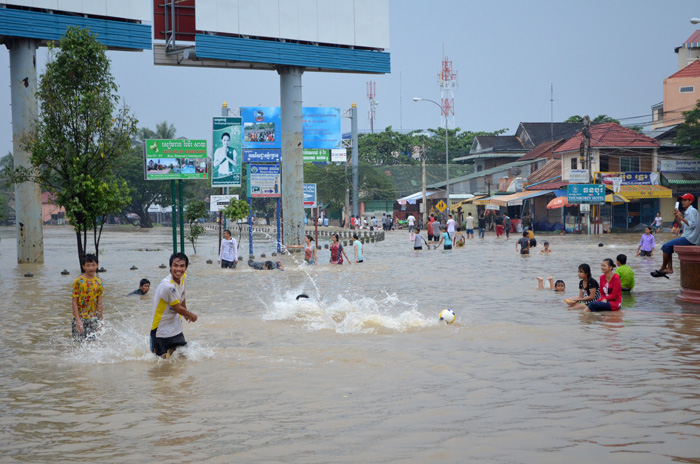
Water play at the intersection of Sivutha Blvd and Phnom Krom Road just south of the Old Market

Siem Reap Provincial Hospital

Tep Vong Street

Intersection of Sivutha Blvd. and Tep Vong Street

Tuk-tuk

Bow wave on Sivutha Blvd.

Snack vendors next to the river near the Old Market

Makeshift boat

Sivutha Blvd.

Many businesses have lined sandbags against the flooding.
Sunday, September 18, 2011
The Polite Tuk-Tuk

Tuk-tuks and motodups (motorcycle taxis) rank amongst the most annoying of annoyances for foreigners in Cambodia, badgering tourists and expats with their sales pitch virtually non-stop. If you are in a tourist area such as the riverfront in Phnom Penh, the beach area in Sihanoukville or anywhere in Siem Reap, you can scarcely walk 5 feet without one after another calling to you, following you, blocking your way, spinning their pitch no matter how many times you say ‘no.’ Their harassment has tainted many a Cambodian holiday, all of which makes the guy pictured above pretty special. I spotted him a few weeks back as I walked up the Phnom Penh riverfront. He didn’t say a word as I passed, just smiled and nodded, his sign telling the story. “WELCOME: I do not want to disturb you…” it reads, going on to offer his tuk-tuk services. ‘My God,’ I thought - courtesy and information rather than harassment and hucksterism – what a completely unique and thoroughly welcome approach from a Cambodian tuk-tuk. I stopped to express my approval for his idea, even though I didn’t need a tuk-tuk right at that moment. He told me he is trying to be “polite,” hoping that foreigners would appreciate the difference. I know I do. And I want to support this guy in his effort. Since then, when I need a tuk-tuk, if I can find him, I use him. In fact I will go out of my way to give him my business, walking up the riverfront to search him out. I urge others to do the same. Good business practices such as this should be rewarded and encouraged.
He seems to hang out at the corner of Sisowath Quay and Street 148 on the Phnom Penh riverfront, just next to Metro and Riverside Bistro. He’s easy to spot. There’s the sign on the side, and he’s the only one in the group who’s not charging at you yelling “tuk-tuk!...tuk-tuk!…tuk-tuk!..."
UPDATE, Sept 24, 2011: I ran across Mr. Sally today (at his usual place in front of Metro) and asked if he would mind if I published his phone number in this post. He enthusiastically endorsed the idea. So here it is: 092-319232 (+855-92-319232.) He told me that his working hours are from 7AM-10PM (Cambodia time.) Please do not call him outside of his working hours.
Sunday, May 29, 2011
Amsterdam
The Dutch government announced today that the Netherlands will soon ban tourists from their famed marijuana dispensing coffee shops which have long offered a haven for pot smokers from around the world. A letter from the Dutch Parliament stated, "In order to tackle the nuisance and criminality associated with coffee shops and drug trafficking, the open-door policy of coffee shops will end..."
So comes the conclusion of drug tourism in the Netherlands, or at least to the above-the-board type.
Which reminds me of a travel story from decades back, the last time I was in Amsterdam...
........
It was mid-winter about 24 years ago.
I was sitting in a coffee shop in the tourist district of Amsterdam with some friends, when a strung-out looking junky-type wearing a brand new, bright red, cold-weather jumpsuit stumbled through the door and planted himself at the end of the counter a few seats away. Spittle dribbling down his thick beard, he muttered loudly to himself about how America "is shit because Van Damme is soooo much better than Sylvester Stallone," all the while staring at us, or at least trying to stare at us, his head slowly bobbing and his eyes seemingly unable to focus.
Paying him little mind, we continued to sip tea and coffee and chat amongst ourselves (including speculating quietly about the possible origins of the brand new bright red jumpsuit) as some other guy sitting at the counter near me slowly cleaned some ganja to roll a joint. A few minutes later, just as he put joint to lips, the jumpsuit mumbler rose abruptly to his feet and marched unsteadily toward us with obvious purpose in his plodding step.
I was the closest. He stopped right in front of me, inches away, and looked me as square in the eyes as he could muster. I was prepared to say 'no' to pretty much anything he had to ask, but his request surprised me. Motioning to the ashtray on the counter, he implored, "Can I eat your seeds and roaches...Maaaaan?," his Germanic accent adding a very appropriate Tommy Chong drawl to his already slurred speech.
I didn't know quite what to think except, 'how can I deny him this?'
Mildly dumbstruck, I slowly nodded and leaned back so he could reach across and pick up the ashtray. Dirty treasure in hand, he squatted on the floor in front of us, blew most of the ashes out of the ashtray and then dumped the entire contents into his mouth - seeds, sticks, remaining ashes, roaches, a couple of filters and a used tea bag with the tag string still attached. He reach into his mouth and fished out the string, held on and pulled, squeezing the teabag against his tongue, sucking it with an expression of deep savor and using the remaining moister to help swallow the dry sticks and seeds. Fearing he would choke, I offered my cup of tea, but he refused.
When finished, he made a smooth exit. With taught, seemingly practiced moves, he stood straight, handed me the ashtray, put the teabag in his pocket, offered a polite "thank you," felt his way back along the counter to the door and left.
The proprietor emerged and walked over, broom in hand to clean up the ashes from the floor. He shook his head, grumbling, "fooking Danish junkie comes in here everyday."
So comes the conclusion of drug tourism in the Netherlands, or at least to the above-the-board type.
Which reminds me of a travel story from decades back, the last time I was in Amsterdam...
........
It was mid-winter about 24 years ago.
I was sitting in a coffee shop in the tourist district of Amsterdam with some friends, when a strung-out looking junky-type wearing a brand new, bright red, cold-weather jumpsuit stumbled through the door and planted himself at the end of the counter a few seats away. Spittle dribbling down his thick beard, he muttered loudly to himself about how America "is shit because Van Damme is soooo much better than Sylvester Stallone," all the while staring at us, or at least trying to stare at us, his head slowly bobbing and his eyes seemingly unable to focus.
Paying him little mind, we continued to sip tea and coffee and chat amongst ourselves (including speculating quietly about the possible origins of the brand new bright red jumpsuit) as some other guy sitting at the counter near me slowly cleaned some ganja to roll a joint. A few minutes later, just as he put joint to lips, the jumpsuit mumbler rose abruptly to his feet and marched unsteadily toward us with obvious purpose in his plodding step.
I was the closest. He stopped right in front of me, inches away, and looked me as square in the eyes as he could muster. I was prepared to say 'no' to pretty much anything he had to ask, but his request surprised me. Motioning to the ashtray on the counter, he implored, "Can I eat your seeds and roaches...Maaaaan?," his Germanic accent adding a very appropriate Tommy Chong drawl to his already slurred speech.
I didn't know quite what to think except, 'how can I deny him this?'
Mildly dumbstruck, I slowly nodded and leaned back so he could reach across and pick up the ashtray. Dirty treasure in hand, he squatted on the floor in front of us, blew most of the ashes out of the ashtray and then dumped the entire contents into his mouth - seeds, sticks, remaining ashes, roaches, a couple of filters and a used tea bag with the tag string still attached. He reach into his mouth and fished out the string, held on and pulled, squeezing the teabag against his tongue, sucking it with an expression of deep savor and using the remaining moister to help swallow the dry sticks and seeds. Fearing he would choke, I offered my cup of tea, but he refused.
When finished, he made a smooth exit. With taught, seemingly practiced moves, he stood straight, handed me the ashtray, put the teabag in his pocket, offered a polite "thank you," felt his way back along the counter to the door and left.
The proprietor emerged and walked over, broom in hand to clean up the ashes from the floor. He shook his head, grumbling, "fooking Danish junkie comes in here everyday."
Sunday, January 23, 2011

Sunday, January 16, 2011
Update: National Route #3 to Kampot
Three months ago I reported on the state of the roads south from Phnom Penh to Kampot and Kep, recommending at the time taking an alternative route via Nation Route #2 (NR2) in lieu of the on-going road construction on the more direct National Route #3 (NR3.) Over the last few months the conditions on NR3 have improved greatly. Most of the construction on NR3 is now complete and the road is wide, flat and paved. A sure sign that NR3 is now the better route, most Kampot-bound taxis and buses have begun to use NR3 again instead of NR2. There are still comparatively short unfinished sections (a few kilometers) at both ends, near Phnom Penh and near Kampot, and several bridges are also still incomplete, requiring short detours. But the trip down NR3 to Kampot can now be made in about 3 hours, perhaps a bit longer, the same or faster than the alternative routes. As road construction seems to be moving along at a brisk pace and is in its final stages, my guess is that NR3 will 100% complete in the fairly near future.
Most direct route from Phnom Penh to Kampot: NR3 all the way.
Most direct rout from Phnom Penh to Kep: NR3 > R31 > R33 > R33a
See the map in my previous post.
Most direct route from Phnom Penh to Kampot: NR3 all the way.
Most direct rout from Phnom Penh to Kep: NR3 > R31 > R33 > R33a
See the map in my previous post.
Saturday, January 15, 2011
The state of Otres Beach
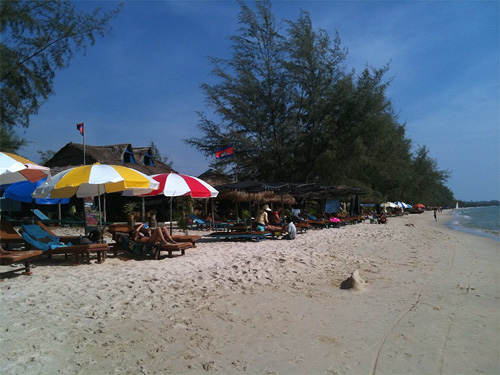 |
| The near end of Otres Beach, last week |
The beach itself is wonderfully primitive and laid back. There are no hotels, spas or shops, not even any running water or, until just last year, regular electricity. Until mid-2010, thatch covered beach bars dotted the full length of Otres, but much more sparsely than Ochheuteal. There were a few basic bungalows on the sand and a couple of places offering kayaks and Hobies. Even the roaming beach vendors (massage and trinkets) were much fewer and far less aggressive than their Ochheuteal counterparts. Otres was (and still is) a place that you can fall asleep in your beach chair unperturbed by crowds, beggar kids and hawkers. The only real drawback to Otres was that it is difficult (and even dangerous) to get back to the main town area come evening. The road is long, lonely and dark, and robberies of those trying to make their way back in the evening are not unknown. Better to come back either before sundown or stay the night at Otres.
 |
| Map of Otres showing the project area |
Early last year, it seemed the end was nigh. The on and off talk of development began to concretize. The government delivered notice that all businesses were to clear the beach in a month to make way for a planned development. After negotiations, the government seemed to relent, demanding only that people stop laying permanent foundations on the beach. And offering even greater hope at the time, the city connected the Otres area to the regular electrical grid and allowed the beach businesses to hook in, bringing Otres its first 24/7 power.
 |
| The development project |
 |
| Inside the development area, last week |
At the near end, the atmosphere has changed very little from the old Otres. If you don't walk up the beach too far you won't even know the development project is there. Relaxed little beach bars and BBQ shacks still ply their trade. Many of the beach bungalows are now gone, but not all, and little guesthouses have begun to pop up on the other side of the road, off the sand but still only 20 meters from the
 |
| Evicted villager's huts |
How long will it last? God and the government only know. There are still rumors of an expanded development project that will take out the remaining businesses at the near end, but no sign or official word of it yet. There is still the very grim reminder of Otres development on the entry road - the sad remnants of the Otres community, local people violently evicted from their village by a land deal back in 2007, now living in a string of squatter huts along the roadside. But for beach goers, for now, Otres is not gone. In fact, save the middle section, it is much the same as before.
 |
| Otres Beach, 2006 |
Eviction of Otres village
DAS: Otres evictions, update, February 12, 2008
PPP: Band bids Otres beach bars farewell, February 12, 2010
PPP: Otres eviction talks set for today, July 5, 2010
July 2010, Otres Beach 2010: What does the future hold???
Tuesday, December 21, 2010
A passing encounter
Bangkok. Out of the hospital with a clean bill and no required follow-ups. Not quite what I was but a helluva lot better than I could have been. I'm done with them and almost home.
Feeling tired and weak and a bit beaten up by the doctors, but nevertheless past it, I decided to make a night out, recoup some strength, if in attitude only. I began at a Soi 4 bar, perchance talking to an old (35ish) Thai taxi girl with whom I had one of the most disturbing conversations I've had.
I think she was trying to talk me up, hoping that I'd become a customer, but she spewed so much hatred, such unrelenting bile for everybody and every kind of person, that she literally made me feel physically ill. Any other time I would have been able to take it in stride, perhaps knock her down a few pegs, but my weakened state left me vulnerable.
One of the reasons I went to the bar was to try to relax and buck up a bit, put on a light, listen to some music, watch some people, get into a better frame. I just wasn't ready for her. Not that she directed any of her venom at me - after all, I was a potential customer. But no-one else was spared.
She began when I entered, harshly forcing some other (younger, prettier) taxi girls to relinquish their choice streetside seats to me, referring to them as "buffaloes." Granted, as a paying customer I was entitled to the seat, but I wouldn't have asked them to move, taxi girls or not.
I sat down.
She plopped down next to me and immediately began about the 'half-brained idiot farang bar owner' who lets these "useless buffaloes" do what they want. She went on…and on.
Trying to change the subject to something completely different, I asked about a katoey fortune teller that used to sit on the sidewak in front of the Dynasty Inn a few doors down. A deck of cards, a candle and a kerchief on the pavement - he was there for many years and I noticed in my last couple of visits that he had disappeared. I thought maybe he had moved. To be honest, I have no particular sympathy for katoeys and probably even something of a prejudice against them, but would never dream of wishing harm on somebody who had done me no harm. And this particular guy (girl) had always been kind to me. He spoke decent English and turned the cards and told my fortune a couple-few times over the years, doing a pretty good job of it. Anyway, when I asked about him she told me bluntly and with something of a smirk that he was dead - "dead of AIDS," she enunciated.
I felt an immediate rush of sadness. I knew this guy, or at least who he was. She went on to revel in it a bit, telling me how he deserved it because he was a katoey, how all katoeys deserve it, "butt-fuckers" that they are. I pressed for more info, received little, and in hindsight, I'm not sure she was telling the truth anyway. It may have all have been an exercise in wishful thinking.
She then went on to attack, in turn, the stupid Khmer beggars, the job-stealing Burmese, the thieving Vietnamese children who sell flowers on the street and, of course, the "smelly Muslims" that inhabit Soi 3. With a big smile she used my almost empty beer bottle to demonstrate how she would crack the skull of an 8-year-old Vietnamese 'match-girl' who was working the street nearby. And even though I went from a polite smile, to defending these people, to a blank stare, to a disgusted stare and finally quite obviously just looking away trying to ignore her, I don't think she ever got the idea that I was anything but enjoying her vile banter. I guess I should have just laid into her, but really wasn't up for a fight. That's not why I was there.
In the end, after only two beers, I called for my bill, paid the exact amount, and left. As I was leaving she followed, proffering the standard lilting "where are you going?" and a sweet voiced "come again," probably hoping for a tip or an offer to have her join me, but I wouldn't/couldn't even look at her.
I went on to better places and better people and made a pretty good night of it.
I have no moral to this story or conclusion to offer, just a vaguely sick feeling from the encounter, slowly fading as the hangover wanes and my strength returns.
Feeling tired and weak and a bit beaten up by the doctors, but nevertheless past it, I decided to make a night out, recoup some strength, if in attitude only. I began at a Soi 4 bar, perchance talking to an old (35ish) Thai taxi girl with whom I had one of the most disturbing conversations I've had.
I think she was trying to talk me up, hoping that I'd become a customer, but she spewed so much hatred, such unrelenting bile for everybody and every kind of person, that she literally made me feel physically ill. Any other time I would have been able to take it in stride, perhaps knock her down a few pegs, but my weakened state left me vulnerable.
One of the reasons I went to the bar was to try to relax and buck up a bit, put on a light, listen to some music, watch some people, get into a better frame. I just wasn't ready for her. Not that she directed any of her venom at me - after all, I was a potential customer. But no-one else was spared.
She began when I entered, harshly forcing some other (younger, prettier) taxi girls to relinquish their choice streetside seats to me, referring to them as "buffaloes." Granted, as a paying customer I was entitled to the seat, but I wouldn't have asked them to move, taxi girls or not.
I sat down.
She plopped down next to me and immediately began about the 'half-brained idiot farang bar owner' who lets these "useless buffaloes" do what they want. She went on…and on.
Trying to change the subject to something completely different, I asked about a katoey fortune teller that used to sit on the sidewak in front of the Dynasty Inn a few doors down. A deck of cards, a candle and a kerchief on the pavement - he was there for many years and I noticed in my last couple of visits that he had disappeared. I thought maybe he had moved. To be honest, I have no particular sympathy for katoeys and probably even something of a prejudice against them, but would never dream of wishing harm on somebody who had done me no harm. And this particular guy (girl) had always been kind to me. He spoke decent English and turned the cards and told my fortune a couple-few times over the years, doing a pretty good job of it. Anyway, when I asked about him she told me bluntly and with something of a smirk that he was dead - "dead of AIDS," she enunciated.
I felt an immediate rush of sadness. I knew this guy, or at least who he was. She went on to revel in it a bit, telling me how he deserved it because he was a katoey, how all katoeys deserve it, "butt-fuckers" that they are. I pressed for more info, received little, and in hindsight, I'm not sure she was telling the truth anyway. It may have all have been an exercise in wishful thinking.
She then went on to attack, in turn, the stupid Khmer beggars, the job-stealing Burmese, the thieving Vietnamese children who sell flowers on the street and, of course, the "smelly Muslims" that inhabit Soi 3. With a big smile she used my almost empty beer bottle to demonstrate how she would crack the skull of an 8-year-old Vietnamese 'match-girl' who was working the street nearby. And even though I went from a polite smile, to defending these people, to a blank stare, to a disgusted stare and finally quite obviously just looking away trying to ignore her, I don't think she ever got the idea that I was anything but enjoying her vile banter. I guess I should have just laid into her, but really wasn't up for a fight. That's not why I was there.
In the end, after only two beers, I called for my bill, paid the exact amount, and left. As I was leaving she followed, proffering the standard lilting "where are you going?" and a sweet voiced "come again," probably hoping for a tip or an offer to have her join me, but I wouldn't/couldn't even look at her.
I went on to better places and better people and made a pretty good night of it.
I have no moral to this story or conclusion to offer, just a vaguely sick feeling from the encounter, slowly fading as the hangover wanes and my strength returns.
Friday, December 17, 2010
Southeast Asia Backpacker's Credo and Motto
The Credo
1. I shall eschew the ways of the tourist and have an authentic Asian experience rather than a shallow, contrived, package holiday. I am Traveler.
1. I shall eschew the ways of the tourist and have an authentic Asian experience rather than a shallow, contrived, package holiday. I am Traveler.
2. I shall wear the largest possible backpack to bear proud witness of my creed.
3. I will spend my travels on the quest for Our Holy Grail - for the ‘Unspoiled Place’ - a place undiscovered by tourists, where happy, welcoming, generous natives tend vast fields of ganja along a deserted, previously unknown tropical beach, and that has Internet access.
4. I shall begin my quest on Khao San Road.
5. I shall not leave Khao San Road without a Lonely Planet guide.
6. I shall never admit to using a Lonely Planet guide.
7. I shall follow ‘Wheeler’s Way’, a mystical school of thought, which both eschews and embraces Khao San Road – a way of finding the Unspoiled Place without ever leaving the path.
3. I will spend my travels on the quest for Our Holy Grail - for the ‘Unspoiled Place’ - a place undiscovered by tourists, where happy, welcoming, generous natives tend vast fields of ganja along a deserted, previously unknown tropical beach, and that has Internet access.
4. I shall begin my quest on Khao San Road.
5. I shall not leave Khao San Road without a Lonely Planet guide.
6. I shall never admit to using a Lonely Planet guide.
7. I shall follow ‘Wheeler’s Way’, a mystical school of thought, which both eschews and embraces Khao San Road – a way of finding the Unspoiled Place without ever leaving the path.
(Editors note: ‘Wheeler’s Way’ is a school of thought posited as a possible answer to the decades old conundrum known as the ‘Sang Thip Paradox’: If it is in Lonely Planet then I can find it, but it won’t be the Unspoiled Place. If it is not in Lonely Planet, it might be the Unspoiled Place, but I won’t be able to find it.)
8. I shall wear the traditional international backpacker’s uniform and don at least one piece of local clothing (conical hat, krama, yam, etc.) to show my oneness with the Asian people.
9. I shall not clean the local soils and aromas from my uniform for I wish to always carry a piece of where I have been.
10. I shall never wear a souvenir tee shirt in the tee-shirt’s country of origin.
11. I shall eat banana pancakes on a regular basis, for it is the quintessential Asian food.
12. I shall eat in the cheapest restaurants. Hygiene is for package tourists.
13. I shall travel by the least comfortable means, for comfort is also for package tourists.
14. I shall drink the local beer, for I shall always endeavor to be in tune with the local culture. And because it is the cheapest.
15. I shall stay in the cheapest guesthouse. More money for beer.
16. I shall not allocate more that 75% of my daily budget to alcohol and drugs. Moderation in all things.
17. I shall make a pilgrimage to a Full Moon Party at Had Rin Beach Koh Phangan at least once in my life. For it is Mecca.
18. I shall revel in food and mosquito-borne diseases, for these are the badges of the true Asian Traveler.
19. I shall not leave Thailand without having my hair colored, dreaded, corn-rolled or shaved off.
20. I shall model my travels on “On the Road” by Jack Kerouac
21. I shall read “The Beach” before entering Thailand so that I understand the goal of quest.
22. I shall read “Off the Rails in Phnom Penh” before entering Cambodia so that I understand the dangers of the quest.
23. I shall read “The Quite American” while travelling through Vietnam because everybody else is.
24. And this above all: I shall bargain without mercy and hone my skills to a sharp edge, so that I can proudly proclaim our sacred motto:
“I get it for less than the locals”
In times of trial and doubt – as I lose all feeling in my legs in the 14th hour of a local bus ride…when I can’t sleep for the noise of a thousand rats scurrying through my $2 room…as vomit and diarrhea spew simultaneously from my salmonella saturated body – I will repeat this mantra unto myself…
I am not a tourist
I am not a tourist
I am not a tourist
I am not a tourist
I am not a tourist
I am not a tourist
I am not a tourist
I am not a tourist
I am not a tourist
I am not a tourist
I am not a tourist
…until the doubt passes and I am ready for more authentic Asian experiences.
(I originally published this several years back. A couple of the references are a bit dated, but otherwise it seems to be holding up pretty well. Yes, I know, backpackers are an easy mark and perhaps picked on a bit too much, but having visited Khao Sarn Road today, I just can't help myself. And it is, after all, the season to be jolly.)
Tuesday, November 16, 2010
The Last Smile

The real tale of the sign begins in the early years of Thai tourism when Thailand was, as the promotional slogan used to go, “The Land of Smiles,” with the emphasis on the plural. In those days the Realm was awash in smiles, quite unlike the stodgy West where smiles were in short supply and huge demand.
The promise of cheap, plentiful smiles drew hoards of foreign smile collectors to Thailand. Many of these collectors, when confronted with the overwhelming abundance of smiles and almost complete lack of legal regulation, acted like pigs in slop, wallowing, sometimes drowning in a sea of cheap smiles at the likes of Koh Phangan, Phuket, Pattaya and Patpong. Other collectors, perhaps the majority, were better behaved. But behaved or not, all of them had one thing in common. They all bought smiles as fast as the Thais would sell them.
In a matter of just a few short years virtually every smile in Thailand had been bought, packaged and shipped overseas. Such was the state of things when, at the end of a fated high season, a nameless European tourist on his way home from a Thai holiday was waiting in line at airport immigration at Don Muang. As the queue inched forward, he noted the bored, almost surly mechanical actions of the immigration officers - much like the hotel receptionist had acted when he had paid his bill earlier. In fact, he had not seen a single smile since he had gotten out of bed that morning. Not from the waiter at breakfast, not from the taxi driver, not from anybody on the street, not even from the bar girl he woke up with. This was not the Thailand he had known and loved.
Lost in this thought, he didn’t notice the open counter in front of him. The immigration officer harrumphed impatiently, waving him forward. He stepped up, handed over his passport and fell back into thought about the recently purchased smiles he had in his bag - a bunch of cheap 5-for-250 baht smiles from Khao Sarn Road and a couple of big expensive ones from Soi Cowboy. The officer pushed his passport back across the desk and harrumphed again for him to move on.
On an impulse, the tourist reached into his bag and pulled out one of his best new 'Made in Issan' smiles. “For you”, he said, handing it to the officer with two hands and a polite little bow of the head. Slowly, a broad, happy, inscrutably bemused smile spread across the immigration cop’s face. The tourist smiled back, picked up his passport and disappeared into the crowd. Over the next few weeks, as the officer wore his smile around the airport, it became apparent that he was alone.
As it turns out, that tourist was carrying the last few free-roaming smiles in Thailand. By chance alone, he left behind the last living member of a now extinct species. Shortly after the incident, the officer was transferred from departures to arrival immigration where his unique expression became a fixture, and later a legend. That smile, ‘the last smile in Thailand’, was commemorated by the sign, “Welcome to the Land of Smile” in the airport arrival area. He has since transferred to immigration arrival at the new Sovamabhumi Airport in Bangkok, where he works to this day. It is still possible to see him if you happen into the right immigration line. He is easy to spot. He is the only one smiling.
Tuesday, October 26, 2010
Leho
 It was March 1994 if I remember correctly. My first visit to Angkor. I was fortunate. I had almost 4 weeks at the temples and I took full advantage, spending every day amongst the ruins, much of the time at Angkor Wat studying the bas-reliefs and architecture. It was at Angkor Wat that I met Leho, a little Cambodian boy, maybe 6 or 7 years old, abandoned and living in the temple ruin. He was a pitiful sort - gaunt, weak, his hands and feet covered with sores - scabies and bug bites. A beggar kid working the very few tourists Angkor had back then.
As I usually do with beggars, especially children, I brushed him off the first couple of times he tried begging from me. But he looked so neglected and was so meek in his approach that I finally relented and gave him 500 or 1000 riel (20-40 cents.) I noticed that he went straight to the food stands and bought a small plain baguette (the cheapest and most filling food you can buy for 500 riel,) which he gobbled down all too quickly. This kid appeared to be in real difficulty - hungry, sick and seemingly alone - not one of the usual beggar-scammers working the tourists. So I made it a habit of giving him a little money every morning when I saw him at Angkor Wat.
He began to follow me around in my exploration of the ruin, not being a nuisance as temple children often are, but standing quietly in the background just watching what I was doing, which was fine with me. I'd buy him bottled water, share my snacks and occasionally bounce ideas and opinions off of him, some point of art or history, to which he would always nod in agreement.
I couldn't get his story out of him. My Khmer was poor at the time and his English non-existent. One of the temple nuns that tended the Buddhas on the third level told me that he was an orphan and that she knew little more of him than that. Slowly growing more fond of
 him and concerned over his situation, one day I gave him $15, hoping he'd use it wisely. A naïve move on my part. The following day he was missing. The day after that I found him on the third level of Angkor Wat with that same temple nun, his face bloodied and swollen from a pummeling. He had been beaten for the money by this band of miscreants>>>
I decided then to take him under my wing the best I could for the time I was there, which I communicated to him through the nun. He seemed grateful.
Almost everyday I would arrive at Angkor at 4:45AM to photograph the sunrise. Around 5:00 Leho would appear from the nearby pagoda with a big smile and come stand at my side as I took photos. The sun risen, we'd go get a noodle soup from one of the stands along the pagoda wall. After breakfast, back to the temple where he would stick by me through the morning as I studied and photographed the bas-reliefs or sometimes just sit and read. Come noonish he'd often have lunch with me at one of the sandwich carts, after which I'd go to other temples, leaving him at Angkor Wat. But I'd usually swing by in the evening on the way back to town and give him food and water or some money for dinner.
One morning he didn't show. Nor did he for the next three days. I started to worry. On the fourth day I began to search for him, asking the soldiers and nuns around the temple if they had seen him, but without luck. One of the nuns told me that he would sometimes stay in the southern gateway of the outer wall, a place rarely visited by anybody save the occasional monk to tend the enormous 'mud-daub Buddha' inside.
I walked out the path through the woods to the gateway and entered quietly. At first it seemed empty, but then I heard a sound from the great Buddha to my right. I peeked behind. It was Leho. Curled in a ball, coughing shallowly, seemingly unable to breath. He looked to be at death's door. He couldn’t walk. He was very hot. I picked him up and carried him all the way back to and around Angkor Wat, up the main causeway and out to the street, more than a kilometer, almost giving this old smoker a heart attack. I flagged a motodup and took him to a little clinic in town. He was in a bad way. Pneumonia I gather. Or maybe Dengue Fever. He was there for 4 days on IV something. I'm not sure what. I didn't visit. They charged me $75 in advance and assured me it would cover everything.
 The next week he was back at Angkor again, as was I. He became a fixture at my side, carrying my camera equipment, eating meals with me and listening to me read stories of the history of Angkor from Parmentier, Glaize and Coedès, though I am sure he didn't understand a word. He showed me little secrets of Angkor Wat - the smiling apsara outside on the second level, the fork tongue apsara (photo below,) 'the friends' apsara pair in the first level interior gallery. It all did my heart good and I think helped him as well.
When it finally came time to leave I was terribly worried about him. I gave the nun and the police money to help take care of him and protect him,
 promising/threatening that I would return in two months and that I expected him to be well when I got back. They promised that they would watch over him. If I had accomplished nothing else in my stay there, I had accomplished this. I hugged him and said goodbye.
Three months later I returned, this time with my wife. First thing, we went to check on Leho. Sure enough, he was still there at Angkor Wat, looking a little bit better. The sores on his hands and feet were healing. The nun had kept her promise, feeding him and cleaning him properly. She said that even the police had honored their word, warning the other temple boys to leave him alone and allowing him to sleep at the police post. He seemed to have formed a relationship with the nun and was happier. I was only there for two weeks that time and spent less time at Angkor Wat, but whenever we (my wife and I) were there he followed us around just as he had before. Over the next year, we saw him a few times on our visits, looking stronger and healthier each time. Finally, after a couple of years, he just wasn't there anymore. Perhaps he moved to another temple. Perhaps he just moved on.
 Leho with the nun
Tuesday, October 19, 2010
Boeung Kak bye-bye
 |
| Restaurants and guesthouses line the edge of Boeung Kak lake, 2007 |

It won't be long now.
 |
| Street 93 in 2008 |

Monday, October 18, 2010
The Liar Paradox and a Saigon Taxi
The Cretin said, "The Cretans are always liars."
- The Liar Paradox
- The Liar Paradox
I arrived in Ho Chi Minh City by plane, checked through immigration and customs and walked out of the terminal to the taxi stand to get a cab to my hotel (the Trang Long Hotel on Mac Thi Buoi Street, a tourist hotel in the heart of a tourist district.) I had reservations and know the place well as I have stayed there several times. The taxis in Ho Chi Minh City are equipped with meters, but at the airport the drivers refused to use them, instead demanding a flat rate of US$10 into town. A rip-off price, but so it goes at airports and bus stations the world over where they have you over a barrel. Tired and anxious to get to my hotel, I argued only weakly, then agreed to the $10.
I handed the taxi driver a slip of paper I had prepared beforehand with the name, address and directions to the hotel written in Vietnamese. He glanced at the paper and told me that there was no such hotel or street of that name in Saigon, though he knew of a good hotel in a different part of town. (I didn't bother to ask how his hotel could be in a different part of town from a place that doesn't exist.) So I dug through my stuff, found a business card for the hotel and handed it to him. He looked and responded "only Vietnam people stay at that hotel," and added that he had a much better place for foreigners like me. I told him that I had reservations at that hotel and had to go there. With that he seemed to relent and ushered me to his cab. I got in, keeping my one bag in hand.
As we were leaving the airport he slowed the car, glanced back over the seat and told me that my hotel had "closed a long time ago" and that it would be a waste of time for us to go there. He warned that driving all over town could get very expensive. I said again that I had reservations at the Trang Long, that I had just spoken to them yesterday and that I was certain that they were not closed. Without missing a beat, he shot back that the hotel was both dirty and dangerous, and that several tourists had been robbed and there had even been a murder in the previous weeks, but that his hotel was "very clean, safe and famous with tourists." I told him that I was meeting people at my hotel and that I really had no choice but to go there. He asked if I was meeting Vietnamese people, and when I responded in the affirmative he warned me not to believe anything they said because "Vietnamese people will just lie to you just to get your money."
We met eyes in the rear view mirror. He looked like he just bit into a chili. I smiled slyly and assured him that I would be "very careful of Vietnamese people." He looked away quickly. I think he realized his fallacy, him being Vietnamese and all. He went quiet and we continued on to the Trang Long Hotel.
As we pulled up in front of the hotel he pointed at the closed doors and said excitedly "see, closed!" just as the door opened and the doorman came out to welcome us. He instructed me, "stay here in the taxi, I'll check for you" and then hopped out, grabbed the doorman by the arm and leaned into him talking quickly. While he was distracted with the doorman I got out of the taxi and walked into the hotel before he noticed me. He tried to follow but the doorman stopped him from entering the hotel. I walked to the reception desk well away from the door and called over the bellhop, handed him the taxi fare (including a tip) and asked him to go pay the driver for me, which he did. As the bellhop returned I could see the driver through the glass doors wave for me to come out. Concerned there was some sort of problem I walked to the door and pressed it open slightly. He stuck his head in and whispered, "You need lady? Vietnam lady very good. Do everything..." I just dropped the door on him and walked away. The last I saw of him was just before I went to my room, still out front talking in an animated fashion to the doorman, no doubt trying to extract some sort of commission from this dirty, dangerous, non-existent, all-Vietnamese hotel.
Of all the things he said to me that day I think he may have come closest to the truth when he invoked the Liar's Paradox. At least then he was half right.
Subscribe to:
Posts (Atom)