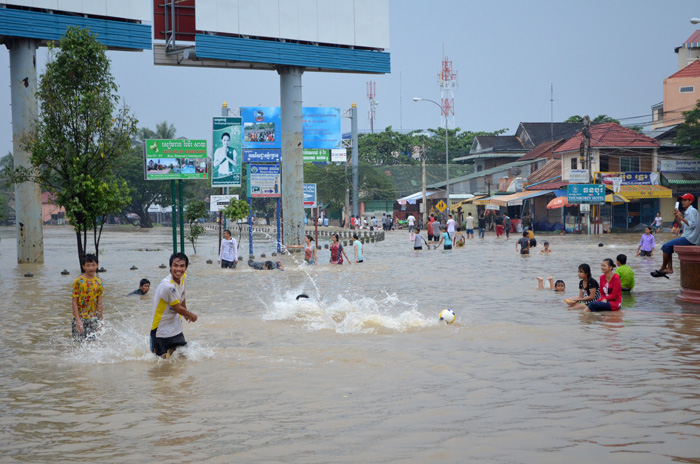
Showing posts with label flooding 2011. Show all posts

Monday, September 24, 2012

Flooding: A year later

Last year on this day I posted comparison photos of the water level of the Tonle Sap River in Phnom Penh, showing a dramatic rise in the level between September 17 and September 24. Though there wasn't any flooding in Phnom Penh at the time, flooding was sweeping other parts of the country and getting worse by the day. The rapidly rising river in Phnom Penh hinted the capital city might be next.

This year is quite different. The rain has been much lighter and the rivers not filling as quickly as last year. There were near drought conditions in several provinces in the first months of this monsoon season, and though the rains have increased in recent weeks and there has been flooding in some western provinces, there is no comparison to last year. So far, 2012 is proving to be a comparatively dry year in Cambodia. Still, there is at least 6 weeks left in this year's monsoon season, there has been flooding in neighboring Thailand, and as last year's photos illustrate flood conditions can change quickly.

The photos below were taken from approximately the same spot on the Phnom Penh riverfront (Tonle Sap River,) exactly one year apart: 2011 on the left and 2012 on the right.

 River level comparison 2011/2012. Phnom Penh riverfront, Tonle Sap River. (Note the stair steps, particularly in the Sept 24 photos - 2 visible in 2011, 16+ visible in 2012.)


Today's observed water level of the Tonle Sap River at the Phnom Penh Port from the Mekong River Commission. See MRC Cambodia flood info at: MRC Cambodia

Monday, August 13, 2012

Cambodia: Flooding 2012 (not...yet)

Getting lots of hits on my 2011 flooding posts and starting to get e-mails from travelers asking about current flooding – ‘Is there flooding in Cambodia?’ ‘Is Phnom Penh flooded?’ ‘Will there be flooding this year?’The disastrous 2011 floods in Cambodia and Thailand have left many wondering if there will be a repeat performance this year.

Is there flooding in Cambodia ? In short, no, there is no flooding or threat of imminent flooding in Cambodia. In fact, so far this year the monsoon rains have been rather sparse and the rivers are at normal, even slightly below normal levels. The river level at the Phnom Penh Port is currently at 6 meters, well below even warning level and on the low side of normal for mid-August.

Phnom Penh riverfront, August 10, 2012. Water level 3.5 meters below warning level and 5 meters below flood level.

Water level chart for the Phnom Penh Port on the Tonle Sap River, August 12, 2012. Note that the current observed water level is below previous flood years, (though that could certainly change.) MRC website.

Will there be floods this year? Depends on what is meant by ‘floods.’

Parts of Cambodia flood every year. During the monsoon season (June-November) the great Tonle Sap Lake in the center of the country ordinarily swells to cover as much as 5 times its dry season surface area, flooding vast mangrove forests and beyond. Villages along the lake build their houses on 9 meter stilts to stay above the water. This flooding is part of a normal annual cycle that helps replenish the land and irrigate the rice fields. The flood of 2011 was different. The water was much deeper, the flood area more extensive and the duration of the flooding much longer than a normal year. The rivers repeatedly crested their banks in some cities such as Siem Reap (but not Phnom Penh,) flooding the cities for days, even weeks at a time.

Tonle Sap Lake and floodplain.

There will also be a certain amount of flooding in Phnom Penh this year, as there is every year, every rainy season, after heavy downpours. After a typical afternoon monsoon, certain streets and parts of town will flood ankle to knee deep on average and then will drain off within a couple/few hours of the end of the storm. It’s been that way in Phnom Penh for the 19 years that I have been here and is as predictable as clockwork. Someday the city may sort out its drainage problems, but until then, brief flooding with heavy rains is the norm and to be expected.

Street flooding in Phnom Penh (Street 178), May 8, 2012. This flooding drained off within a couple of hours.

Street flooding in Phnom Penh (Sothearos Blvd at the corner of Street 184), May 8, 2012. This flooding drained off within a couple of hours.

But if asking ‘will there be destructive floods of the same sort as 2011, perhaps even in Phnom Penh’ the answer is 'nobody knows.'

While there are several factors, the extent of this year’s flooding will depend largely on the amount of rain Cambodia and the countries along the Mekong River receive in the coming months, which is an unknown. There have been some long term forecasts for the region but such predictions are tentative at best.

That said, after last year’s disaster, people in Cambodia are understandably a bit on the sensitive side regarding the possibility of flooding this year. There is something of an air of anticipation.

Some locals (including some of the Khmer and Vietnamese I work with) predict that there will be severe flooding again this year, noting with ominous tone that 2012 is the Year of the Dragon, specifically a Water Dragon, which is associated with rain and flood.. They also point out that the last big flood prior to 2011, and the last time the river in Phnom Penh crested its banks and flooded the city, was in 2000, also a Year of the Dragon, suggesting that flooding will follow the same cycle.

And the media has been playing it up a bit as well, looking for new angles (e.g. climate change and landgrabbing,) intermittently rehashing the story and generating more flood talk. Three weeks ago a local paper managed to get a foreboding but dubious quote from a UN guy, “The Tonle Sap lake is already filled to the brim, and satellite pictures indicate that we are actually preparing for [another] flooding disaster.” (Really? Where is “the brim” of the Tonle Sap Lake? Is it already filled to its maximum extent, 2 months early? If accurate, that should have been a story in itself.)

Offering a more prudent assessment, the National Committee for Disaster Management’s Pey Sopheap said “for the estimation, we cannot say anything” regarding the potential for flooding this year. We will have to wait and see.

A few notes on flood watching: Severe flooding, if there is any, tends to start later in the season, often in September/October (see river level chart above)... Last year the river level in many places rose quite quickly, often in a matter of days. In Phnom Penh the Tonle Sap rose 2 meters in less than a week... Expect brief flooding (1-4 hours) after heavy rains in Phnom Penh and other cities and also occasional brief flooding over parts of the National Roads. This happens every year. Do not confuse reports of rain-related street flooding with the sort of disastrous flooding that occurred in 2011... The Mekong River Commission online daily river level reports are an excellent resource... Last year Twitter was also an good source of on-the-spot flood reports... The monsoon season is, IMO, the best time of year to visit Cambodia - the Angkor ruins are at their most picturesque, the countryside is alive with activity, the rice paddies are full and green, the tourists are at their thinnest...

Resources:

Mekong River Commission, river levels, Southeast Asia
Mekong River Commission, river levels, Cambodia page
Ministry of Water Resources and Meteorology - Flood Bulletin (Khmer)
Ministry of Water Resources and Meteorology - Flood Warnings (Khmer)
Ministry of Water Resources and Meteorology - Hydrographs

Sunday, January 22, 2012

Better late than never - 2011

Phnom Penh Tower, Cambodia
Newly completed Phnom Penh Tower, the city's second highrise.
Running a couple of weeks late on this post. Stray thoughts of Cambodia last year.

2010 At the end of last year, the on-going conflict with Thailand over Preah Vihear was probably the most talked about issue of that moment and perhaps the year. A decades old dispute, the flare up of the last few years was largely the result of Thai political instability stemming from the 2006 coup that ousted Prime Minister Thaksin Shinawatra. After months of deadly border skirmishes in 2010, political and military tensions had begun to ease in December, only to spike again with the arrest of a Thai politician and yellow-shirt activists on the Cambodian side of the border. And so began 2011.
Preah Vihear: the Thai-Cambodia temple dispute 
New developments in the Thai-Cambodia conflict (Dec 30, 2010)

Cambodia Daily, Cambodia
Cambodia Daily
Voluntourism The international press turned a long overdue critical light on Pity Industry tourism, including orphanage tourism and commercialized voluntourism. Prompted by a study of orphanage tourism in Africa, papers such as the Guardian and the Telegraph published critical pieces toward the end of 2010, sparking several other unfavorable articles, blog entries and internet debates throughout the year. In October 2011 the high-respected NGO Friends-International in Cambodia launched an important new campaign aimed at bringing an end to orphanage tourism.
Guardian: Before you pay to volunteer abroad, think of the harm you might do
Telegraph: Volunteer holidays 'do more harm than good'
Inside the thriving industry of AIDS orphan tourism
Taking Aim at Voluntourism

The Independent: Cambodia's orphanages target the wallets of well-meaning tourists
When Children Become Tourist Attractions

Internet censorship Cambodia stumbled clumsily into the world of Internet censorship in February. After a ham-handed start in which all of BlogSpot was suddenly blocked and ISPs initially affirmed then denied knowledge of the blockage, the outage narrowed, leaving only the highly provocative KI Media and Khmerization permanently unavailable through some ISPs in Cambodia. Both the government and the ISP’s denied responsibility. The media squawked about it for a month or so, but the story has since been relegated to NGO reports. The blocked sites are still unavailable through many, perhaps most ISPs in Cambodia. That said, Cambodia still has some of the most unrestricted internet access in Southeast Asia, significantly better than its immediate neighbors.
The Curious Case of the Banning that Wasn't
LICADHO Condemns Censorship of Web Sites Critical of Government


Sam Rainsy Mid-March, Sam Rainsy was stripped of his seat in Parliament. It seemed much less of a story than it would have been in years past.
Cambodia opposition leader loses parliamentary seat

US Maintains Ban on Cambodian Adoptions  There has been a US imposed ban on the adoption of Cambodian children by Americans since 2001. After reconsidering the ban in March, the US ultimately declined to rescind it.
Cambodia Law Blog: Can expats adopt Cambodian children? Dispelling the myths

Unhappy Hippi In May Sihanoukville’s fabled Happy Hippi lost its smile.
K440: Happy Hippy smacked

The Cows of Spring On Royal Plowing Day in May the Royal Oxen ate beans and corn, eschewing the rice and other offerings.

Phsar Thmey, Central Market, Phnom Penh Cambodia
Phsar Thmey and wart
Central Market After more than two years of work, during which many vendors were displaced to temporary buildings next to the market, the renovation and refurbishment of Phsar Thmey was completed mid-2011, including a brand new bright yellow paint job. (And it grew a wart in the form of a new, completely out-of-place 7-story building on the market square.) What a fantastic building, even with wart.

Preah Vihear In July elections were held in Thailand. The Pheu Thai party won. Thaksin’s sister became PM, Thailand’s political turmoil eased a bit, the yellows quieted, and the Preah Vihear situation has been getting better ever since. Come the end of 2011, Thai activist Veera remains in Cambodian jail.
Cambodia congratulates Pheu Thai Party on election win
Yingluck's visit to improve relations: Cambodian deputy PM
Cambodian PM stresses good relations with Thailand

DVDs at Russian Market
Legend In July The Legend Theatre opened in Phnom Penh, Cambodia’s first ‘international-standard’ cinema. Full size screen, proper theater seats, quality projection and sound and the first screen in Cambodia to (legally) show Hollywood first run movies, including 3D movies. As a result there has been a threatened crackdown on bootlegged DVDs of certain first run movies.
Cambodia Law Blog: New moves on pirated movies

Tonle Sap Prime Minister Hun Sen continued to make the health of the Tonle Sap a priority, apparently with significant success. Illegal reservoirs and fishing lots were ordered shut down and the orders were enforced. Initial reports indicate the annual total fish catch is way up.
Fishing licenses around Cambodia's Tonle Sap Lake revoked
Hun Sen extends Tonle Sap fishing lot closure
AKP: Large Scale Crack-down of Illegal Fishing in Tonle Sap to Come
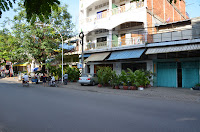
Former brothels, Street 63, Phnom Penh, Cambodia
Former brothels on 63
Brothels closed on 63 Sometime in July, the long-running string of brothels on Street 63 was raided and closed. I posted about the bust of one in this group back in 2010. The place was back in operation a couple of weeks later, business as usual. Clearly well protected. But all of the brothels are gone now. To my knowledge those places on 63 were the last openly brothel-like businesses in central Phnom Penh. They have been there as long as I can remember and survived years after every other city center brothel had been shuttered. There must have been dozens of girls there. Closing them was probably one of the biggest brothel raid/ closures in the country this year. But to my knowledge the raid went unreported in the English press in Cambodia.

A Brief Tour of the Cambodian Sex Industry Best article on prostitution in Cambodia by an international journalist in recent memory. I don’t agree with everything he wrote, but unlike many of the weepy, sensationalistic, pre-scripted reports in the international media of late, he drew his conclusions from the evidence rather than looking for evidence to support his conclusions.

Faintings There was a spate of mass faintings at several different garment factories and even a couple of schools in Cambodia. Many observers were understandably quick to cast a suspicious eye on factory conditions, but the cause is still a matter of investigation. The mass faintings began suddenly and have occurred over a relatively short span, the only obvious commonalities being most happened in the factories and were exclusively amongst the laborers. It would be an extraordinary coincidence for such a cluster to occur, yet not have some common cause or link between the incidents – e.g. some new chemical, pesticide or product in use, a new ventilation system, a illness of some sort being passed around, longer working hours or increased production requirements, some new practice common to all of the affected factories.

Different causes have been suggested by investigators and labor advocates. In fact, there have been almost as many possible causes cited as there have been fainting incidents – chemicals, smells, ventilation, long hours, hunger, food poisoning, dehydration, etc., but nothing definitive and nothing new and common to all of the affected facilities. Working conditions in the factories appear to be pretty much the same as they have been for years.

In lieu of evidence of a common cause I am inclined to agree with Time Magazine. The mass fainting are, for lack of a better term, ‘mass-hysteria,’ but by that I don't mean to diminish their significance. These factory workers are largely poor young women, often rural girls accustomed to rice farming and country living, now working in gray, stuffy, unpleasant conditions, feeling homesick, pressured by family (for money) and harsh supervisors, and doing mind-numbingly repetitive work for very little compensation (averaging $55-$61/month,) often for long hours. Though the factories are not 'sweat shops,' this is still the kind of work that is undesirable enough to drive some young women to choose prostitution in preference. In my opinion, for whatever reason that first mass fainting happened, it sparked a chain reaction of all the faintings that followed - it was the spark for a sort of involuntary protest by these young women against the unhappy and oppressive circumstances in which they find themselves.
Hundreds sick in mass fainting at Cambodian factory
Mass Fainting In Garment Factory
Mass faintings at H&M factory in Cambodia
What's Causing 'Mass Faintings' at Cambodian Factories?


Siem Reap, September 2011
Floods The wet season was too wet this year. Cambodia (and Thailand) saw some of the worst flooding in more than a decade. In Cambodia huge swathes of countryside along the Mekong and Tonle Sap rivers were submerged, hundreds of deaths, enormous crop loss and property damage. Government response was slow and inadequate. In an unprecedented but widely supported move, the government cancelled the Water Festival boat races in Phnom Penh. Just as the press was beginning to take note of the flooding in Cambodia, especially with the repeated flooding of Siem Reap town, Bangkok came under flood threat and story in the international press changed focus to Thailand and never really returned to Cambodia. Interestingly, even with the flood related crop loss, Cambodia managed to produce more rice in 2011 than the previous year.
Flood reports, photos and links
Cambodia's rice yield stable in 2011 despite flood devastation: PM


Most self-absorbed article of the year Amidst stories of captive Cambodian women jumping from upper floor windows to escape Malaysian recruitment agencies and of repeated allegations of abuse, torture and rape of Cambodian maids in Malaysia, the Cambodian government has banned its citizens from working as maids in Malaysia. Reporting on the ban in ‘this article’ the Malaysian press complained of a “dire maid shortage”in Malaysia and of how the ban will hurt their recruitment agencies. "Dire." Never mind the abuses suffered by these maids in Malaysia or captive women jumping from windows to escape these so called 'recruitment agencies' in Phnom Penh, it sounds like tough times in Malaysia. It's dire. They're having to make their own beds and there's nobody to do the dishes. 
“They Deceived Us at Every Step”
Recruiters Round Up Cambodians to Work in Malaysia

Rice wine deaths There were several mass poisonings attributable to bad batches of homemade rice wine. A regular motodup on my street died a couple of months ago after being poisoned. In one tragic case the better part of a village was wiped out. One poisoning incident:
12 Cambodians died of wine poisoning

Top Ten Tycoons The essential Who’s Who

Land Next to the floods, the rampant land-grabbing and mistreatment of evictees was the story of the year. So much has been written on the subject I am not sure what more is to be said. The problem continues and is growing. It is involving ever more people and confrontations between evictees and authorities are becoming more violent. In terms of politics, it is a gift from the ruling party government to the opposition. While I accept it is unrealistic to expect there will not be evictions as the city and country develops, I don’t understand from either a human or political POV why it is being handled so badly and the evictees treated with such callous inhumanity. It is sowing the seeds of dissent and future conflict in ever growing numbers. As one Kampong Speu evictee put it, "If there was still a Khmer Rouge hiding in the jungle, I'd join." In the long and even medium term, these pitiless evictions don't make moral or even Machiavellian sense.

NGO Law The government wants to regulate NGOs and has proffered a law. The NGOs are suspicious of the government’s intent but split between those who say the proposed law needs modification and those who say there should be no law at all. Much ink has been spilled on the subject with the highlight being an exchange between Elizabeth Becker and an anonymous commentator at AKP, the government media mouthpiece. The proposed law is currently in its fourth draft and the debate continues. The Prime Minister recently calmed the debate by saying that there was no rush, that they would work as long as necessary to craft a law acceptable to both sides. But, of course, this also takes the ‘no law’ option off the table.
Catalogue of artcles related to the NGO Law
Hun Sen Calls for More Talks on NGO Law

Elizabeth Becker/AKP exchange
Silencing Cambodia's Honest Brokers By ELIZABETH BECKER
AKP: Commentary: Elizabeth Becker and the Campaign to Put NGOs above the Law
Response To Anonymous Critique by Elizabeth Becker


The King, King Father and Queen Mother on the occasion of the 90/20 celebration.
90/20 King Father Sihanouk celebrated his 90th birthday and 20-year anniversary of returning to Cambodia. A truly historic occasion.
Birthday of King Father Norodom Sihanouk of Cambodia

Mu Sochea proves to be a continuing force, making her mark (and political hay) taking a hands-on approach and focusing on issues that directly affect the poor and disadvantaged such as land grabbing and maid trafficking. Like I said last year, keep an eye on this lady, especially in the coming election year. She’s going places.

Kristof Tweets In November Nicholas Kristof parachuted in to Anlong Veng to tweet a brothel raid and promote his favorite anti-trafficking NGO in Cambodia. His dramatic tweeting of the raid probably did more to raise public awareness of his questionable ethics in the reporting of sex trafficking than anything he has done since purchasing two underage girls in Cambodia in 2005.
Nick Kristof to the rescue!
Nick Kristof Live Tweets a Raid on an Underage Brothel – And Not Everyone is Thrilled
Fighting back, one brothel raid at a time
A human trafficker defends Cambodian sweatshops
Be Aware: Nick Kristof’s Anti-Politics


Laos threatens to construct the first hydropower dam on the Lower Mekong.
Laos' Mekong Xayaburi dam plan delayed again

@Faineg Tweets KR trial The KR trials continue under a darkening cloud of criticism from disparate quarters. Growing feelings that the trials may be fundamentally flawed, talk of UN incompetence, accusations of government interference, a judge resigned, acrimony between the government and UN, and that's just the now of it. Case 002 is underway. Nuon Chea (Brother #2) has been on the stand and has put on quite a show, well-worth a hundred million, see-sawing between denying knowledge and blaming Vietnam. In an innovative and powerful use of Twitter, Faine Greenwood, aka @faineg, (and others more sporadically,) has been live tweeting the proceedings from the courtroom. This is journalism. ( Recently @KRT_Monitor has taken up the blow by blow.)

Plane to Sihanoukville Cambodia Angkor Air began regular flights between Siem Reap and Sihanoukville in December. If memory serves, this is the first regular air service to Sihanoukville since Royal Air Cambodge stopped flying to Sihanoukville in late 1997…except for PMT’s short-lived ill-fated venture on the same route a few years back. 

Tourism grows and grows At year’s end the government announced that tourist arrivals were up 14% over last year, Vietnamese leading the way. Tuk-tuk drivers in Siem Reap complain that the increasing numbers of Asian tourists, often on packages, is driving down local transport prices. Still, Siem Reap is booming and some of it is spilling off to Sihanoukville and Phnom Penh.
Cambodia's foreign tourist arrivals up 14% in 2011

Gold Tower 42, The Phnom Penh Tower and The OCIC Tower
Phnom Penh towers At the site of the old Ministry of Tourism, Phnom Penh's second highrise after the OCIC Tower (Canadia Tower,) the new Phnom Penh Tower on Monivong Blvd, was completed and opened for business. Stalled project Gold Tower 42 (aka Grey Tower 31, aka Bassac Thmey) has been idle now for 15 months.

The Riel The Cambodian Riel held its own against the US dollar throughout the year, varying only about +/-50 Riel over the course of the year, beginning 2011 at about 4055KHR = US$1 and finishing around 4075KHR = US$1.

New bridge to Koh Pos, Sihanoukville, 2/11. Construction is now complete.
Outrage In the final week of the year Cambodia publicly soiled itself and walked around stinking of shit in its pants all week after pardoning and releasing convicted Russian pedophile Alexander Trofimov. Alexi first arrived in Cambodia heading up a high-profile US$300,000,000 Koh Pos investment project before being caught diddling dozens of prepubescent girls in Sihanoukville in 2007. His subsequent handling by the Cambodian judiciary was riddled with irregularities and he had served only a fraction of his original sentence before being freed by royal pardon. Juice speaks. He has since disappeared into Cambodia somewhere, doing what...we can only imagine. After he was released all of the authorities that should have been in-the-know did a Sgt. Schultz style, "I know nothing...nothing!" all denying knowledge of how he got on the pardon list. His former company even denied knowing who he is. Yeah, right.  
Cambodia pardons Russian in paedophile case
Phnom Penh Post: Petition to deport pedophile Alexander Trofimov

Ten Cambodia Tweeps to Follow
khmerbird
peter_k440
faineg
nate_thayer
dickonverey
HunSensEye
ChrisInCambo
SimOliver
MuSochua
mybigfatface
JaredsCambodia

Cambodia News and Info on Twitter
phnompenhpost
voakhmer
tweetcambodia
cambopedia
cambodianews
Canby_Cambodia
USEmbPhnomPenh
EyeOnCambodia
KRT_Monitor

New Cambodia Blogs of Note
Faine Opinines
Nate Thayer

Wednesday, January 4, 2012

Tonle Sap River Level

Tonle Sap River, Phnom Penh riverfront
Left: October 18, 2011 (Water level 9.9m at Phnom Penh Port)
Right: December 31, 2011 (Water level 3.6m at Phnom Penh Port)
Photos taken from almost the same spot, standing at the edge of the river. Note the stairs, covered in water to the top step in the left photo, the entire stairway exposed down to the river in the right photo. 

Also see my posts on the Cambodia Floods 2011

Saturday, October 22, 2011

Brief Cambodia Flood Update

Phnom Penh riverfront, 10/29
Final UPDATE, October 29 - There is no flooding in Phnom Penh, Siem Reap city, Battambang city, Sihanoukville, Kampot city or Kep. There is no imminent threat of flooding in any of these cities. The river levels in Phnom Penh, Siem Reap and Battambang continue to fall. Here in Phnom Penh, in my casual observation, it is falling at a rate of 10-15cm per day. The river level has dropped below alarm stage all along the Mekong River and Tonle Sap River in Cambodia and continues to fall. All National Routes are clear of water and buses and taxis are running normally. There is still some flooding lingering in the countryside but it is slowly subsiding. From what I read in the papers, parts of Thailand and Bangkok are facing significant flooding problems, but that is completely unrelated to the flooding situation in Cambodia. In my inexpert opinion, the flooding threat to all major Cambodian cities has passed for the season. Unless there is some change for the worse in the situation, this is my final update on the flooding in Cambodia.
-----
-----
Phnom Penh riverfront, 10/26
UPDATE, October 26 - A very quick update. The drying trend continues in the major cities. There is no flooding in Phnom Penh or Siem Reap. The same goes for Sihanoukville, Kampot and Kep. As of today, Siem Reap is drier than it was two days ago when I posted that almost all the flooding had receded from the city. All businesses are open. All Angkor temples are open. There is no flooding in Phnom Penh. The river level in Phnom Penh continues to fall and, in my casual observation, has dropped at least 20cm in the last two days. According to the MRC website, the river level at the Phnom Penh Port station is now below alarm level for the first time since September. All national routes throughout the country are clear of water and buses and taxis are running between all major cities as normal. Much of the countryside is still inundated, and as mentioned before, there has been major crop loss, loss of life and property damage. See below for some of the projects bringing relief to flood victims in the countryside. There seems to be a growing trend on internet over the last couple of days of posting and/or retweeting old information and sometimes downright misleading information about the flooding, presumably out of inattention, ignorance or a desire to jack up their web stats. When looking at information regarding the flooding in Cambodia, especially in the cities, make sure that it is up-to-date.
-----
-----
Phnom Penh riverfront, 10/24
UPDATE, October 24 - There is no flooding left in Siem Reap town. Though there are some muddy roads and puddled areas, the town is, for most intents and purposes, dry. All businesses, restaurants, shops, bars, etc. are open. All Angkor temples are open. There is no flooding in Phnom Penh or threat of flooding in Phnom Penh. The river level (Tonle Sap) in Phnom Penh continues to fall. When I did my regular riverfront water level check this afternoon, that level had dropped low enough that I could see the third step for the first time in a month. The MRC website shows the water level of the Mekong River continuing to fall all along the river. The water level at the Phnom Penh Port has dropped to near MRC 'Alarm Level' for the first time since late September. The flooding in the countryside is still draining, albeit very slowly. In an informal conversation today, a government official told me that though there may be concerts, parties and such put on by businesses, there are no official Water Festival events scheduled for Phnom Penh this year.
-----
-----

 Phnom Penh river level comparison

As of earlier this afternoon (Oct 22):

There is no flooding in Phnom Penh. Well, there is some lingering flooding at the northern and southern outskirts of the city, but none in Phnom Penh proper. In fact there hasn’t been any significant or unusual flooding in Phnom Penh at any point during the Cambodian flooding crisis. I check the river level at the Phnom Penh riverfront every day, looking at the exactly same spot to see if the water level has changed. In my casual, inexpert observation, give or take a few centimeters the river has been at about the same level for a few weeks now. Today the river was down 5-10cm from yesterday. That is the single largest 24-hour drop in the water level I have seen in weeks. The MRC website also shows either stable or falling water levels all along the Mekong in Cambodia.

Water Level depth chart for Phnom Penh Port
(near central Phnom Penh) from the MRC.

I called around to a few friends that live in Siem Reap today and all report the same – the flooding has largely receded from Siem Reap town. Most roads in town, including the Old Market area, Pub Street, all of the shopping areas and even the river road and traffic circle south of the Old Market area are flood-free. All shops, restaurants, bars and markets are open for business. And, to the best I have been able to determine, all of the Angkor temples are available to visit. There is still some water on the road from Siem Reap to the Lake and on High School Road, but both are reportedly passable. There has been damage to many of the roads, but all are passable. Travelfish posted an entry yesterday with up-to-date, first hand information on the state of flooding in Siem Reap.Travelfish has also posted an entry on some of the local organizations and projects helping to bring aid to the affected communities around Siem Reap.

According to taxi drivers and friends I spoke with today, all of the National Routes are free of flooding, including – from Phnom Penh - NR1 to Vietnam, NR 3 to Kampot/Kep, NR4 to Sihanoukville, NR5 to Battambang, NR6 to Siem Reap, Road48 (from NR4 to Koh Kong) and NR3 (Kampot to NR4). I don’t have any information about NR2 to Takeo or NR7 north. All the National Routes have suffered road damage to varying degrees, but all are passable.

I don’t have much information on the situation in the countryside beside what I see in the newspapers, but from what I've read it sounds like things have changed very little. Much of the countryside is still flooded and draining very slowly. There has been huge property damage and crop loss and many people are in a desperate way. See my October 18 post for more information and links.

Whether the flood waters return or continue to fall depends largely on the weather. But at the moment things look to be stable in the countryside and improving in the cities.

Tuesday, October 18, 2011

Cambodia Flooding - Update

(See Brief Cambodia Flood Update above for the latest info.)

Southeast Asia has seen some of the heaviest monsoon season related flooding in many years. So far Thailand and Cambodia have been particularly hard hit. Though I only know of Thailand what I read in the papers, I have witnessed some of the flooding here in Cambodia first hand and have also been able to gather first hand reports in real time from trusted sources in some locations around the country.

Cambodia's Annual Floods

Monsoon season flooding is a normal occurrence in Cambodia. It happens every year between July and November as the Mekong and other rivers swell with run-off from the mountains to the north and monsoons drop copious amounts of rain over the whole region. Much of Cambodia is a floodplain and is inundated on an annual basis. This is one of the reasons why traditional Cambodian houses are built on stilts. The floods replenish the land and make possible the rice crops that are the country’s staple food.

This year has been unusual. Too much rain and over swollen rivers in many parts of the country have brought some of the worst flooding in a decade to Cambodia – covering a much wider area, more deeply and for a longer period than a normal year. The result has been disastrous in the countryside - extensive property damage, crop loss and deaths of almost 250 people. Perhaps the most apparent manifestation of the flooding to tourists has been the repeated flooding of Siem Reap City, the gateway to the temples of Angkor. The city has flooded 4 or 5 times in the past 5 weeks (depending how you count,) affecting businesses, making it difficult to move around town and cutting off a couple of the Angkor temples (not Angkor Wat) from visitors.

A summary of the current situation:

The situation in the countryside

The flooding situation in the countryside is severe and it is difficult to overstate the desperate plight of the people affected. Most of the countryside is populated by poor subsistence farmers that depend on their rice crops to survive. They have little or no safety net and the government response has been slow, weak and uncoordinated, though is now reportedly improving. In many areas water stretches to the horizon, the rice crops completely submerged. To date there is flooding across 17 of Cambodia's 24 provinces; 247 people have died; 34,000 households have been evacuated; 390,000 hectares of rice paddies had been inundated destroying as much as 200,000 hectares of the crops (approaching 10 percent of the total harvest.) Many people are stranded and quickly running short of food. There will also likely be future food shortages in the countryside as a result of this flood. Government organizations, relief organizations such as the Cambodian Red Cross and several NGO and volunteer groups are working to bring relief to those affected. As of today (Oct 18) the USA, China and Singapore have sent some aid but the Cambodian government has yet to request international assistance.

More info:

Travelfish: Amid floods, Siem Reap needs your help
The Green Gecko Project: Cambodia is flooding... the kids ask "what can we do?"
Phnom Penh Post:  Aid arrives but floods slow to recede
Phnom Penh Post: Floods not yet an ‘emergency’
IRIN: CAMBODIA: Worries about long-term flood fallout 
VOA: Aid Arrives for Flood-Swamped Thailand, Cambodia
ABC: Cambodia floodwaters yet to recede
Phnom Penh Post: Flow of Flood Aid Speeds Up

The current situation in Siem Reap

Siem Reap, Cambodia, flood map
Siem Reap town has flooded 4 or 5 times in the past 5 weeks. Some have likened it to a yo-yo. It tends to flood in the same areas of town (see map) each time, ankle to knee deep. The town flooded for the third time a little more than a week ago, started to dry out then flooded again about 4 days ago. Day before yesterday the water was as deep as it has ever been. Most of the shops in the Old Market area were closed at the time. But as of today (Oct 18,) the flood has begun to recede again, reportedly rather quickly.

As of 4PM this afternoon (Oct 18) Pub Street had about 5cm of water on it, the Old Market area and parts of Sivutha Blvd about 10cm, the roundabout south of the Market area (always one of the deepest area) about 30cm, parts of Wat Bo Road 10-15cm, and parts of the river road north of Route 6 on the east side of the about 10-15cm. Most of the rest of the main part of town was dry. Pub Street, and most all of the shops, bars and restaurants in the Old Market area are open for business. Tuk-tuks and motodups are easily able to move around most of the town. All of the Angkor temples on the main circuits (except perhaps Neak Pean) are open.  The flood waters continue to recede rapidly, and as the end of the rainy season is nearing, Siem Reap residents are hoping that this will be the last of it. Time will tell.

(UPDATE, October 19 - Friends in Siem Reap tell me that the flood waters continue to recede from town very quickly. Many of the previously flooded areas, including Pub Street and much of the Old Market area are now dry or almost dry. Flooding lingers on High School Road and the area around the roundabout south of the Old Market area.)

I visited Siem Reap City and the temples of Angkor for a week during the second flood in late September. While I do not want to diminish the losses being suffered in the countryside right now, or the difficulties and financial losses to the businesses in Siem Reap, I must say that it was the most fun and adventure I have had in Siem Reap in years. Yes, it was inconvenient getting around, but I simply took a second pair of shoes, resigned myself to wet feet and plodded on through the floods, sometimes by tuk-tuk, sometimes by foot. (Though you need to be careful of potholes hidden by the water and it probably isn’t wise to cycle around at night for the same reason.) Even at the worst of it, all but one of the Angkor temples were available, there were still plenty of bars and restaurants open in town, I got lots of great photos and I can say that “I was there for the great flood of 2011.” If I were a tourist on my way to Siem Reap now, I’d consider this an opportunity for a unique adventure, not a glitch in my holiday. The shops, hotels and restaurants in Siem Reap that have been hurt by the flooding could sure use the business right now, and you may even be able to find some legitimate volunteer opportunities helping with flood relief. 

The current situation in Phnom Penh

Phnom Penh riverfront, Cambodia, water level, Oct 18 2011
Phnom Penh riverside, Oct 18
There is no flooding in Phnom Penh proper and hasn’t been at any time during this year’s flood crisis. There is some flooding at the northern outskirts of the city, but these are areas that tourists and visitors rarely go. There has been and may still be flooding of some streets after heavy rains, but this is the norm in Phnom Penh every rainy season and it drains off within a matter of hours.

There has been a video making the internet rounds for the last few weeks entitled ‘Flooding in Phnom Penh.’ Note that the video is 3 weeks old at this point and is also of flooding on streets that flood every time there is a heavy rain, every monsoon season . It does not represent flooding in the same sense that has occurred in Siem Reap City and the countryside.

The Tonle Sap River through Phnom Penh is unusually high - about a meter above normal for this time of year,* a bit above ‘Alarm Level,’ but a meter below ‘Flood Level.’** The water level has been generally stable over the past two weeks, rising and falling by a couple of centimeters every few days. There is no immediate threat of flooding in the city and the MRC is currently not predicting any flooding in the city. Still, it is wise to keep abreast of the current situation through reliable sources such as the MRC website and the Phnom Penh Post.

* Lower Mekong Hydrologic Yearbook 1997
** Mekong River Commission Flood Forecast page (Oct 18)

Water Level depth chart for Phnom Penh Port 
(near central Phnom Penh) from the MRC.

Phnom Penh riverfront/Tonle Sap River, October 17, 2011, about 4PM. The river has reversed (about 3 weeks ago,) now flowing southeast at a goodly clip. Note the floating plants moving downriver with the current, and how at the river's edge they move back against the main current revealing potentially dangerous eddies and whirlpools.

The Water Festival

Water Festival, Phnom Penh, 2007
On October 13 the government announced that the boat races at the annual Water Festival (Nov 9, 10, 11) had been cancelled due to the floods. The Water Festival is one of the biggest holidays of the Cambodian year, celebrating the reversing of the current in the Tonle Sap River and centered around colorful boat races in Phnom Penh and some other areas of the country. The reasons given for the cancellation were: 1) to save money that could be spent on flood relief; 2) because the river was dangerously high and fast; 3) and because these weeks are ordinarily the time the boat racers from the countryside, who are currently preoccupied with the floods in their respective areas, are preparing for the races.  In my opinion, this reasoning is quite sound, especially the latter point. People from the countryside are dealing with the immediate concerns of lost crops and on-going flooding and they simply do not have the time to get ready for the races. It would be unfair, unsafe and unsportsmanlike to hold the races under these conditions. And in my observation, the news of the cancellation and the reasoning behind it also seems to have been well received in the countryside, especially that the moneys saved from the races would be used for flood relief.

The initial announcement of the cancellation through the AKP on October 13 was entitled ‘Water Festival Cancelled’ but in the body of the article it stated that there would be “no boat racing this year, but other festivals are celebrated as usual.” Several media outlets picked up the story, emphasizing that the Water Festival had been cancelled but downplaying or overlooking the details regarding the boat races vs. other Water Festival events. The Phnom Penh Post went as far as to state that “the annual three-day Water Festival celebrations next month, including the renowned boat races, would be cancelled.” The Cambodia Daily was more circumspect in its reporting stating the ‘Water Festival Races Cancelled Due to Floods,’ and further that concerts, related events and street vending would continue as usual. In a later article (‘Plans Continue for Next Month’s Water Festival,’ Oct 15-16,) the Cambodia Daily stated that city officials were continuing in their preparations to receive festival goers in Phnom Penh on the scheduled Water Festival dates.

Other tourist cities

Battambang, Stung Treng and Kratie have all experienced flooding. Kampot City, Sihanoukville and Kep have not seen any significant flooding. This is a bit of a change as, in previous years, Kampot City has been in one of the first cities to flood.

When will it end?

Of course it is impossible to say for sure. It depends in large part on the weather. Though the flood waters have receded from Siem Reap town fairly quickly after each flood, usually in just a few of days, the water has been very slow to recede from the countryside, now lingering more than a month. Heavy rains could worsen the situation. Nevertheless, the end of the monsoon season is nearing, usually trailing off by the beginning of November, and the historical average end of the flood season is the latter part of November, with the worst of it ending well before that. At best, it could be ending now. At worst, it may continue for another couple of weeks.

Comparison to the flood of 2000

The current flooding has been called 'the worst in a decade.'  This is a reference to the flooding of 2000, which was of similar scope in Cambodia. Here are some stats on the flooding of 2000 and the flooding of 2011 to date.

2000 stats:
Crops lost: 421,568 hectares
Dead: 347 persons
Houses: 7086
Schools: 6620
Roads: N/A
Bridges: 1856 km
Culverts: 17 sites
Dams: 397 sites
Flood damage: US$161,000,000

Source: Mekong River Commission Report 2008, Appendix 2

2011 stats (to date):
Crops lost: ~230,000 hectares (updated Oct 20. Source: Cambodia Daily, Floodwaters Expected to Continue Wreaking Havoc, Oct 20, 2011)
Dead: 247 persons
Houses: N/A
Schools: ~1000
Roads: ~2400km
Bridges: N/A
Culverts: N/A
Dams: N/A
Flood damage: N/A

Source: IRIN: CAMBODIA: Worries about long-term flood fallout

Water level at Phnom Penh Port, comparison chart by year including 2000. This year the water level took longer to crest the Alarm Stage than in 2000, but it lingering above the Alarm Stage longer than in 2000. A similar pattern can be seen at other measuring stations as well. From the MRC website.

History of annual flooding on the Mekong River, Chang Saen to Kratie, 1960-2008. 
From, MRC: Annual Mekong Flood Report 2008. (Click to enlarge)

Politics

A couple of thoughts on politics:

1. Opposition parties (read: SRP) have sometimes accused the Cambodian government of unequal distribution of relief aid during disasters such as this. During the National Elections, opposition parties have said that villages and communes that are known to have voted for the opposition in National Elections receive little or no disaster relief. For anybody interested, now would be an ideal time to test that theory and document the results. Get out a map of the 2003 election results, travel to areas that voted for the opposition and see if they are receiving aid. Don't wait until next month, next year or 2013 to collect anecdotal stories.  

2. In the face of this growing disaster, the Cambodian government has yet to request international aid. On October 13 Council of Ministers spokesman Phay Siphan said, “We do not request international aid because everyone has their own problems…It would be very difficult for us to request their help. For the time being donations and any charity are really appreciated.”* This echoes a similar sentiment reportedly expressed by Foreign Minister Namhong that “Cambodia needs no foreign help…but welcomes and foreign help.”** I wonder about the motivation behind this reluctance to request foreign aid. Could it be because in the recent past foreign aid has repeatedly been held over the Cambodian government’s head by the (western) international community to pressure the RGC into changing its ways, specifically in the cases of Boeung Kak Lake evictions and the pending NGO Law? Perhaps the RGC doesn't want to give the international community any more ammunition that may be used against them at a later date.

* Phnom Penh Post, Water Festival Canceled, October 14, 2011
** Cambodia Daily, Coordination of Flood Aid Questioned, October 5, 2011

Monday, October 10, 2011

Siem Reap flooding again

I am not in Siem Reap at the moment and have no first hand knowledge of the current flooding situation, but people keep sending me emails asking about it so I thought I'd pass on what little I know and a few links to forums, bloggers and tweeters that are there and have posted recent info regarding the current flooding in Siem Reap town.

News is that Siem Reap town is flooding again - 3rd time in the last month. Apparently, like before, the river through town began overflowing yesterday afternoon and has continued today. According to friends up there, as of a few hours ago, the flooding is in pretty much the same areas as last week (see my post of September 26 Siem Reap Flooding - Trip Report) but so far not as deep or extensive. The situation is likely evolving as I write.

Links:

'Only in Cambodia' blog has just (Oct 10) posted photos and information about the current flooding: Water, Water Everywhere "OK. So We're going through our 3rd flood in Siem Reap where the river has over flown its banks and spilled into the streets turning them into extended tributaries. From morning to afternoon, the river rose and spilled over so that you couldn't see its banks..." Click the link to read more.

On Twitter:

Rosy Guesthouse, located on the east side of the river in the center of town also sometimes tweets about the flooding: Rosy Guesthouse

Canby Publications does a pretty good job of collecting and retweeting information about the flooding: Canby_Cambodia

Journey's Within Boutique Hotel is located in Siem Reap and is tweeting a bit about the flooding as well: JWBoutiqueHotel

Forums:

TripAdvisor has a running thread on its travel forum where people have been posting up-to-date information on the flooding in Siem Reap town. Make sure to check out the end of the thread for the latest info: Flooding in Siem Reap

Other:

Mekong River Commission situation report. Current flooding situation and forecast for areas along the Mekong River through Southeast Asia. Information on Phnom Penh and other Cambodian cities along the Mekong, but no info on Siem Reap: Mekong River Commission

Article in today's Phnom Penh Post on the flooding situation in Cambodia in general, not specifically about Siem Reap: Death toll rises; risk at riverbanks

Sunday, October 2, 2011

Siem Reap Not Flooding - Trip Report 2

Tep Vong Street, Siem Reap
When I arrived in Siem Reap a week ago Sunday, much of the town was knee deep in water, affected by the flooding that has swept the country over the past few weeks. (See Siem Reap Flooding - Trip Report.) As I left Siem Reap for Phnom Penh early this afternoon, the majority of the in-town flooding had subsided, mostly over the last 3 days. Though much lower, some flooding remained - south of the Old Market area, along short sections of Sivutha Blvd, along stretches of the river road on the east side of the river (Achar Sva Street) and in parts of the Wat Bo area, but all seemed to be draining fairly quickly. The north end of town was completely free of flooding, as was the north end of the Wat Bo area, most of Sivutha Blvd, the Taphul Village area and the Old French Quarter, all of Pub Street and most of the Old Market shopping district. There was still an inch or two of water on the streets around the Old Market itself but the market was open for business as were all of the businesses on Pub Street and most other shops and restaurants in the area.

This was the second time in as many weeks that Siem Reap town has flooded, but as I left the town today, it was quickly returning to normal. Whether the flooding returns will depend on the weather.

I drove from Siem Reap back to Phnom Penh following the same route I came - National Route 6 through Kampong Thom to Skun, then Route 6A through northern Kandal province and on into Phnom Penh. The road was completely dry and easily passable the entire length of the trip. Short sections of road had been damaged by the flooding, but not severely. I saw several Phnom Penh-Siem Reap tourist buses heading both directions.

The flooding in the countryside visible from the road between Siem Reap and Skun had gone down noticeably as compared to a week ago, exposing vast green rice paddies. There was still considerable flooding in the countryside south of Skun along Route 6A in northern Kandal province and the rivers in that area were still overflowing and moving fast and hard. The worst of it that I could see was in the area of Prek Kdam where the road nears and parallels the Mekong River. But even there, water that had been lapping at the road's edge last week had pulled back a couple of meters or more from the road and the possibility of water over the road seemed less of a threat than last week.

One oddity I noticed in the trip was that every countryside school grounds and most medical clinics that I could see from the road were still at least ankle deep in water, even in areas where most of the flooding had receded. I am not sure why except that it would seem schools and clinics are constructed on low ground.

For up-to-date information on Mekong River levels and flooding threats along the Mekong see the Mekong River Commission - Information Resource page


Siem Reap Map courtesy of Canby Publications

Tuesday, September 27, 2011

Siem Reap Flooding - Trip Report

As most know by now, there has been flooding across the Cambodia and the region for almost two weeks, including in Siem Reap town. I drove from Phnom Penh to Siem Reap day before yesterday (Sunday) - the usual route up 6A to Skun, then National Route 6 through Kampong Thom and on to Siem Reap. The road was mostly clear of flooding save a couple of short stretches with a few inches of water across the road that were easily passable. The countryside to either side of the road was flooded to the horizon in many places, especially along 6A south of Skun and also near Kampong Thom City. The water was right up to the road's edge for much of the trip and just a little bit of rain would likely put it over the top. All of the rivers and streams (that could be distinguished from the flooded countryside) were full to the brim and moving fast and hard. Animals - cows and water buffaloes mostly - lined the sides of the road in several areas, driven out of the fields and to the high ground by the flooding.

Siem Reap town has experienced varying levels of flooding for better than a week, the worst of it toward the south end of town. When we arrived on Sunday it hadn't rained in Siem Reap for more than 24 hours and the flooding had reportedly stabilized and even retreated a bit. I'm staying at the north end of town where the flooding is minimal at the moment. Tuk-tuks and motodups were reluctant to try to cross from this side of town to the Old Market area, claiming that there was a 50-50 chance of the engine flooding out in the deeper sections along the way, so I decided to walk over to the Old Market in the early afternoon, about 8 hours ago. The following are some of the photos I took along the way. (Turns out that wading 2-3 kilometers through ankle to knee-deep water is surprisingly good exercise. Suffering some sore leg muscles tonight as a result.)

As mentioned above, the weather has been mostly dry in Siem Reap for at least 48 hours. Yesterday (it is now just after midnight) was sunny and pleasant in the morning with only a brief rain in the afternoon. The waters are receding from town at the moment, quite visibly so in the later evening.

All of the following were taken with a 17mm-55mm lens (Nikon D5100.) If it looks like I was standing in thigh deep water to get the shot, I was.
 

2 Thnou Street (Old Market Street)

Old Market

2 Thnou Street (Old Market Street) near Sivutha Blvd.

Pub Street

Water play at the intersection of Sivutha Blvd and Phnom Krom Road just south of the Old Market

Siem Reap Provincial Hospital

Tep Vong Street

Intersection of Sivutha Blvd. and Tep Vong Street

Tuk-tuk

Bow wave on Sivutha Blvd.

Snack vendors next to the river near the Old Market

Makeshift boat

Sivutha Blvd.

Many businesses have lined sandbags against the flooding.