'No Parking,' Phnom Penh
Thursday, May 3, 2012
Wednesday, May 2, 2012
Traffic Flow PP
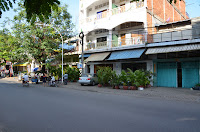
A classic Phnom Penh utility pole.
(Or perhaps a schematic representation of the traffic flow at any given 4-way intersection in Phnom Penh.)
Saturday, April 14, 2012
Exit the Rabbit, Enter the Dragon
Excerpt from Khmer New Year playlet broadcast on local TV in Phnom Penh this evening.
Today (13/4/12) was the first day of Khmer New Year (Chaul Chhnam Thmey) – the end of the Year of the Rabbit, the beginning of the Year of the Dragon. Unlike western New Year, the Khmer New Year does not begin at midnight, but at a different time of day or night every year, as determined by the astrologers. This year it began on April 13 at about 7:10PM (Cambodian time.) Each house prepares a table of offerings during the day, and as the New Year enters, joss sticks are lit and prayers made at the offering table, ideally at the moment of the change.
Each year I am torn about where to be the moment the new year enters. Most Khmers around me would have me at the offering table making prayers. But I’ve always rather enjoyed watching it on TV. As the New Year enters, the local stations run a delightful little playlet of the goddess and new animal arriving and the old departing. People giggle at the cheesy special effects but can get quite serious and attentive about the spirit of the moment and what is being said. Years back, there was a third option. When the wars were still on, the New Year was welcomed with skyward gunfire. Here in Phnom Penh, at the moment of New Year the air would fill with sounds of firearms discharging and the sky would come alight with tracer bullets (phosphorous filled bullets that burn bright when fired.) A live-fire pyrotechnics show of sorts. Of course, what goes up does eventually come down, making this a very dangerous tradition, but an exhilarating one nevertheless.
One year, 1995 or 96 I believe, I had flown into Phnom Penh from the provinces for the holiday. I was staying at the Bopha Tep Hotel near the Cambodiana. That year the New Year was to arrive at night. Anticipating the usual gun show, I put on a heavy jacket (imagining it might act as a makeshift flak jacket) and went up to the hotel roof, which provided a panoramic view over the city. I situated myself under a low concrete overhang to try to guard against falling lead.
Ordinarily, tracer bullets are used in machine guns, placed every fifth round to help the shooter see his actual line of fire. But for the New Year, soldiers and police would fill their entire clips with tracers so that every shot would glow. At the moment of New Year the city erupted in peals of gunfire from every direction. Some fired single shots, sending tracers zipping skyward like supersonic fireflies. Most used AK-47s, letting off 30-shot clips on full-auto, shooting fiery dotted lines crisscrossing the night sky. Most spectacular, on the outskirts of the city where the soldiers had heavier weapons they’d use belt-fed machine guns that could fire continuously for as long as they wanted to make the belt. It could go on for hundreds of rounds, often several guns at a time, creating great glowing snakes writhing skyward from the horizon.
Now, in 2012, going out to watch the gunfire is no longer a New Year option. The hazardous tradition of shooting in the year was wisely quashed more than a decade ago. Today was a choice between the table or the TV. I chose the TV – exit the rabbit, enter the dragon (naga.) See video above.
Suasedey Chhnam Thmey. Happy New Year.
Goddess riding in the Dragon. Front of Royal Palace, Phnom Penh.
A few screenshots from the New Year presentation:
Friday, April 13, 2012
A Khmer New Year Story
Our maid, Mean-Ta, was robbed today, in the ordinary fashion. She was riding pillion on a motodup (motorcycle taxi) when a couple of young guys on a passing moto ripped her bags from her shoulder. She probably appeared an easy mark – a small 50-year-old woman, alone, exposed and overloaded. No match for a couple of 20-something thugs on a faster bike. Pulled off with the bags she fell from the motodup, banging her up a bit, mostly bruises and road rash. The robbers escaped with her goods. Not an unusual occurrence here in Phnom Penh, especially in the days and weeks before Khmer New Year (i.e. Chhaul Chhnam Thmey) when robberies and other petty crimes spike as unscrupulous sorts try to put together some holiday coin for their New Year’s festivities. It’s still National Robbery Month here in Cambodia.
Pissed me off something fierce when I heard the story. Like most Khmers, she planned to travel to her native province for the New Year to be with family. She was heading off to begin her holiday when it happened – on her way to the bus station to make the trip home to Battambang. I didn’t see her this morning before she left, but when I got back to my office this afternoon, there she was, bloodied and crying, her clothes torn, her remaining bag smashed and wet from something that had broken in the fall. Two of the staff were tending to her, trying to calm her. Truly a pitiful sight. The thought of a couple of young city boys, probably middle classers or better, targeting a 50 year old country woman for her meager belongings just infuriated me. Perhaps even more upsetting, mostly because I saw how disappointed she was, this was her New Year in tatters.
She had been saving for her trip home for at least the last 2 months. A couple of days ago she took an advance on next month’s pay and I had given her an additional $150 New Year bonus. She spent the last two days preparing, buying a new outfit and bag, as well as some presents for the family. Almost all of the money and most of the belongings were lost or ruined in the robbery.
But, in the spirit of the season, the situation took a heartening turn. Most of the staff was still here at the office when she stumbled in after the robbery - 12 people, all Cambodians, everybody due to leave on their own New Year holidays at day's end. On hearing the story, people spontaneously started chipping in money for her. A impromptu collection arose in the office. Everybody contributed without hesitation. As the story spread, even the cyclo driver and motodups that sit near the office tossed what they could afford into the pot. I Twittered about the robbery shortly after hearing the story, primarily out of frustration and as a warning about pre-New Year street crime. Again, without prompting or request, local barang Tweeps offered money to help her. It was all an amazing outpouring of sympathy and generosity.
As I understand it, the spirit of the second day of Khmer New Year (Virak Wanabat) is expressed in generosity and giving to those less fortunate than oneself. I saw that spirit manifest today (if a couple of days early) in the swift and unreserved support shown this woman. Perhaps, amongst good people, they would have responded that way at any time of year, but it seemed particularly appropriate to this time.
Calmed briefly after the robbery, Ta was soon in tears again, but this time for being overwhelmed by the flood of help she was receiving. Most of her lost money was replaced. Her thanks were profuse and animated (a bit uncomfortably so.) She told me to say "thank you" and "happiness" and "Happy New Year" (and more) to all who helped and offered kind words. By late afternoon she had collected herself and the staff was readying to escort her back to the bus station to catch an evening bus. I bowed out at that point. I understand that she made it onto the bus without further problem. She should be in Battambang by now, probably in her village, home with her family for the holiday.
Saturday, March 31, 2012
When safe sex isn’t
According to Cambodia Daily reports of recent prostitution busts in Phnom Penh, the Cambodian police are using the presence/possession of condoms as evidence of prostitution and as a basis for arresting the people involved.* For example, in ‘Police Raid Parlor Alleged to Provide Sex Services’ (Cambodia Daily, March 14, 2012,) police reportedly stated that, in addition to other evidence, “…used condoms showed the massage place is 100% providing sex services.” The women from that bust were taken by the police for “education” (i.e. possibly sent to one of Cambodia’s notorious ‘rehabilitation centers’) and the parlor owners were arrested.
While I understand, from a law enforcement perspective, why the police would want to use condoms as evidence, this practice clearly runs contrary to this interests of community health and the health and safety of individuals involved in the sex trade. It creates a situation in which sex workers and brothel owners must choose between possessing condoms/risking arrest and eschewing condoms/risking sexual disease. It makes safe sex unsafe (at least legally) and incentivizes sex workers to forgo condoms.
This is particularly frustrating in light of Cambodia’s hard-fought battle against high HIV infection rates. Due in part to efforts by NGOs and government to encourage condom use amongst sex workers, the country’s comparatively high HIV rates have been significantly reduced over the last decade. While the recent crackdown on brothels has negatively impacted this effort in several ways, it has been largely indirect, e.g. forcing prostitutes out of brothels and onto the streets has made them less accessible to the NGOs that provide condoms and safe sex education, and also made them more vulnerable to customer pressure not use condoms.
The practice of using condoms as criminal evidence represents a much more present and direct threat to condom use and safe sex. It amounts to the de facto criminalization of condoms, actively discouraging condom use amongst sex workers. In terms of community health, it is a step backwards, working to undo efforts to reduce the spread of HIV and STDs. And in so far as the anti-trafficking/prostitution laws are intended to protect the women involved, it acts to the contrary, putting their health and safety at greater risk.
Time to end this practice.
---------------------------------------
(* Cambodia is not alone in this practice. 'The Policy That Keeps Prostitutes From Carrying and Using Condoms' addresses a similar policy in New York.)
See also:
Cambodia: Sex workers, 100% condom use and human rights
Off the Streets: Arbitrary Detention and Other Abuses against Sex Workers in Cambodia
Cambodia HIV and Aids treatment programmes threatened
AIDS on Stamps
Thursday, February 2, 2012
Tuesday, January 31, 2012
Land, Cops, the Rich and the Poor
The morning of Chinese New Year Day, on my way to the pharmacy, I happened up a street on which the owner of one of Cambodia’s controversial land development companies lives. The road was lined with cars and motorcycles and filled with uniformed police loitering about. Dozens of them, with more arriving by the minute. At first I thought there might be a problem of some sort, but soon realized there was a New Year party going on at the home of the land developer and these were the guests. I was ready for a caffeine break anyway so I stopped at a café a couple of doors down, ordered an ice coffee, went back outside and sat down with the parking guard to watch the happenings.
The uniformed men stood in small knots in the street in front of the party house, smoking and chit-chatting. The mood was light and festive. I couldn't see anything of the party for the tall walls surrounding the place but could hear the sounds of traditional lion dancing and then an enormous string of firecrackers going off. It went on continuously for several minutes, punctuated by gunshot-like M-80 blasts. Drawn by the noise and goings-on, a group of poor folk gathered across the street – kids, women, old men with walking sticks - country people, street people, (evictees?,) hard to say who they were exactly. Perhaps 40 or 50 in all, quietly gazing on at the activities from the sidelines.
The uniformed men took turns going into the party. When they reemerged through the front gate, each had a big smile and a bright red ung-bao envelope in his hand. (Part of the Chinese New Year tradition is to give ung-bao envelopes containing token gifts of money.) They stood in the street together, tearing open their envelopes, holding out the money and comparing gifts. The poor people watched and tittered amongst themselves. The parking guard next to me speculated that they were hoping for a hand-out from the house.
A couple of the party goers walked nearby, opened envelopes in-hand. The guard asked them how much they got. “Everybody got 50,000 Riel (US$12.50) each,” one said, adding, boastfully, that over 1300 police had attended the party. If he was correct about those figures, that’s more than US$16,000 in little red envelopes.
The party wound down. Within an hour most of the uniforms were gone and the street was clear again, except for dozens of torn and empty ung-bao envelopes blowing around in the road. As the last of the attendees left and the front gate snapped shut, it became apparent that the party was over.
Nothing was given to the poor.
The group of poor lingered briefly, then slowly thinned, moving off in different directions, disappearing. When I left, a few, maybe 4 or 5, were still there holding out. Perhaps hoping against hope that a few crumbs may still fall from the table. Or maybe they just didn't have anyplace else to go.
Monday, January 23, 2012
Greeting the Dragon at Wat Phnom
Ushered in the new Year of the Dragon at Wat Phnom in Phnom Penh a couple of hours ago. The crowd seemed a bit bigger than last year. I didn't see any foreigners there besides myself. Like last year, the beggars were conspicuously absent and there seemed to be fewer incense vendors. Like every year the smoke from burning incense was overwhelming and the threat of being burned or set alight by an errant joss stick was constant. Note that many people in the crowds are wearing helmets. It's not because they're all responsible motorcycle riders. It's to protect against burns. The following are a few photos from earlier this evening at Wat Phnom around midnight.
A gong rang. People looked. It was midnight (or about 12:04 by my watch.) The Year of the Dragon Enters. The gong stopped. People cheered, then the crowd made a mad rush to escape the smoke filled pavilion. Not sure if it was part of the tradition or just a desperate dash for oxygen.
Arriving at Wat Phnom. Incense smoke rises.
Incense vendor.
Overlooking the pavilion madness, a churning mass of people packed sardine tight, covered in a thick cloud of incense smoke.
At midnight people jostle aggressively to get their personal joss stick in the pagoda incense pot at the most auspicious moment. Afterward they take the joss stick and burn it at home.
Pavilion crowd.
Offerings
The crowd on the pavilion.
Lady Penh Shrine. (Legendary 14th century founder of Wat Phnom. Name sake for the city.)
Smoke
Sunday, January 22, 2012
Better late than never - 2011
![]() |
| Newly completed Phnom Penh Tower, the city's second highrise. |
2010 At the end of last year, the on-going conflict with Thailand over Preah Vihear was probably the most talked about issue of that moment and perhaps the year. A decades old dispute, the flare up of the last few years was largely the result of Thai political instability stemming from the 2006 coup that ousted Prime Minister Thaksin Shinawatra. After months of deadly border skirmishes in 2010, political and military tensions had begun to ease in December, only to spike again with the arrest of a Thai politician and yellow-shirt activists on the Cambodian side of the border. And so began 2011.
Preah Vihear: the Thai-Cambodia temple dispute
New developments in the Thai-Cambodia conflict (Dec 30, 2010)
![]() |
| Cambodia Daily |
Guardian: Before you pay to volunteer abroad, think of the harm you might do
Telegraph: Volunteer holidays 'do more harm than good'
Inside the thriving industry of AIDS orphan tourism
Taking Aim at Voluntourism
The Independent: Cambodia's orphanages target the wallets of well-meaning tourists
When Children Become Tourist Attractions
Internet censorship Cambodia stumbled clumsily into the world of Internet censorship in February. After a ham-handed start in which all of BlogSpot was suddenly blocked and ISPs initially affirmed then denied knowledge of the blockage, the outage narrowed, leaving only the highly provocative KI Media and Khmerization permanently unavailable through some ISPs in Cambodia. Both the government and the ISP’s denied responsibility. The media squawked about it for a month or so, but the story has since been relegated to NGO reports. The blocked sites are still unavailable through many, perhaps most ISPs in Cambodia. That said, Cambodia still has some of the most unrestricted internet access in Southeast Asia, significantly better than its immediate neighbors.
The Curious Case of the Banning that Wasn't
LICADHO Condemns Censorship of Web Sites Critical of Government
Sam Rainsy Mid-March, Sam Rainsy was stripped of his seat in Parliament. It seemed much less of a story than it would have been in years past.
Cambodia opposition leader loses parliamentary seat
US Maintains Ban on Cambodian Adoptions There has been a US imposed ban on the adoption of Cambodian children by Americans since 2001. After reconsidering the ban in March, the US ultimately declined to rescind it.
Cambodia Law Blog: Can expats adopt Cambodian children? Dispelling the myths
Unhappy Hippi In May Sihanoukville’s fabled Happy Hippi lost its smile.
K440: Happy Hippy smacked
The Cows of Spring On Royal Plowing Day in May the Royal Oxen ate beans and corn, eschewing the rice and other offerings.
![]() |
| Phsar Thmey and wart |
Preah Vihear In July elections were held in Thailand. The Pheu Thai party won. Thaksin’s sister became PM, Thailand’s political turmoil eased a bit, the yellows quieted, and the Preah Vihear situation has been getting better ever since. Come the end of 2011, Thai activist Veera remains in Cambodian jail.
Cambodia congratulates Pheu Thai Party on election win
Yingluck's visit to improve relations: Cambodian deputy PM
Cambodian PM stresses good relations with Thailand
![]() |
| DVDs at Russian Market |
Cambodia Law Blog: New moves on pirated movies
Tonle Sap Prime Minister Hun Sen continued to make the health of the Tonle Sap a priority, apparently with significant success. Illegal reservoirs and fishing lots were ordered shut down and the orders were enforced. Initial reports indicate the annual total fish catch is way up.
Fishing licenses around Cambodia's Tonle Sap Lake revoked
Hun Sen extends Tonle Sap fishing lot closure
AKP: Large Scale Crack-down of Illegal Fishing in Tonle Sap to Come
![]() |
| Former brothels on 63 |
A Brief Tour of the Cambodian Sex Industry Best article on prostitution in Cambodia by an international journalist in recent memory. I don’t agree with everything he wrote, but unlike many of the weepy, sensationalistic, pre-scripted reports in the international media of late, he drew his conclusions from the evidence rather than looking for evidence to support his conclusions.
Faintings There was a spate of mass faintings at several different garment factories and even a couple of schools in Cambodia. Many observers were understandably quick to cast a suspicious eye on factory conditions, but the cause is still a matter of investigation. The mass faintings began suddenly and have occurred over a relatively short span, the only obvious commonalities being most happened in the factories and were exclusively amongst the laborers. It would be an extraordinary coincidence for such a cluster to occur, yet not have some common cause or link between the incidents – e.g. some new chemical, pesticide or product in use, a new ventilation system, a illness of some sort being passed around, longer working hours or increased production requirements, some new practice common to all of the affected factories.
Different causes have been suggested by investigators and labor advocates. In fact, there have been almost as many possible causes cited as there have been fainting incidents – chemicals, smells, ventilation, long hours, hunger, food poisoning, dehydration, etc., but nothing definitive and nothing new and common to all of the affected facilities. Working conditions in the factories appear to be pretty much the same as they have been for years.
In lieu of evidence of a common cause I am inclined to agree with Time Magazine. The mass fainting are, for lack of a better term, ‘mass-hysteria,’ but by that I don't mean to diminish their significance. These factory workers are largely poor young women, often rural girls accustomed to rice farming and country living, now working in gray, stuffy, unpleasant conditions, feeling homesick, pressured by family (for money) and harsh supervisors, and doing mind-numbingly repetitive work for very little compensation (averaging $55-$61/month,) often for long hours. Though the factories are not 'sweat shops,' this is still the kind of work that is undesirable enough to drive some young women to choose prostitution in preference. In my opinion, for whatever reason that first mass fainting happened, it sparked a chain reaction of all the faintings that followed - it was the spark for a sort of involuntary protest by these young women against the unhappy and oppressive circumstances in which they find themselves.
Hundreds sick in mass fainting at Cambodian factory
Mass Fainting In Garment Factory
Mass faintings at H&M factory in Cambodia
What's Causing 'Mass Faintings' at Cambodian Factories?
![]() |
| Siem Reap, September 2011 |
Flood reports, photos and links
Cambodia's rice yield stable in 2011 despite flood devastation: PM
Most self-absorbed article of the year Amidst stories of captive Cambodian women jumping from upper floor windows to escape Malaysian recruitment agencies and of repeated allegations of abuse, torture and rape of Cambodian maids in Malaysia, the Cambodian government has banned its citizens from working as maids in Malaysia. Reporting on the ban in ‘this article’ the Malaysian press complained of a “dire maid shortage”in Malaysia and of how the ban will hurt their recruitment agencies. "Dire." Never mind the abuses suffered by these maids in Malaysia or captive women jumping from windows to escape these so called 'recruitment agencies' in Phnom Penh, it sounds like tough times in Malaysia. It's dire. They're having to make their own beds and there's nobody to do the dishes.
“They Deceived Us at Every Step”
Recruiters Round Up Cambodians to Work in Malaysia
Rice wine deaths There were several mass poisonings attributable to bad batches of homemade rice wine. A regular motodup on my street died a couple of months ago after being poisoned. In one tragic case the better part of a village was wiped out. One poisoning incident:
12 Cambodians died of wine poisoning
Top Ten Tycoons The essential Who’s Who
Land Next to the floods, the rampant land-grabbing and mistreatment of evictees was the story of the year. So much has been written on the subject I am not sure what more is to be said. The problem continues and is growing. It is involving ever more people and confrontations between evictees and authorities are becoming more violent. In terms of politics, it is a gift from the ruling party government to the opposition. While I accept it is unrealistic to expect there will not be evictions as the city and country develops, I don’t understand from either a human or political POV why it is being handled so badly and the evictees treated with such callous inhumanity. It is sowing the seeds of dissent and future conflict in ever growing numbers. As one Kampong Speu evictee put it, "If there was still a Khmer Rouge hiding in the jungle, I'd join." In the long and even medium term, these pitiless evictions don't make moral or even Machiavellian sense.
NGO Law The government wants to regulate NGOs and has proffered a law. The NGOs are suspicious of the government’s intent but split between those who say the proposed law needs modification and those who say there should be no law at all. Much ink has been spilled on the subject with the highlight being an exchange between Elizabeth Becker and an anonymous commentator at AKP, the government media mouthpiece. The proposed law is currently in its fourth draft and the debate continues. The Prime Minister recently calmed the debate by saying that there was no rush, that they would work as long as necessary to craft a law acceptable to both sides. But, of course, this also takes the ‘no law’ option off the table.
Catalogue of artcles related to the NGO Law
Hun Sen Calls for More Talks on NGO Law
Elizabeth Becker/AKP exchange
Silencing Cambodia's Honest Brokers By ELIZABETH BECKER
AKP: Commentary: Elizabeth Becker and the Campaign to Put NGOs above the Law
Response To Anonymous Critique by Elizabeth Becker
![]() |
| The King, King Father and Queen Mother on the occasion of the 90/20 celebration. |
Birthday of King Father Norodom Sihanouk of Cambodia
Mu Sochea proves to be a continuing force, making her mark (and political hay) taking a hands-on approach and focusing on issues that directly affect the poor and disadvantaged such as land grabbing and maid trafficking. Like I said last year, keep an eye on this lady, especially in the coming election year. She’s going places.
Kristof Tweets In November Nicholas Kristof parachuted in to Anlong Veng to tweet a brothel raid and promote his favorite anti-trafficking NGO in Cambodia. His dramatic tweeting of the raid probably did more to raise public awareness of his questionable ethics in the reporting of sex trafficking than anything he has done since purchasing two underage girls in Cambodia in 2005.
Nick Kristof to the rescue!
Nick Kristof Live Tweets a Raid on an Underage Brothel – And Not Everyone is Thrilled
Fighting back, one brothel raid at a time
A human trafficker defends Cambodian sweatshops
Be Aware: Nick Kristof’s Anti-Politics
Laos threatens to construct the first hydropower dam on the Lower Mekong.
Laos' Mekong Xayaburi dam plan delayed again
@Faineg Tweets KR trial The KR trials continue under a darkening cloud of criticism from disparate quarters. Growing feelings that the trials may be fundamentally flawed, talk of UN incompetence, accusations of government interference, a judge resigned, acrimony between the government and UN, and that's just the now of it. Case 002 is underway. Nuon Chea (Brother #2) has been on the stand and has put on quite a show, well-worth a hundred million, see-sawing between denying knowledge and blaming Vietnam. In an innovative and powerful use of Twitter, Faine Greenwood, aka @faineg, (and others more sporadically,) has been live tweeting the proceedings from the courtroom. This is journalism. ( Recently @KRT_Monitor has taken up the blow by blow.)
Plane to Sihanoukville Cambodia Angkor Air began regular flights between Siem Reap and Sihanoukville in December. If memory serves, this is the first regular air service to Sihanoukville since Royal Air Cambodge stopped flying to Sihanoukville in late 1997…except for PMT’s short-lived ill-fated venture on the same route a few years back.
Tourism grows and grows At year’s end the government announced that tourist arrivals were up 14% over last year, Vietnamese leading the way. Tuk-tuk drivers in Siem Reap complain that the increasing numbers of Asian tourists, often on packages, is driving down local transport prices. Still, Siem Reap is booming and some of it is spilling off to Sihanoukville and Phnom Penh.
Cambodia's foreign tourist arrivals up 14% in 2011
![]() |
| Gold Tower 42, The Phnom Penh Tower and The OCIC Tower |
The Riel The Cambodian Riel held its own against the US dollar throughout the year, varying only about +/-50 Riel over the course of the year, beginning 2011 at about 4055KHR = US$1 and finishing around 4075KHR = US$1.
![]() |
| New bridge to Koh Pos, Sihanoukville, 2/11. Construction is now complete. |
Cambodia pardons Russian in paedophile case
Phnom Penh Post: Petition to deport pedophile Alexander Trofimov
Ten Cambodia Tweeps to Follow
khmerbird
peter_k440
faineg
nate_thayer
dickonverey
HunSensEye
ChrisInCambo
SimOliver
MuSochua
mybigfatface
JaredsCambodia
Cambodia News and Info on Twitter
phnompenhpost
voakhmer
tweetcambodia
cambopedia
cambodianews
Canby_Cambodia
USEmbPhnomPenh
EyeOnCambodia
KRT_Monitor
New Cambodia Blogs of Note
Faine Opinines
Nate Thayer
Wednesday, January 4, 2012
Tonle Sap River Level
Tonle Sap River, Phnom Penh riverfront
Left: October 18, 2011 (Water level 9.9m at Phnom Penh Port)
Right: December 31, 2011 (Water level 3.6m at Phnom Penh Port)
Photos taken from almost the same spot, standing at the edge of the river. Note the stairs, covered in water to the top step in the left photo, the entire stairway exposed down to the river in the right photo.
Also see my posts on the Cambodia Floods 2011
Friday, December 30, 2011
Street 51
![]() |
| Street 51, early evening, 1AM |
New Year nears. A perfect excuse for talk of auld lang syne (times gone by,) and so I indulge. In the following I mean only to note some of the changes on Street 51 over the years, not imply (as would be cliche in expat reminiscences) that it was somehow better ‘way back when,’ (even though it was.)
Street 51 in Phnom Penh, at least the short section between Streets 154 and 174, is an ‘entertainment center’ as the nearby hotels like to say – a couple of blocks of bars, clubs, a few eateries and more bars - a 'bar street' reminiscent of a Sukhumvit soi. And the Heart of Darkness was the start of it all, the seed from which the Street 51 bar scene grew, planted in the early 90s and now in full blossom, though not exactly fragrant.
In the beginning (1993) the Heart of Darkness was the only bar on a dark block of Rue Pasteur (Street 51) - a small one-shop open-facade place next to a couple of brothels. The old French Colonial Police Headquarters sat opposite, but otherwise it was a quiet block of daytime shops and houses. Inside the Heart, the walls were flat black, Doors, Hendrix, Stones and the like on the CD player, cobwebs hanging from the ceiling, a betel box of ganja on the bar, beer from an esky and the same three guys behind the bar every night. There was a duct-tape patched pool table in a small back room that required a short stick for the near side. "No Dancing" was spray painted in large letters on the poolroom wall. And in fact there was no dancing at the Heart.
Back then during the monsoon season Street 51 would flood every time it rained. I have fond memories of plowing through shin-deep water after work, past the old police HQ and stopping at the Heart, which sat comparatively high and rarely flooded. I'd check in a couple times a week for a smoke and some chess with the bartenders. On weekend evenings it was the place to go (in fact one of the few places to go) in Phnom Penh - frequented by the embassy and NGO crowd, English teachers, journalists and the few tourists that happened to be in town. It had something of a 'notorious' reputation and was on more than one embassy no-go list, but for the life of me I could never figure out why.
![]() |
| Heart of Darkness, New Year Eve, 31/12/99 |
![]() |
| Heart of Darkness, New Year Eve, 31/12/99 |
![]() |
| Heart of Darkness, New Year, 1/1/00, Samnang |
There were no soldiers, regular trouble makers or much in the way of dodgy dealings, at least by Cambodian standards. It wasn't that kind of crowd. There were a couple/few regular prostitutes, but that was it. Sure, there were people sitting around smoking pot but that was, for the most part, the hardest drug in the place, and back then it was de facto legal in Cambodia anyway. I used to imagine that the bar garnered its notorious reputation, not from anything that actually went on there, but from its dark name, the town it was in and the imagination of travel writers who were afraid to go anyplace truly notorious (like the Cambodian night clubs.)
The Heart slowly expanded over the years, growing two shops wide in 96 (absorbing the brothel) and eventually closing in the front and adding air-con. The brothels of 51 were all gone by the late 90s and the second bar I recall on the street, in 96 I believe, was the Duck Tub a couple of doors down from the Heart. They did semi-regular live rock - the only place in town at the time. After the owner was killed in a tragic traffic accident, the Duck Tub became the AK-47 briefly, then Huey's (if I recall correctly) and eventually Howie's which it still is today. Beginning in the late 90s other bars opened along that couple of blocks - some of the earliest being Club 51 which became Shanghai within a year, and the Walkabout, formerly the Pasteur Hotel.
By the early 00s the Heart started taking on a clubbier atmosphere, it expanded to three shops, changed its look, music and ultimately its clientele. The decor went from rattle-can basic to Khmer baroque, it became a dance club, no pot, no rock, more cocktails, drawing clubbers, travelers, young locals and Khmer bad boys. Around that same period, especially after the 2003 elections, more small bars, many of the hostess variety, opened along the same block, eventually filling out most of the street and stretching around the corner. The old colonial police station was finally torn down 4 or 5 years ago and replaced with the Golden Sorya Mall a couple of years later where Pontoon Club (Phnom Penh’s most popular foreigner disco of the moment) opened its doors last year like the proverbial cherry on the top of the Street 51 sundae.
The street was now officially booming.
Street 51 is a totally different place - a different crowd, a different look, a different atmosphere. Though the Heart isn’t my kind of place anymore, I’ve been generally pleased with ever growing choice of bars and clubs on 51. Yet these last couple of years the street seems to be taking a bit of a mean turn.
I have always felt safe on Street 51, or at least as safe as on any tourist street in town. And there have always been beggars and of course the occasional punch up, drunk drivers, trashed backpackers and such. It all goes with the bar business. But the other evening, for the first time ever, I felt unsafe on 51.
It was the end of the night, admittedly quite late - 4ish - when I left my last bar. I wanted to buy food at a burger stand 80 meters away. In that 80 meters, over the next 10 minutes, a couple of Middle Eastern guys tried to pick a fight with me, 2 drunken luxury cars weaving through the intersection at 60kph narrowly missed me, a tuk-tuk driver told me to ‘fuck off’ because I politely declined his offer of a ride or a prostitute, a parade of infant bearing beggar women and half a dozen glue sniffing children pawed and moaned for money, two people offered to sell me drugs, and when I finally got to the food stand a 6-year-old tried to pickpocket me while I ordered my dog and ribs. I sat with my back to the wall as I waited for the food. A tourist girl vomited in the middle of the street in front of me and a motorcycle crashed trying to avoid her. Down the street near the Heart a commotion began. Some sort of fight, drawing a crowd. I went for a look.
A barang and a Khmer guy were having at it. The barang was big. His friend was trying to stop it. A barang standing next to me in the crowd started taking photos with his phone. A Khmer girl ordered him to stop. “You cannot take photo. No photo of Khmer fight barang!” she barked. He didn’t respond so she repeated herself then continued, “I am Khmer! I tell you what to do. You not stop, I take camera. I am Khmer. I tell you, stop!” Inspired by her words, I took out my phone to film it too. This is what I got. That's her, in the pinkish clothes and light hair, bouncing in and out of the commotion.
I’ve seen most all of these things on 51 before – fights, pickpockets, glue sniffing kids, aggressive drunks, moto crashes, rude tuk-tuks, the beggars, druggies, etc., etc. – but not all within 80 meters and 10 minutes of each other. That was a first for me. It gave me pause.
Street 51 really does seem a bit notorious these days.
Monday, December 26, 2011
Sunday, December 25, 2011
Merry Christmas
Santa's Bodyguard
Originally drawn in 1998 by Dutch artist Arijan (Aryan) Jansonius, inspired by life here in Phnom Penh at the time. Note the old style motorcycle. Issued as one in a set postcards available in Cambodia in the late 90s.
Merry Christmas
On Earth Peace, Good Will toward Men
Saturday, December 24, 2011
Friday, December 23, 2011
Cambodian Beggars in Bangkok
3 or 4 year old Cambodian boy, begging cup in hand, working the tourists on Sukhumvit, about 1:00AM
I was in Bangkok last week. Stayed in the heart of the Sukhumvit tourist area, Soi 4. In my 3-day stay I was a bit surprised by the number of Cambodian beggars I saw there – all women and young children. Seemed to be a lot more than usual. I don't know much about the foreign beggar situation in Bangkok. I’m in the city every couple of months for a few days or a week at a time – shopping, doctor, perhaps a bit of R&R. I know the place mostly from the perspective of a tourist.
There have always been both Thai and foreign beggars in that area. Of the foreigner beggars I’ve noticed, it’s been mostly Cambodians and some Vietnamese in the past, often children. One or two at a time here and there. What seemed unique this time was the sheer number of Cambodian beggars, and that they seemed to be working in family groups. There were at least a dozen and a half that I saw, comprising 3 or 4 family (or family-like) groups working a relatively compact tourist area around Sukhumvit Soi 4, including 3 or 4, 22-32 year old women with infants, several very young (3-6 year old) children begging and selling gum, and also several, mostly female flower sellers, around 9-12 years old. They all seemed to know one another and from what I could overhear they all spoke Khmer i.e. Cambodian Khmer, not Khmer as it is spoken in Thailand. These people were from Cambodia, not ethnic-Khmer from Northern Thailand.
They were likely trafficked here from Cambodia.
One evening I sat in front of the hotel for more than 3 hours, drinking beer and lazily watching the street scene including watching the beggars work. That area is solid tourists and those feeding off of them – punters and prostitutes, shoppers, street sellers, travelers and, of course, beggars. There was an easy dozen Cambodian beggars working that block alone. No men. All women and children. The youngest beggar children carried plastic cups to collect money, as did the infant toting Moms. The older children sold flowers and chewing gum.
A three year old boy was working the sidewalk right in front of where we sat, pacing back and forth hitting up passing tourists for change and doing a pretty good job of it. Seemed about 1 in 3 or 4 would give something, highlighting why he's been put on the street to beg. Because it works.
My wife called him over and asked him in Khmer where he was from. He said, in Khmer, that he was from Siem Reap and that he had been working in Thailand a ‘long time,’ (whatever a 'long time' may mean to a 3 year old.) One of the flower girls saw him talking to us and yelled to him in Khmer, ‘Don’t speak.’ He went back to begging, working long stretches unsupervised. He sure was a puffy-eyed, tired looking little guy still working at 1AM. He’d lay his head on the railing in front of us to rest, but would go on auto-pilot when he heard a tourist coming, automatically waving his plastic cup in their path. He knew how to do it in his sleep, so to speak.
A few times the whole lot of them went dashing up the street in a panic as if they were running from something, but we never saw anybody give chase. I asked a Thai street seller what it was all about and she explained that they probably spotted the police nearby and were fleeing for fear of arrest. Apparently the local constabulary is not on the trafficker's payroll.
I noticed in the Pattaya Daily News a couple of weeks ago that there are reports of Cambodian beggars of similar description working the tourists (and now arrested) in Pattaya – all Cambodian women with infants and children. While noting that there are Cambodian beggars in Bangkok would not be news, in my limited observation this time there seems to have been a recent influx and numbers are up. And I wonder why. Is the increase because of the beginning of the tourist season? Or did some new trafficking route just open? Or did I just fail to notice all of them before?
Cambodian girls selling flowers on Soi 4
Cambodian mother with infant (well, presumably she's the mother) working as a beggar on Sukhumvit Soi 4, Bangkok
More:
The Nature and Scope of the Foreign Beggar Issue (especially as related to Cambodian child beggars) in Bangkok
Subscribe to:
Posts (Atom)


